 Add to Chrome
 Add to Firefox
 Add to Edge
DScheLLM: Enabling Dynamic Scheduling through a Fine-Tuned Dual-System Large language Model
Jan 15, 2026
Production scheduling is highly susceptible to dynamic disruptions, such as variations in processing times, machine availability, and unexpected task insertions. Conventional approaches typically rely on event-specific models and explicit analytical formulations, which limits their adaptability and generalization across previously unseen disturbances. To overcome these limitations, this paper proposes DScheLLM, a dynamic scheduling approach that leverages fine-tuned large language models within a dual-system (fast-slow) reasoning architecture to address disturbances of different scales. A unified large language model-based framework is constructed to handle dynamic events, where training datasets for both fast and slow reasoning modes are generated using exact schedules obtained from an operations research solver. The Huawei OpenPangu Embedded-7B model is subsequently fine-tuned under the hybrid reasoning paradigms using LoRA. Experimental evaluations on standard job shop scheduling benchmarks demonstrate that the fast-thinking mode can efficiently generate high-quality schedules and the slow-thinking mode can produce solver-compatible and well-formatted decision inputs. To the best of our knowledge, this work represents one of the earliest studies applying large language models to job shop scheduling in dynamic environments, highlighting their considerable potential for intelligent and adaptive scheduling optimization.

Agentar-Fin-R1: Enhancing Financial Intelligence through Domain Expertise, Training Efficiency, and Advanced Reasoning
Jul 24, 2025Large Language Models (LLMs) exhibit considerable promise in financial applications; however, prevailing models frequently demonstrate limitations when confronted with scenarios that necessitate sophisticated reasoning capabilities, stringent trustworthiness criteria, and efficient adaptation to domain-specific requirements. We introduce the Agentar-Fin-R1 series of financial large language models (8B and 32B parameters), specifically engineered based on the Qwen3 foundation model to enhance reasoning capabilities, reliability, and domain specialization for financial applications. Our optimization approach integrates a high-quality, systematic financial task label system with a comprehensive multi-layered trustworthiness assurance framework. This framework encompasses high-quality trustworthy knowledge engineering, multi-agent trustworthy data synthesis, and rigorous data validation governance. Through label-guided automated difficulty-aware optimization, tow-stage training pipeline, and dynamic attribution systems, we achieve substantial improvements in training efficiency. Our models undergo comprehensive evaluation on mainstream financial benchmarks including Fineva, FinEval, and FinanceIQ, as well as general reasoning datasets such as MATH-500 and GPQA-diamond. To thoroughly assess real-world deployment capabilities, we innovatively propose the Finova evaluation benchmark, which focuses on agent-level financial reasoning and compliance verification. Experimental results demonstrate that Agentar-Fin-R1 not only achieves state-of-the-art performance on financial tasks but also exhibits exceptional general reasoning capabilities, validating its effectiveness as a trustworthy solution for high-stakes financial applications. The Finova bench is available at https://github.com/antgroup/Finova.
Prism: Mining Task-aware Domains in Non-i.i.d. IMU Data for Flexible User Perception
Jan 03, 2025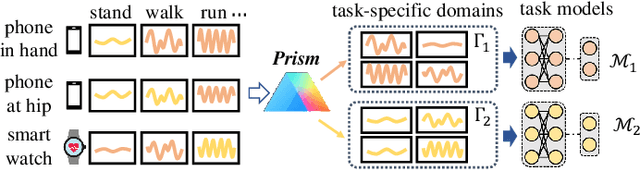
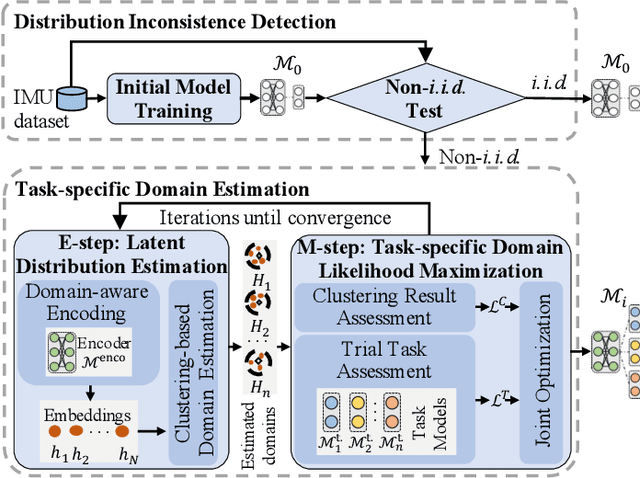
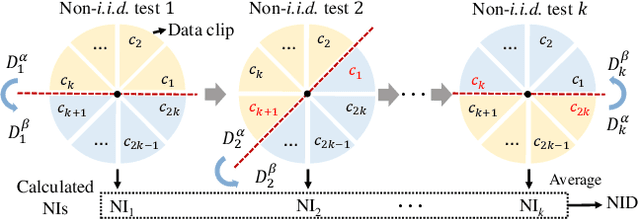
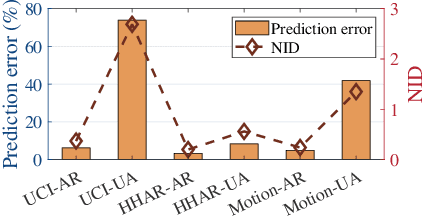
A wide range of user perception applications leverage inertial measurement unit (IMU) data for online prediction. However, restricted by the non-i.i.d. nature of IMU data collected from mobile devices, most systems work well only in a controlled setting (e.g., for a specific user in particular postures), limiting application scenarios. To achieve uncontrolled online prediction on mobile devices, referred to as the flexible user perception (FUP) problem, is attractive but hard. In this paper, we propose a novel scheme, called Prism, which can obtain high FUP accuracy on mobile devices. The core of Prism is to discover task-aware domains embedded in IMU dataset, and to train a domain-aware model on each identified domain. To this end, we design an expectation-maximization (EM) algorithm to estimate latent domains with respect to the specific downstream perception task. Finally, the best-fit model can be automatically selected for use by comparing the test sample and all identified domains in the feature space. We implement Prism on various mobile devices and conduct extensive experiments. Results demonstrate that Prism can achieve the best FUP performance with a low latency.