 Add to Chrome
 Add to Firefox
 Add to Edge
Conditional Diffusion Guidance under Hard Constraint: A Stochastic Analysis Approach
Feb 05, 2026
We study conditional generation in diffusion models under hard constraints, where generated samples must satisfy prescribed events with probability one. Such constraints arise naturally in safety-critical applications and in rare-event simulation, where soft or reward-based guidance methods offer no guarantee of constraint satisfaction. Building on a probabilistic interpretation of diffusion models, we develop a principled conditional diffusion guidance framework based on Doob's h-transform, martingale representation and quadratic variation process. Specifically, the resulting guided dynamics augment a pretrained diffusion with an explicit drift correction involving the logarithmic gradient of a conditioning function, without modifying the pretrained score network. Leveraging martingale and quadratic-variation identities, we propose two novel off-policy learning algorithms based on a martingale loss and a martingale-covariation loss to estimate h and its gradient using only trajectories from the pretrained model. We provide non-asymptotic guarantees for the resulting conditional sampler in both total variation and Wasserstein distances, explicitly characterizing the impact of score approximation and guidance estimation errors. Numerical experiments demonstrate the effectiveness of the proposed methods in enforcing hard constraints and generating rare-event samples.

ART for Diffusion Sampling: A Reinforcement Learning Approach to Timestep Schedule
Jan 26, 2026We consider time discretization for score-based diffusion models to generate samples from a learned reverse-time dynamic on a finite grid. Uniform and hand-crafted grids can be suboptimal given a budget on the number of time steps. We introduce Adaptive Reparameterized Time (ART) that controls the clock speed of a reparameterized time variable, leading to a time change and uneven timesteps along the sampling trajectory while preserving the terminal time. The objective is to minimize the aggregate error arising from the discretized Euler scheme. We derive a randomized control companion, ART-RL, and formulate time change as a continuous-time reinforcement learning (RL) problem with Gaussian policies. We then prove that solving ART-RL recovers the optimal ART schedule, which in turn enables practical actor--critic updates to learn the latter in a data-driven way. Empirically, based on the official EDM pipeline, ART-RL improves Fréchet Inception Distance on CIFAR-10 over a wide range of budgets and transfers to AFHQv2, FFHQ, and ImageNet without the need of retraining.
DiFFPO: Training Diffusion LLMs to Reason Fast and Furious via Reinforcement Learning
Oct 02, 2025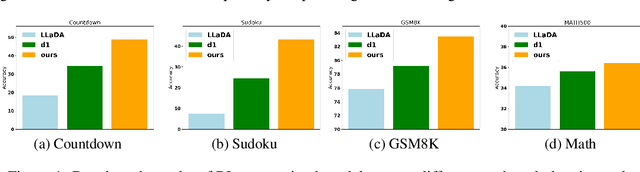

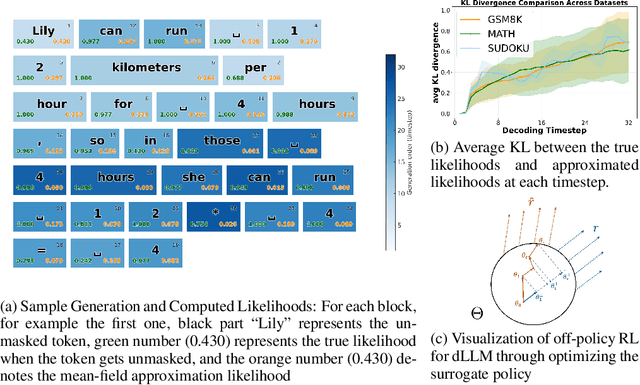

We propose DiFFPO, Diffusion Fast and Furious Policy Optimization, a unified framework for training masked diffusion large language models (dLLMs) to reason not only better (furious), but also faster via reinforcement learning (RL). We first unify the existing baseline approach such as d1 by proposing to train surrogate policies via off-policy RL, whose likelihood is much more tractable as an approximation to the true dLLM policy. This naturally motivates a more accurate and informative two-stage likelihood approximation combined with importance sampling correction, which leads to generalized RL algorithms with better sample efficiency and superior task performance. Second, we propose a new direction of joint training efficient samplers/controllers of dLLMs policy. Via RL, we incentivize dLLMs' natural multi-token prediction capabilities by letting the model learn to adaptively allocate an inference threshold for each prompt. By jointly training the sampler, we yield better accuracies with lower number of function evaluations (NFEs) compared to training the model only, obtaining the best performance in improving the Pareto frontier of the inference-time compute of dLLMs. We showcase the effectiveness of our pipeline by training open source large diffusion language models over benchmark math and planning tasks.
Diffusion Generative Models Meet Compressed Sensing, with Applications to Image Data and Financial Time Series
Sep 04, 2025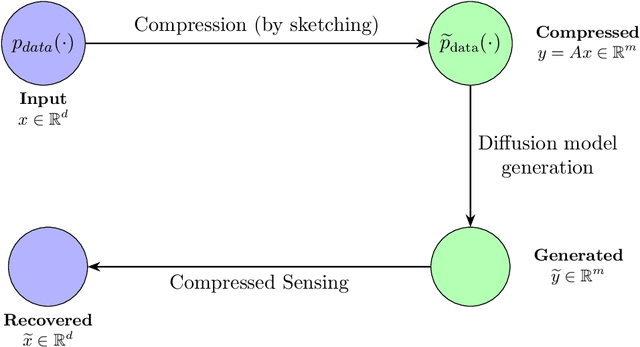


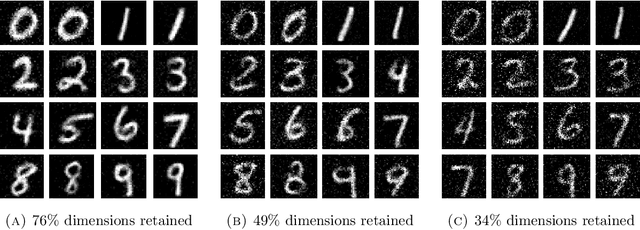
This paper develops dimension reduction techniques for accelerating diffusion model inference in the context of synthetic data generation. The idea is to integrate compressed sensing into diffusion models: (i) compress the data into a latent space, (ii) train a diffusion model in the latent space, and (iii) apply a compressed sensing algorithm to the samples generated in the latent space, facilitating the efficiency of both model training and inference. Under suitable sparsity assumptions on data, the proposed algorithm is proved to enjoy faster convergence by combining diffusion model inference with sparse recovery. As a byproduct, we obtain an optimal value for the latent space dimension. We also conduct numerical experiments on a range of datasets, including image data (handwritten digits, medical images, and climate data) and financial time series for stress testing.
Fine-Tuning Diffusion Generative Models via Rich Preference Optimization
Mar 13, 2025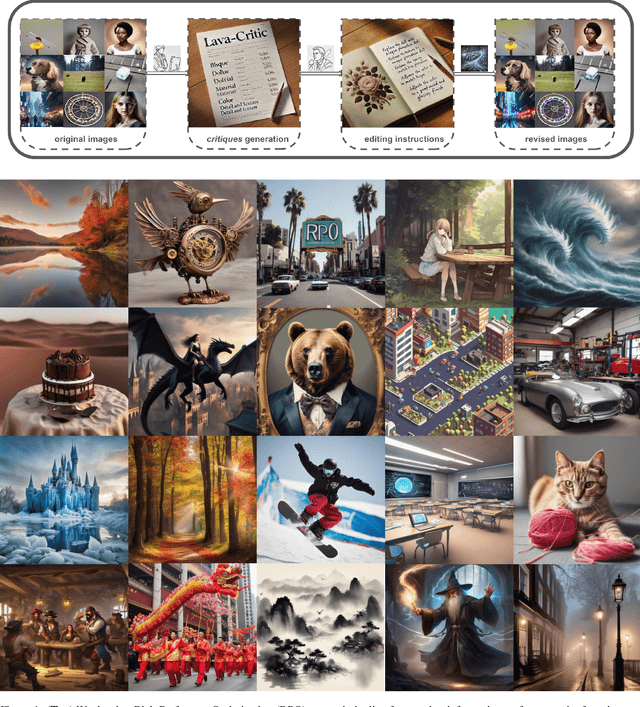
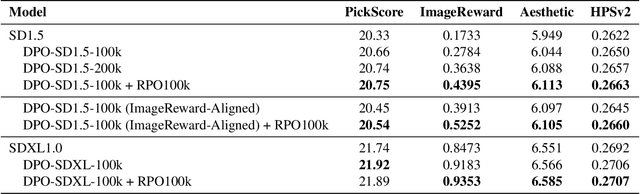
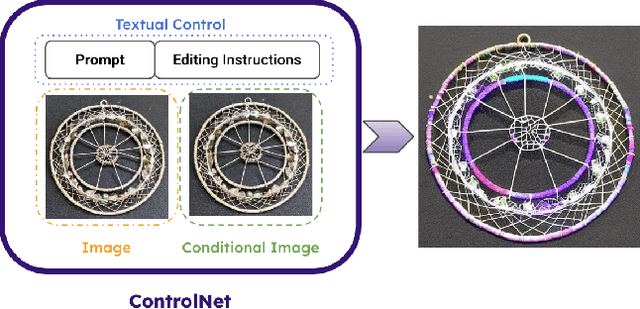
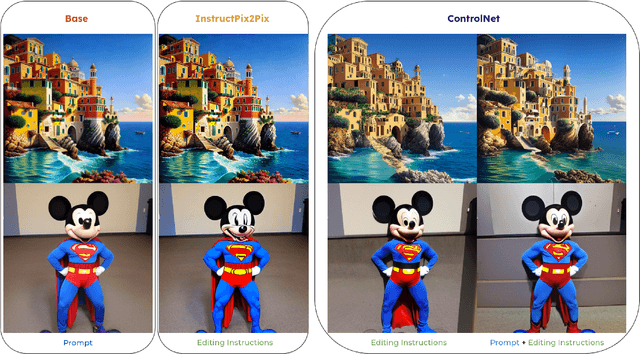
We introduce Rich Preference Optimization (RPO), a novel pipeline that leverages rich feedback signals to improve the curation of preference pairs for fine-tuning text-to-image diffusion models. Traditional methods, like Diffusion-DPO, often rely solely on reward model labeling, which can be opaque, offer limited insights into the rationale behind preferences, and are prone to issues such as reward hacking or overfitting. In contrast, our approach begins with generating detailed critiques of synthesized images to extract reliable and actionable image editing instructions. By implementing these instructions, we create refined images, resulting in synthetic, informative preference pairs that serve as enhanced tuning datasets. We demonstrate the effectiveness of our pipeline and the resulting datasets in fine-tuning state-of-the-art diffusion models.
Score as Action: Fine-Tuning Diffusion Generative Models by Continuous-time Reinforcement Learning
Feb 03, 2025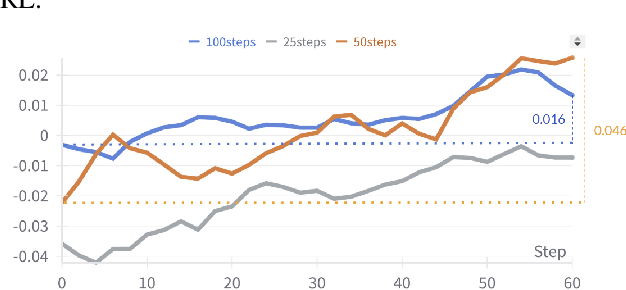
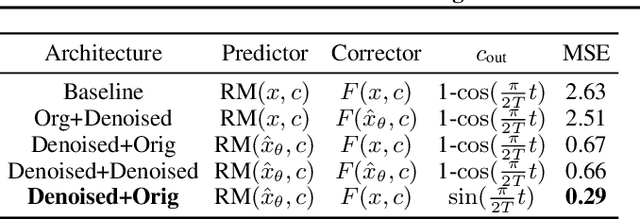
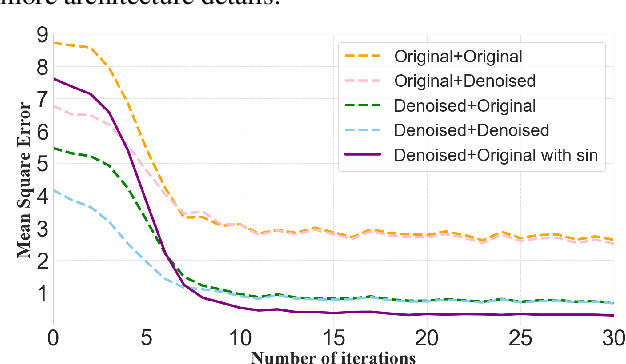
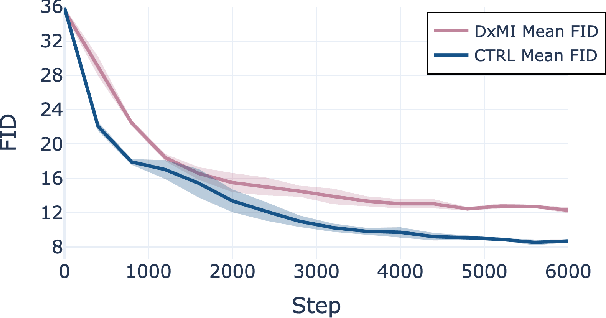
Reinforcement learning from human feedback (RLHF), which aligns a diffusion model with input prompt, has become a crucial step in building reliable generative AI models. Most works in this area use a discrete-time formulation, which is prone to induced errors, and often not applicable to models with higher-order/black-box solvers. The objective of this study is to develop a disciplined approach to fine-tune diffusion models using continuous-time RL, formulated as a stochastic control problem with a reward function that aligns the end result (terminal state) with input prompt. The key idea is to treat score matching as controls or actions, and thereby making connections to policy optimization and regularization in continuous-time RL. To carry out this idea, we lay out a new policy optimization framework for continuous-time RL, and illustrate its potential in enhancing the value networks design space via leveraging the structural property of diffusion models. We validate the advantages of our method by experiments in downstream tasks of fine-tuning large-scale Text2Image models of Stable Diffusion v1.5.
Regret of exploratory policy improvement and $q$-learning
Nov 02, 2024
We study the convergence of $q$-learning and related algorithms introduced by Jia and Zhou (J. Mach. Learn. Res., 24 (2023), 161) for controlled diffusion processes. Under suitable conditions on the growth and regularity of the model parameters, we provide a quantitative error and regret analysis of both the exploratory policy improvement algorithm and the $q$-learning algorithm.
RainbowPO: A Unified Framework for Combining Improvements in Preference Optimization
Oct 05, 2024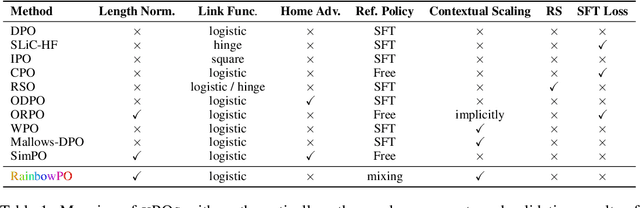
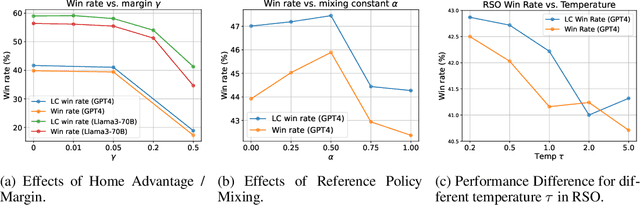
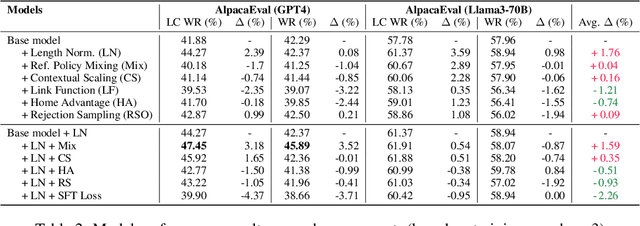
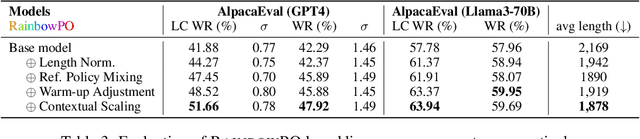
Recently, numerous preference optimization algorithms have been introduced as extensions to the Direct Preference Optimization (DPO) family. While these methods have successfully aligned models with human preferences, there is a lack of understanding regarding the contributions of their additional components. Moreover, fair and consistent comparisons are scarce, making it difficult to discern which components genuinely enhance downstream performance. In this work, we propose RainbowPO, a unified framework that demystifies the effectiveness of existing DPO methods by categorizing their key components into seven broad directions. We integrate these components into a single cohesive objective, enhancing the performance of each individual element. Through extensive experiments, we demonstrate that RainbowPO outperforms existing DPO variants. Additionally, we provide insights to guide researchers in developing new DPO methods and assist practitioners in their implementations.
Preference Tuning with Human Feedback on Language, Speech, and Vision Tasks: A Survey
Sep 17, 2024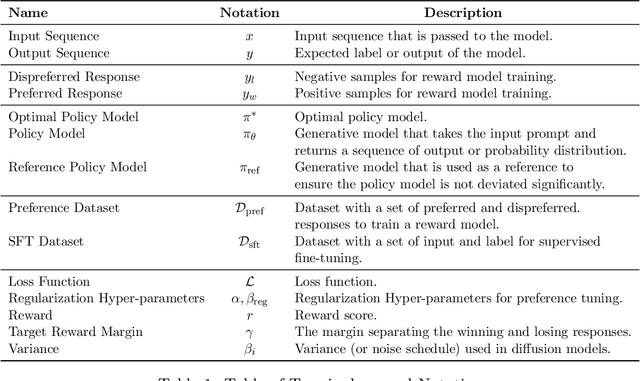
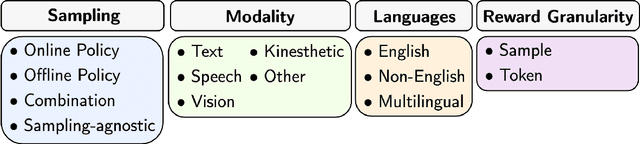
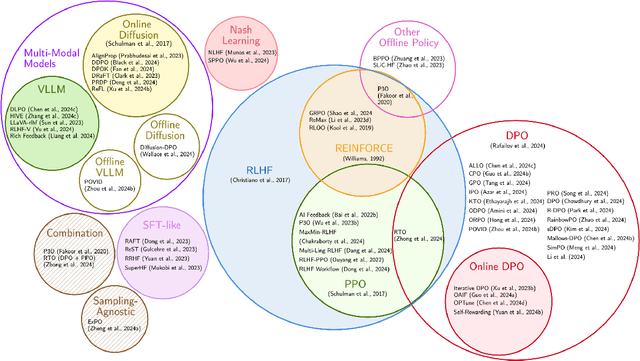
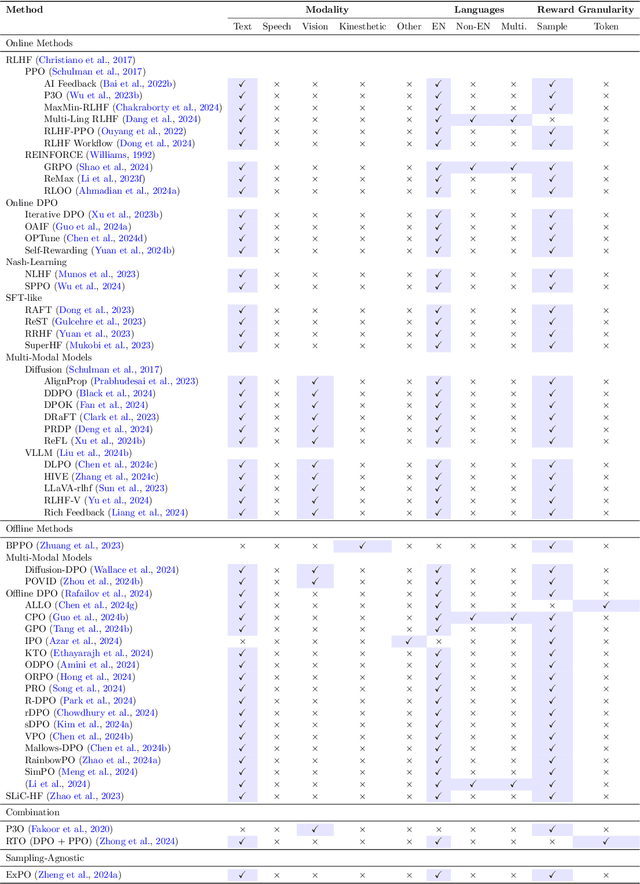
Preference tuning is a crucial process for aligning deep generative models with human preferences. This survey offers a thorough overview of recent advancements in preference tuning and the integration of human feedback. The paper is organized into three main sections: 1) introduction and preliminaries: an introduction to reinforcement learning frameworks, preference tuning tasks, models, and datasets across various modalities: language, speech, and vision, as well as different policy approaches, 2) in-depth examination of each preference tuning approach: a detailed analysis of the methods used in preference tuning, and 3) applications, discussion, and future directions: an exploration of the applications of preference tuning in downstream tasks, including evaluation methods for different modalities, and an outlook on future research directions. Our objective is to present the latest methodologies in preference tuning and model alignment, enhancing the understanding of this field for researchers and practitioners. We hope to encourage further engagement and innovation in this area.
Scores as Actions: a framework of fine-tuning diffusion models by continuous-time reinforcement learning
Sep 12, 2024Reinforcement Learning from human feedback (RLHF) has been shown a promising direction for aligning generative models with human intent and has also been explored in recent works for alignment of diffusion generative models. In this work, we provide a rigorous treatment by formulating the task of fine-tuning diffusion models, with reward functions learned from human feedback, as an exploratory continuous-time stochastic control problem. Our key idea lies in treating the score-matching functions as controls/actions, and upon this, we develop a unified framework from a continuous-time perspective, to employ reinforcement learning (RL) algorithms in terms of improving the generation quality of diffusion models. We also develop the corresponding continuous-time RL theory for policy optimization and regularization under assumptions of stochastic different equations driven environment. Experiments on the text-to-image (T2I) generation will be reported in the accompanied paper.