 Add to Chrome
 Add to Firefox
 Add to Edge
Darwinian Memory: A Training-Free Self-Regulating Memory System for GUI Agent Evolution
Jan 30, 2026
Multimodal Large Language Model (MLLM) agents facilitate Graphical User Interface (GUI) automation but struggle with long-horizon, cross-application tasks due to limited context windows. While memory systems provide a viable solution, existing paradigms struggle to adapt to dynamic GUI environments, suffering from a granularity mismatch between high-level intent and low-level execution, and context pollution where the static accumulation of outdated experiences drives agents into hallucination. To address these bottlenecks, we propose the Darwinian Memory System (DMS), a self-evolving architecture that constructs memory as a dynamic ecosystem governed by the law of survival of the fittest. DMS decomposes complex trajectories into independent, reusable units for compositional flexibility, and implements Utility-driven Natural Selection to track survival value, actively pruning suboptimal paths and inhibiting high-risk plans. This evolutionary pressure compels the agent to derive superior strategies. Extensive experiments on real-world multi-app benchmarks validate that DMS boosts general-purpose MLLMs without training costs or architectural overhead, achieving average gains of 18.0% in success rate and 33.9% in execution stability, while reducing task latency, establishing it as an effective self-evolving memory system for GUI tasks.

DPGP: A Hybrid 2D-3D Dual Path Potential Ghost Probe Zone Prediction Framework for Safe Autonomous Driving
Apr 23, 2025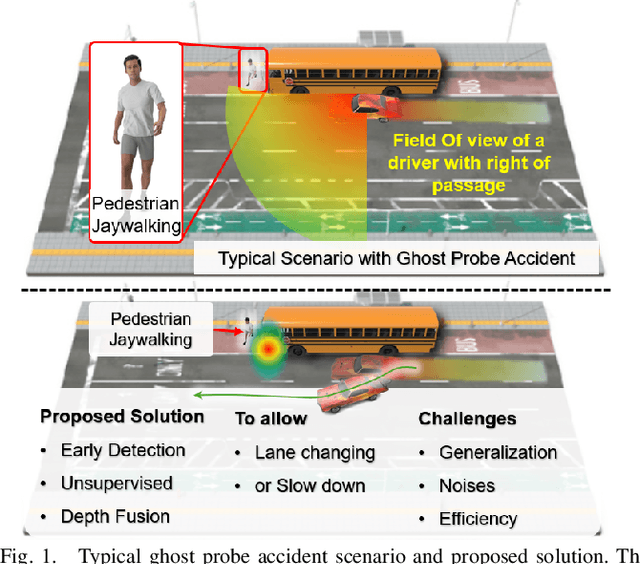
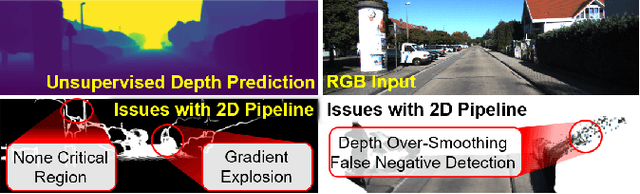
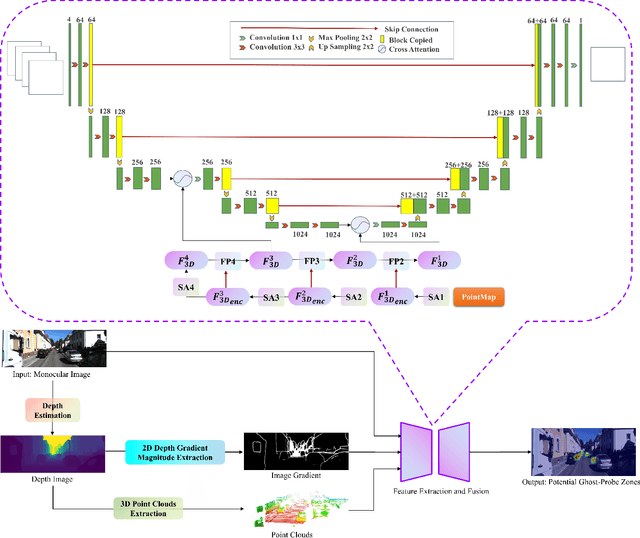
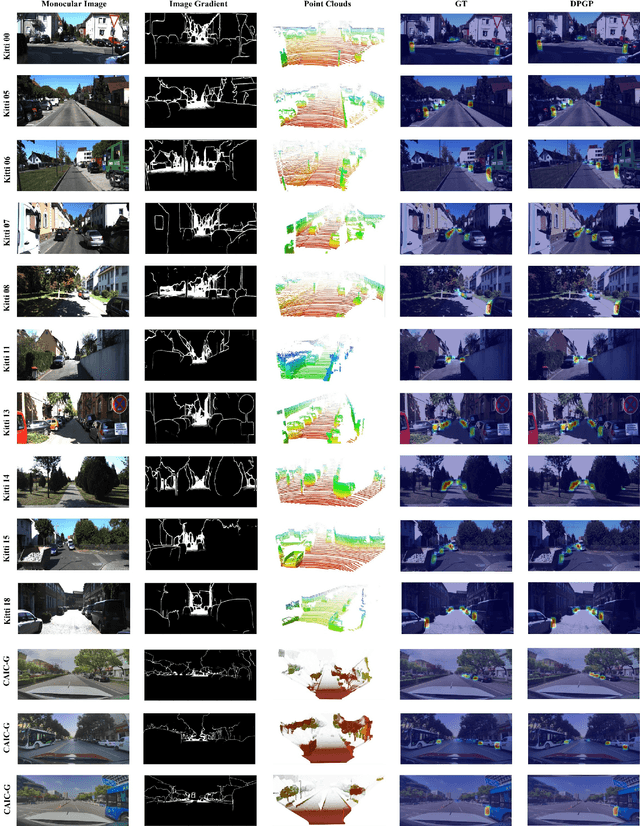
Modern robots must coexist with humans in dense urban environments. A key challenge is the ghost probe problem, where pedestrians or objects unexpectedly rush into traffic paths. This issue affects both autonomous vehicles and human drivers. Existing works propose vehicle-to-everything (V2X) strategies and non-line-of-sight (NLOS) imaging for ghost probe zone detection. However, most require high computational power or specialized hardware, limiting real-world feasibility. Additionally, many methods do not explicitly address this issue. To tackle this, we propose DPGP, a hybrid 2D-3D fusion framework for ghost probe zone prediction using only a monocular camera during training and inference. With unsupervised depth prediction, we observe ghost probe zones align with depth discontinuities, but different depth representations offer varying robustness. To exploit this, we fuse multiple feature embeddings to improve prediction. To validate our approach, we created a 12K-image dataset annotated with ghost probe zones, carefully sourced and cross-checked for accuracy. Experimental results show our framework outperforms existing methods while remaining cost-effective. To our knowledge, this is the first work extending ghost probe zone prediction beyond vehicles, addressing diverse non-vehicle objects. We will open-source our code and dataset for community benefit.