 Add to Chrome
 Add to Firefox
 Add to Edge
Darwinian Memory: A Training-Free Self-Regulating Memory System for GUI Agent Evolution
Jan 30, 2026
Multimodal Large Language Model (MLLM) agents facilitate Graphical User Interface (GUI) automation but struggle with long-horizon, cross-application tasks due to limited context windows. While memory systems provide a viable solution, existing paradigms struggle to adapt to dynamic GUI environments, suffering from a granularity mismatch between high-level intent and low-level execution, and context pollution where the static accumulation of outdated experiences drives agents into hallucination. To address these bottlenecks, we propose the Darwinian Memory System (DMS), a self-evolving architecture that constructs memory as a dynamic ecosystem governed by the law of survival of the fittest. DMS decomposes complex trajectories into independent, reusable units for compositional flexibility, and implements Utility-driven Natural Selection to track survival value, actively pruning suboptimal paths and inhibiting high-risk plans. This evolutionary pressure compels the agent to derive superior strategies. Extensive experiments on real-world multi-app benchmarks validate that DMS boosts general-purpose MLLMs without training costs or architectural overhead, achieving average gains of 18.0% in success rate and 33.9% in execution stability, while reducing task latency, establishing it as an effective self-evolving memory system for GUI tasks.

VP-MEL: Visual Prompts Guided Multimodal Entity Linking
Dec 10, 2024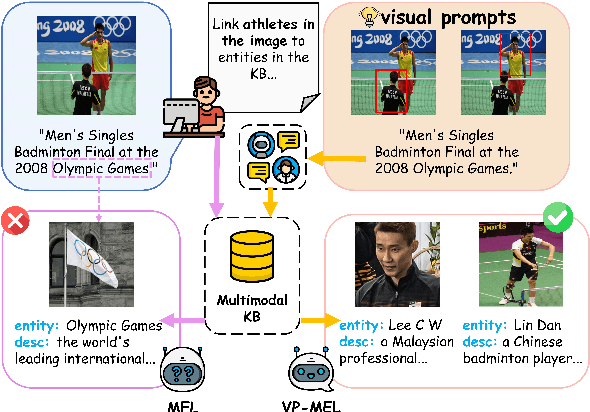
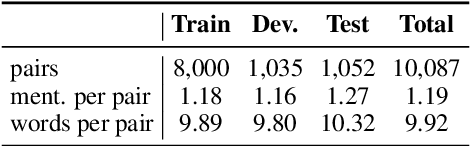
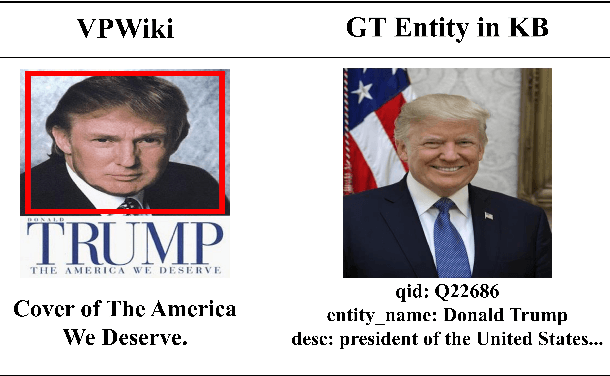
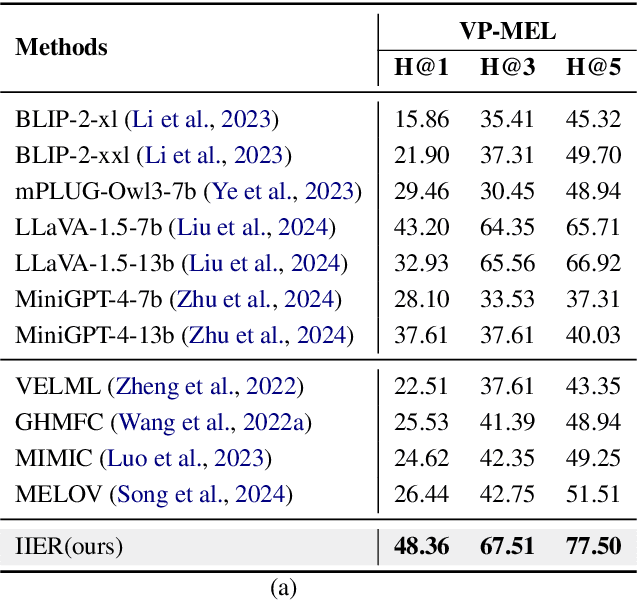
Multimodal Entity Linking (MEL) is extensively utilized in the domains of information retrieval. However, existing MEL methods typically utilize mention words as mentions for retrieval. This results in a significant dependence of MEL on mention words, thereby constraining its capacity to effectively leverage information from both images and text. In situations where mention words are absent, MEL methods struggle to leverage image-text pairs for entity linking. To solve these issues, we introduce a Visual Prompts guided Multimodal Entity Linking (VP-MEL) task. VP-MEL directly marks specific regions within the image. These markers are referred to as visual prompts in VP-MEL. Without mention words, VP-MEL aims to utilize marked image-text pairs to align visual prompts with specific entities in the knowledge bases. A new dataset for the VP-MEL task, VPWiki, is proposed in this paper. Moreover, we propose a framework named FBMEL, which enhances the significance of visual prompts and fully leverages the information in image-text pairs. Experimental results on the VPWiki dataset demonstrate that FBMEL outperforms baseline methods across multiple benchmarks for the VP-MEL task.