 Add to Chrome
 Add to Firefox
 Add to Edge
RISE-Video: Can Video Generators Decode Implicit World Rules?
Feb 05, 2026
While generative video models have achieved remarkable visual fidelity, their capacity to internalize and reason over implicit world rules remains a critical yet under-explored frontier. To bridge this gap, we present RISE-Video, a pioneering reasoning-oriented benchmark for Text-Image-to-Video (TI2V) synthesis that shifts the evaluative focus from surface-level aesthetics to deep cognitive reasoning. RISE-Video comprises 467 meticulously human-annotated samples spanning eight rigorous categories, providing a structured testbed for probing model intelligence across diverse dimensions, ranging from commonsense and spatial dynamics to specialized subject domains. Our framework introduces a multi-dimensional evaluation protocol consisting of four metrics: \textit{Reasoning Alignment}, \textit{Temporal Consistency}, \textit{Physical Rationality}, and \textit{Visual Quality}. To further support scalable evaluation, we propose an automated pipeline leveraging Large Multimodal Models (LMMs) to emulate human-centric assessment. Extensive experiments on 11 state-of-the-art TI2V models reveal pervasive deficiencies in simulating complex scenarios under implicit constraints, offering critical insights for the advancement of future world-simulating generative models.

Reducing Spurious Correlation for Federated Domain Generalization
Jul 27, 2024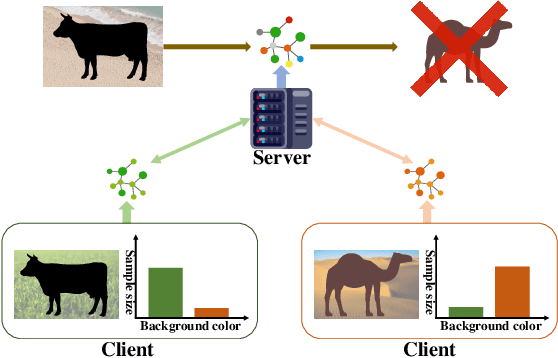
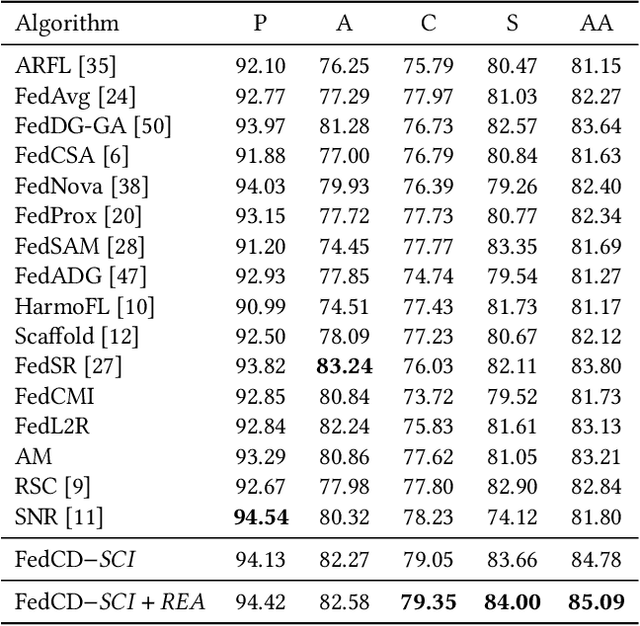
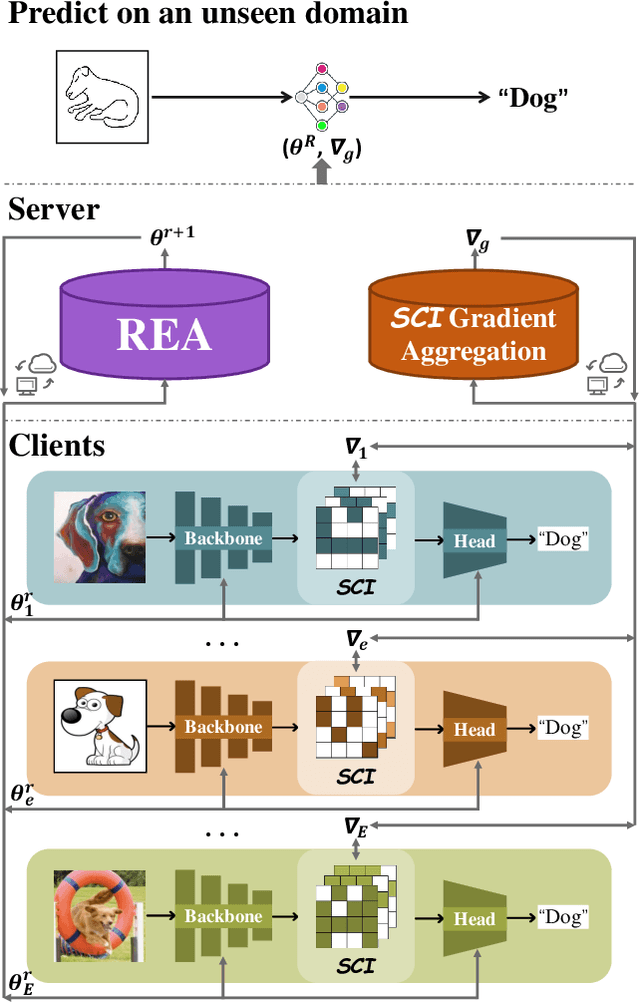
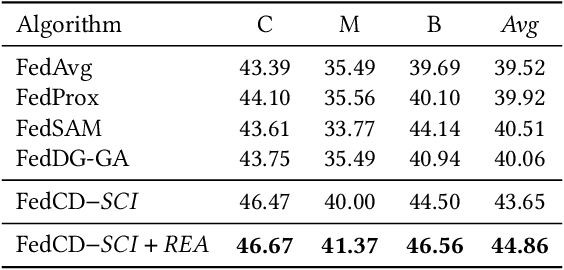
The rapid development of multimedia has provided a large amount of data with different distributions for visual tasks, forming different domains. Federated Learning (FL) can efficiently use this diverse data distributed on different client media in a decentralized manner through model sharing. However, in open-world scenarios, there is a challenge: global models may struggle to predict well on entirely new domain data captured by certain media, which were not encountered during training. Existing methods still rely on strong statistical correlations between samples and labels to address this issue, which can be misleading, as some features may establish spurious short-cut correlations with the predictions. To comprehensively address this challenge, we introduce FedCD (Cross-Domain Invariant Federated Learning), an overall optimization framework at both the local and global levels. We introduce the Spurious Correlation Intervener (SCI), which employs invariance theory to locally generate interventers for features in a self-supervised manner to reduce the model's susceptibility to spurious correlated features. Our approach requires no sharing of data or features, only the gradients related to the model. Additionally, we develop the simple yet effective Risk Extrapolation Aggregation strategy (REA), determining aggregation coefficients through mathematical optimization to facilitate global causal invariant predictions. Extensive experiments and ablation studies highlight the effectiveness of our approach. In both classification and object detection generalization tasks, our method outperforms the baselines by an average of at least 1.45% in Acc, 4.8% and 1.27% in mAP50.