 Add to Chrome
 Add to Firefox
 Add to Edge
Filtered Reasoning Score: Evaluating Reasoning Quality on a Model's Most-Confident Traces
Apr 13, 2026
Should we trust Large Language Models (LLMs) with high accuracy? LLMs achieve high accuracy on reasoning benchmarks, but correctness alone does not reveal the quality of the reasoning used to produce it. This highlights a fundamental limitation of outcome-based evaluation: models may arrive at correct answers through flawed reasoning, and models with substantially different reasoning capabilities can nevertheless exhibit similar benchmark accuracy, for example due to memorization or over-optimization. In this paper, we ask: given existing benchmarks, can we move beyond outcome-based evaluation to assess the quality of reasoning itself? We seek metrics that (1) differentiate models with similar accuracy and (2) are robust to variations in input prompts and generation configurations. To this end, we propose a reasoning score that evaluates reasoning traces along dimensions such as faithfulness, coherence, utility, and factuality. A remaining question is how to aggregate this score across multiple sampled traces. Naively averaging them is undesirable, particularly in long-horizon settings, where the number of possible trajectories grows rapidly, and low-confidence correct traces are more likely to be coincidental. To address this, we introduce the Filtered Reasoning Score (FRS), which computes reasoning quality using only the top-K% most confident traces. Evaluating with FRS, models that are indistinguishable under standard accuracy exhibit significant differences in reasoning quality. Moreover, models with higher FRS on one benchmark tend to perform better on other reasoning benchmarks, in both accuracy and reasoning quality. Together, these findings suggest that FRS complements accuracy by capturing a model's transferable reasoning capabilities. We open source our evaluation codebase: https://github.com/Manas2006/benchmark_reproducibility.

Learning Robust Reasoning through Guided Adversarial Self-Play
Jan 30, 2026Reinforcement learning from verifiable rewards (RLVR) produces strong reasoning models, yet they can fail catastrophically when the conditioning context is fallible (e.g., corrupted chain-of-thought, misleading partial solutions, or mild input perturbations), since standard RLVR optimizes final-answer correctness only under clean conditioning. We introduce GASP (Guided Adversarial Self-Play), a robustification method that explicitly trains detect-and-repair capabilities using only outcome verification. Without human labels or external teachers, GASP forms an adversarial self-play game within a single model: a polluter learns to induce failure via locally coherent corruptions, while an agent learns to diagnose and recover under the same corrupted conditioning. To address the scarcity of successful recoveries early in training, we propose in-distribution repair guidance, an imitation term on self-generated repairs that increases recovery probability while preserving previously acquired capabilities. Across four open-weight models (1.5B--8B), GASP transforms strong-but-brittle reasoners into robust ones that withstand misleading and perturbed context while often improving clean accuracy. Further analysis shows that adversarial corruptions induce an effective curriculum, and in-distribution guidance enables rapid recovery learning with minimal representational drift.
A Learnable Wavelet Transformer for Long-Short Equity Trading and Risk-Adjusted Return Optimization
Jan 19, 2026Learning profitable intraday trading policies from financial time series is challenging due to heavy noise, non-stationarity, and strong cross-sectional dependence among related assets. We propose \emph{WaveLSFormer}, a learnable wavelet-based long-short Transformer that jointly performs multi-scale decomposition and return-oriented decision learning. Specifically, a learnable wavelet front-end generates low-/high-frequency components via an end-to-end trained filter bank, guided by spectral regularizers that encourage stable and well-separated frequency bands. To fuse multi-scale information, we introduce a low-guided high-frequency injection (LGHI) module that refines low-frequency representations with high-frequency cues while controlling training stability. The model outputs a portfolio of long/short positions that is rescaled to satisfy a fixed risk budget, and is optimized directly with a trading objective and risk-aware regularization. Extensive experiments on five years of hourly data across six industry groups, evaluated over ten random seeds, demonstrate that WaveLSFormer consistently outperforms MLP, LSTM and Transformer backbones, with and without fixed discrete wavelet front-ends. On average in all industries, WaveLSFormer achieves a cumulative overall strategy return of $0.607 \pm 0.045$ and a Sharpe ratio of $2.157 \pm 0.166$, substantially improving both profitability and risk-adjusted returns over the strongest baselines.
ExPO: Unlocking Hard Reasoning with Self-Explanation-Guided Reinforcement Learning
Jul 03, 2025Recent advances in large language models have been driven by reinforcement learning (RL)-style post-training, which improves reasoning by optimizing model outputs based on reward or preference signals. GRPO-style approaches implement this by using self-generated samples labeled by an outcome-based verifier. However, these methods depend heavily on the model's initial ability to produce positive samples. They primarily refine what the model already knows (distribution sharpening) rather than enabling the model to solve problems where it initially fails. This limitation is especially problematic in early-stage RL training and on challenging reasoning tasks, where positive samples are unlikely to be generated. To unlock reasoning ability in such settings, the model must explore new reasoning trajectories beyond its current output distribution. Such exploration requires access to sufficiently good positive samples to guide the learning. While expert demonstrations seem like a natural solution, we find that they are often ineffective in RL post-training. Instead, we identify two key properties of effective positive samples: they should (1) be likely under the current policy, and (2) increase the model's likelihood of predicting the correct answer. Based on these insights, we propose $\textbf{Self-Explanation Policy Optimization (ExPO)}$-a simple and modular framework that generates such samples by conditioning on the ground-truth answer. ExPO enables efficient exploration and guides the model to produce reasoning trajectories more aligned with its policy than expert-written CoTs, while ensuring higher quality than its own (incorrect) samples. Experiments show that ExPO improves both learning efficiency and final performance on reasoning benchmarks, surpassing expert-demonstration-based methods in challenging settings such as MATH level-5, where the model initially struggles the most.
An Optimal Discriminator Weighted Imitation Perspective for Reinforcement Learning
Apr 17, 2025We introduce Iterative Dual Reinforcement Learning (IDRL), a new method that takes an optimal discriminator-weighted imitation view of solving RL. Our method is motivated by a simple experiment in which we find training a discriminator using the offline dataset plus an additional expert dataset and then performing discriminator-weighted behavior cloning gives strong results on various types of datasets. That optimal discriminator weight is quite similar to the learned visitation distribution ratio in Dual-RL, however, we find that current Dual-RL methods do not correctly estimate that ratio. In IDRL, we propose a correction method to iteratively approach the optimal visitation distribution ratio in the offline dataset given no addtional expert dataset. During each iteration, IDRL removes zero-weight suboptimal transitions using the learned ratio from the previous iteration and runs Dual-RL on the remaining subdataset. This can be seen as replacing the behavior visitation distribution with the optimized visitation distribution from the previous iteration, which theoretically gives a curriculum of improved visitation distribution ratios that are closer to the optimal discriminator weight. We verify the effectiveness of IDRL on various kinds of offline datasets, including D4RL datasets and more realistic corrupted demonstrations. IDRL beats strong Primal-RL and Dual-RL baselines in terms of both performance and stability, on all datasets.
Robot Air Hockey: A Manipulation Testbed for Robot Learning with Reinforcement Learning
May 06, 2024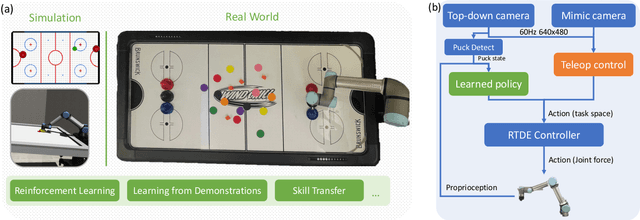
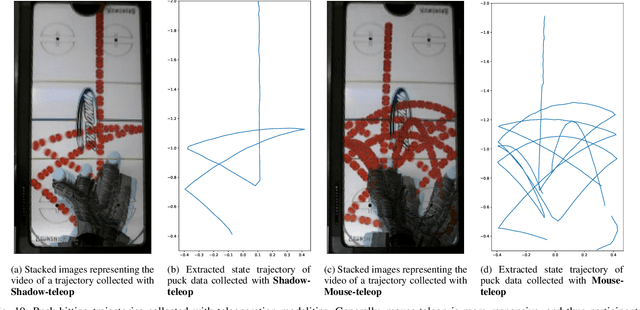
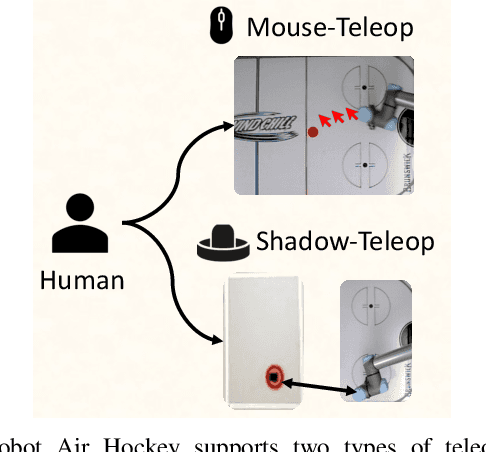

Reinforcement Learning is a promising tool for learning complex policies even in fast-moving and object-interactive domains where human teleoperation or hard-coded policies might fail. To effectively reflect this challenging category of tasks, we introduce a dynamic, interactive RL testbed based on robot air hockey. By augmenting air hockey with a large family of tasks ranging from easy tasks like reaching, to challenging ones like pushing a block by hitting it with a puck, as well as goal-based and human-interactive tasks, our testbed allows a varied assessment of RL capabilities. The robot air hockey testbed also supports sim-to-real transfer with three domains: two simulators of increasing fidelity and a real robot system. Using a dataset of demonstration data gathered through two teleoperation systems: a virtualized control environment, and human shadowing, we assess the testbed with behavior cloning, offline RL, and RL from scratch.
Neural Video Recovery for Cloud Gaming
Jul 22, 2023Cloud gaming is a multi-billion dollar industry. A client in cloud gaming sends its movement to the game server on the Internet, which renders and transmits the resulting video back. In order to provide a good gaming experience, a latency below 80 ms is required. This means that video rendering, encoding, transmission, decoding, and display have to finish within that time frame, which is especially challenging to achieve due to server overload, network congestion, and losses. In this paper, we propose a new method for recovering lost or corrupted video frames in cloud gaming. Unlike traditional video frame recovery, our approach uses game states to significantly enhance recovery accuracy and utilizes partially decoded frames to recover lost portions. We develop a holistic system that consists of (i) efficiently extracting game states, (ii) modifying H.264 video decoder to generate a mask to indicate which portions of video frames need recovery, and (iii) designing a novel neural network to recover either complete or partial video frames. Our approach is extensively evaluated using iPhone 12 and laptop implementations, and we demonstrate the utility of game states in the game video recovery and the effectiveness of our overall design.