 Add to Chrome
 Add to Firefox
 Add to Edge
VoxServe: Streaming-Centric Serving System for Speech Language Models
Jan 30, 2026
Deploying modern Speech Language Models (SpeechLMs) in streaming settings requires systems that provide low latency, high throughput, and strong guarantees of streamability. Existing systems fall short of supporting diverse models flexibly and efficiently. We present VoxServe, a unified serving system for SpeechLMs that optimizes streaming performance. VoxServe introduces a model-execution abstraction that decouples model architecture from system-level optimizations, thereby enabling support for diverse SpeechLM architectures within a single framework. Building on this abstraction, VoxServe implements streaming-aware scheduling and an asynchronous inference pipeline to improve end-to-end efficiency. Evaluations across multiple modern SpeechLMs show that VoxServe achieves 10-20x higher throughput than existing implementations at comparable latency while maintaining high streaming viability. The code of VoxServe is available at https://github.com/vox-serve/vox-serve.

TeleRAG: Efficient Retrieval-Augmented Generation Inference with Lookahead Retrieval
Feb 28, 2025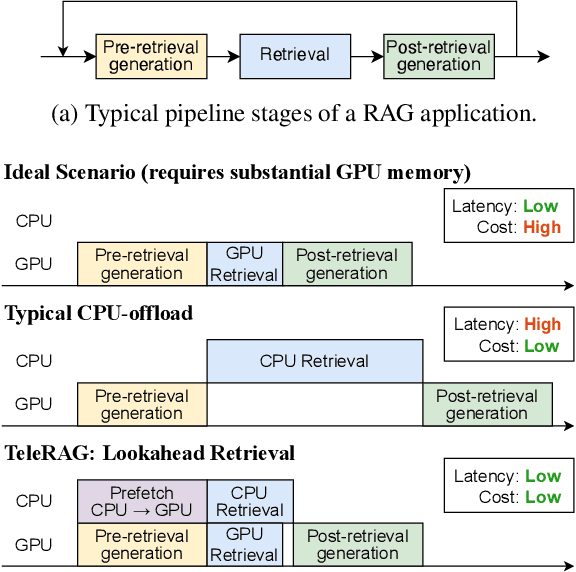
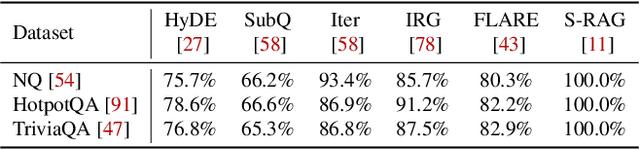
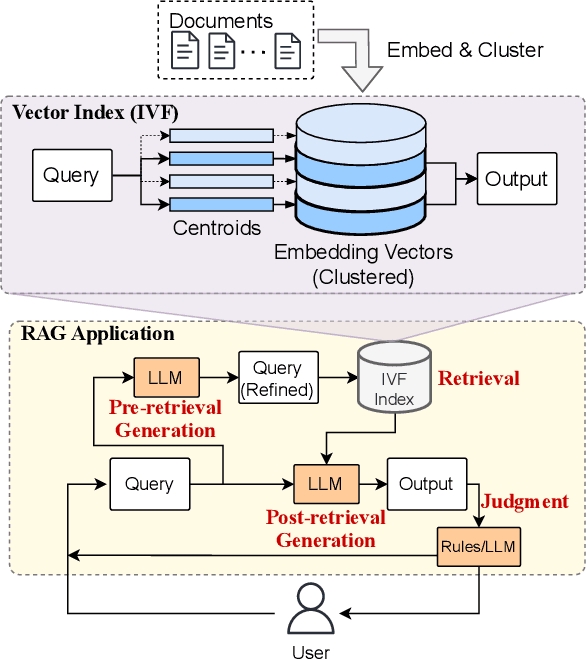
Retrieval-augmented generation (RAG) extends large language models (LLMs) with external data sources to enhance factual correctness and domain coverage. Modern RAG pipelines rely on large datastores, leading to system challenges in latency-sensitive deployments, especially when limited GPU memory is available. To address these challenges, we propose TeleRAG, an efficient inference system that reduces RAG latency with minimal GPU memory requirements. The core innovation of TeleRAG is lookahead retrieval, a prefetching mechanism that anticipates required data and transfers it from CPU to GPU in parallel with LLM generation. By leveraging the modularity of RAG pipelines, the inverted file index (IVF) search algorithm and similarities between queries, TeleRAG optimally overlaps data movement and computation. Experimental results show that TeleRAG reduces end-to-end RAG inference latency by up to 1.72x on average compared to state-of-the-art systems, enabling faster, more memory-efficient deployments of advanced RAG applications.
Tactic: Adaptive Sparse Attention with Clustering and Distribution Fitting for Long-Context LLMs
Feb 17, 2025Long-context models are essential for many applications but face inefficiencies in loading large KV caches during decoding. Prior methods enforce fixed token budgets for sparse attention, assuming a set number of tokens can approximate full attention. However, these methods overlook variations in the importance of attention across heads, layers, and contexts. To address these limitations, we propose Tactic, a sparsity-adaptive and calibration-free sparse attention mechanism that dynamically selects tokens based on their cumulative attention scores rather than a fixed token budget. By setting a target fraction of total attention scores, Tactic ensures that token selection naturally adapts to variations in attention sparsity. To efficiently approximate this selection, Tactic leverages clustering-based sorting and distribution fitting, allowing it to accurately estimate token importance with minimal computational overhead. We show that Tactic outperforms existing sparse attention algorithms, achieving superior accuracy and up to 7.29x decode attention speedup. This improvement translates to an overall 1.58x end-to-end inference speedup, making Tactic a practical and effective solution for long-context LLM inference in accuracy-sensitive applications.