 Add to Chrome
 Add to Firefox
 Add to Edge
MAIN-VLA: Modeling Abstraction of Intention and eNvironment for Vision-Language-Action Models
Feb 02, 2026
Despite significant progress in Visual-Language-Action (VLA), in highly complex and dynamic environments that involve real-time unpredictable interactions (such as 3D open worlds and large-scale PvP games), existing approaches remain inefficient at extracting action-critical signals from redundant sensor streams. To tackle this, we introduce MAIN-VLA, a framework that explicitly Models the Abstraction of Intention and eNvironment to ground decision-making in deep semantic alignment rather than superficial pattern matching. Specifically, our Intention Abstraction (IA) extracts verbose linguistic instructions and their associated reasoning into compact, explicit semantic primitives, while the Environment Semantics Abstraction (ESA) projects overwhelming visual streams into a structured, topological affordance representation. Furthermore, aligning these two abstract modalities induces an emergent attention-concentration effect, enabling a parameter-free token-pruning strategy that filters out perceptual redundancy without degrading performance. Extensive experiments in open-world Minecraft and large-scale PvP environments (Game for Peace and Valorant) demonstrate that MAIN-VLA sets a new state-of-the-art, which achieves superior decision quality, stronger generalization, and cutting-edge inference efficiency.

Retrieve Anyone: A General-purpose Person Re-identification Task with Instructions
Jul 04, 2023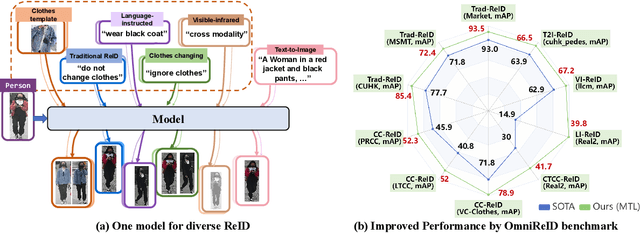
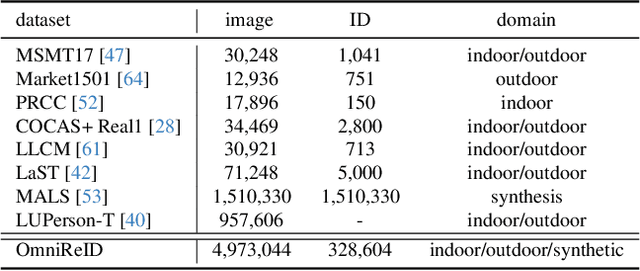
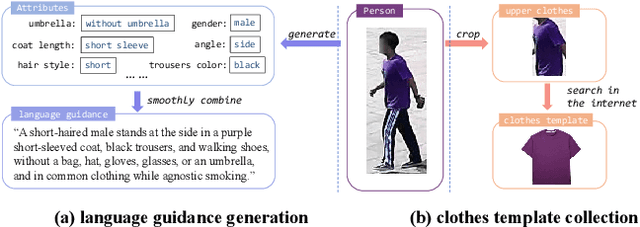
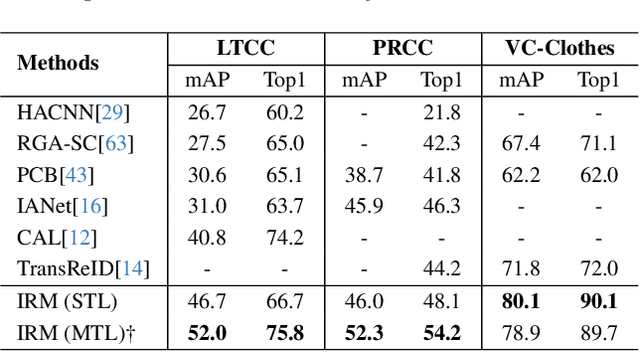
Human intelligence can retrieve any person according to both visual and language descriptions. However, the current computer vision community studies specific person re-identification (ReID) tasks in different scenarios separately, which limits the applications in the real world. This paper strives to resolve this problem by proposing a new instruct-ReID task that requires the model to retrieve images according to the given image or language instructions.Our instruct-ReID is a more general ReID setting, where existing ReID tasks can be viewed as special cases by designing different instructions. We propose a large-scale OmniReID benchmark and an adaptive triplet loss as a baseline method to facilitate research in this new setting. Experimental results show that the baseline model trained on our OmniReID benchmark can improve +0.6%, +1.4%, 0.2% mAP on Market1501, CUHK03, MSMT17 for traditional ReID, +0.8%, +2.0%, +13.4% mAP on PRCC, VC-Clothes, LTCC for clothes-changing ReID, +11.7% mAP on COCAS+ real2 for clothestemplate based clothes-changing ReID when using only RGB images, +25.4% mAP on COCAS+ real2 for our newly defined language-instructed ReID. The dataset, model, and code will be available at https://github.com/hwz-zju/Instruct-ReID.