 Add to Chrome
 Add to Firefox
 Add to Edge
GRASP: Guided Region-Aware Sparse Prompting for Adapting MLLMs to Remote Sensing
Jan 23, 2026
In recent years, Multimodal Large Language Models (MLLMs) have made significant progress in visual question answering tasks. However, directly applying existing fine-tuning methods to remote sensing (RS) images often leads to issues such as overfitting on background noise or neglecting target details. This is primarily due to the large-scale variations, sparse target distributions, and complex regional semantic features inherent in RS images. These challenges limit the effectiveness of MLLMs in RS tasks. To address these challenges, we propose a parameter-efficient fine-tuning (PEFT) strategy called Guided Region-Aware Sparse Prompting (GRASP). GRASP introduces spatially structured soft prompts associated with spatial blocks extracted from a frozen visual token grid. Through a question-guided sparse fusion mechanism, GRASP dynamically aggregates task-specific context into a compact global prompt, enabling the model to focus on relevant regions while filtering out background noise. Extensive experiments on multiple RSVQA benchmarks show that GRASP achieves competitive performance compared to existing fine-tuning and prompt-based methods while maintaining high parameter efficiency.

Syzygy of Thoughts: Improving LLM CoT with the Minimal Free Resolution
Apr 16, 2025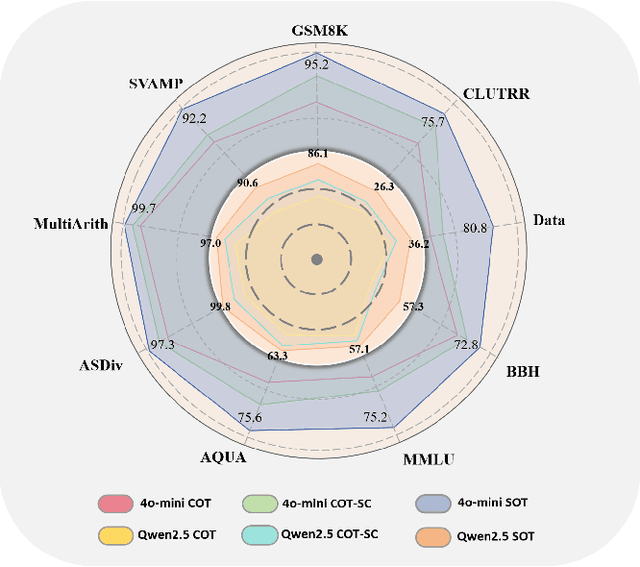
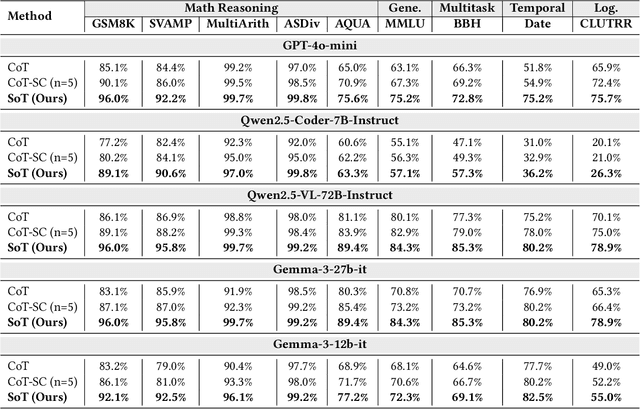
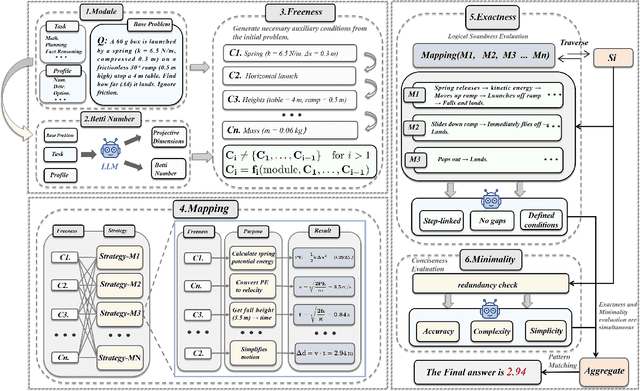
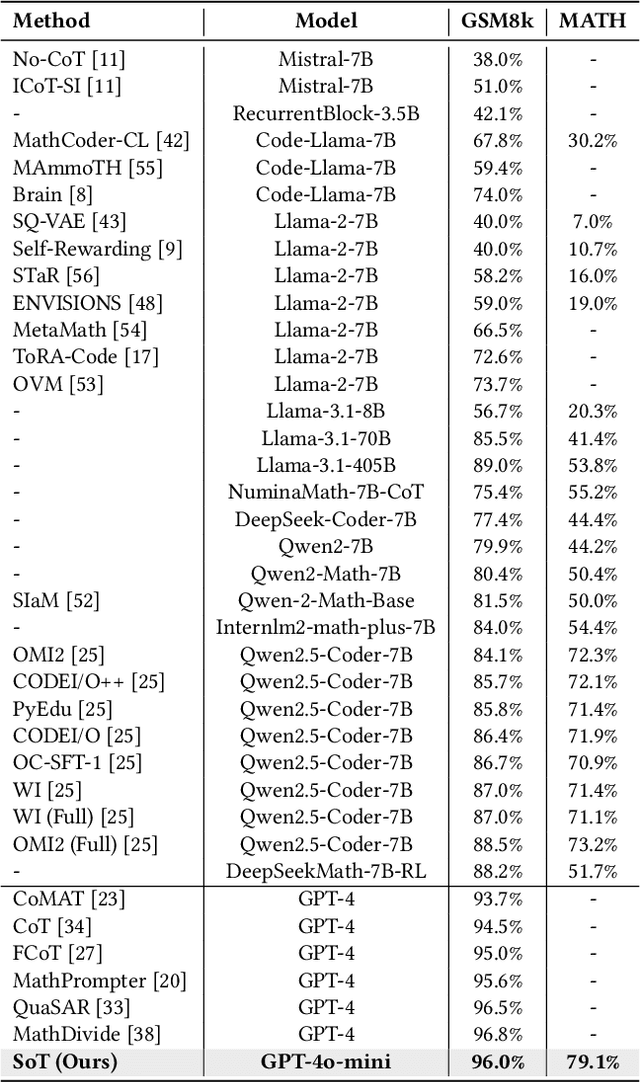
Chain-of-Thought (CoT) prompting enhances the reasoning of large language models (LLMs) by decomposing problems into sequential steps, mimicking human logic and reducing errors. However, complex tasks with vast solution spaces and vague constraints often exceed the capacity of a single reasoning chain. Inspired by Minimal Free Resolution (MFR) in commutative algebra and algebraic geometry, we propose Syzygy of Thoughts (SoT)-a novel framework that extends CoT by introducing auxiliary, interrelated reasoning paths. SoT captures deeper logical dependencies, enabling more robust and structured problem-solving. MFR decomposes a module into a sequence of free modules with minimal rank, providing a structured analytical approach to complex systems. This method introduces the concepts of "Module", "Betti numbers","Freeness", "Mapping", "Exactness" and "Minimality", enabling the systematic decomposition of the original complex problem into logically complete minimal subproblems while preserving key problem features and reducing reasoning length. We tested SoT across diverse datasets (e.g., GSM8K, MATH) and models (e.g., GPT-4o-mini, Qwen2.5), achieving inference accuracy that matches or surpasses mainstream CoTs standards. Additionally, by aligning the sampling process with algebraic constraints, our approach enhances the scalability of inference time in LLMs, ensuring both transparent reasoning and high performance. Our code will be publicly available at https://github.com/dlMARiA/Syzygy-of-thoughts.