 Add to Chrome
 Add to Firefox
 Add to Edge
History Is Not Enough: An Adaptive Dataflow System for Financial Time-Series Synthesis
Jan 15, 2026
In quantitative finance, the gap between training and real-world performance-driven by concept drift and distributional non-stationarity-remains a critical obstacle for building reliable data-driven systems. Models trained on static historical data often overfit, resulting in poor generalization in dynamic markets. The mantra "History Is Not Enough" underscores the need for adaptive data generation that learns to evolve with the market rather than relying solely on past observations. We present a drift-aware dataflow system that integrates machine learning-based adaptive control into the data curation process. The system couples a parameterized data manipulation module comprising single-stock transformations, multi-stock mix-ups, and curation operations, with an adaptive planner-scheduler that employs gradient-based bi-level optimization to control the system. This design unifies data augmentation, curriculum learning, and data workflow management under a single differentiable framework, enabling provenance-aware replay and continuous data quality monitoring. Extensive experiments on forecasting and reinforcement learning trading tasks demonstrate that our framework enhances model robustness and improves risk-adjusted returns. The system provides a generalizable approach to adaptive data management and learning-guided workflow automation for financial data.

Bayesian Robust Financial Trading with Adversarial Synthetic Market Data
Jan 14, 2026Algorithmic trading relies on machine learning models to make trading decisions. Despite strong in-sample performance, these models often degrade when confronted with evolving real-world market regimes, which can shift dramatically due to macroeconomic changes-e.g., monetary policy updates or unanticipated fluctuations in participant behavior. We identify two challenges that perpetuate this mismatch: (1) insufficient robustness in existing policy against uncertainties in high-level market fluctuations, and (2) the absence of a realistic and diverse simulation environment for training, leading to policy overfitting. To address these issues, we propose a Bayesian Robust Framework that systematically integrates a macro-conditioned generative model with robust policy learning. On the data side, to generate realistic and diverse data, we propose a macro-conditioned GAN-based generator that leverages macroeconomic indicators as primary control variables, synthesizing data with faithful temporal, cross-instrument, and macro correlations. On the policy side, to learn robust policy against market fluctuations, we cast the trading process as a two-player zero-sum Bayesian Markov game, wherein an adversarial agent simulates shifting regimes by perturbing macroeconomic indicators in the macro-conditioned generator, while the trading agent-guided by a quantile belief network-maintains and updates its belief over hidden market states. The trading agent seeks a Robust Perfect Bayesian Equilibrium via Bayesian neural fictitious self-play, stabilizing learning under adversarial market perturbations. Extensive experiments on 9 financial instruments demonstrate that our framework outperforms 9 state-of-the-art baselines. In extreme events like the COVID, our method shows improved profitability and risk management, offering a reliable solution for trading under uncertain and shifting market dynamics.
FineFT: Efficient and Risk-Aware Ensemble Reinforcement Learning for Futures Trading
Dec 29, 2025Futures are contracts obligating the exchange of an asset at a predetermined date and price, notable for their high leverage and liquidity and, therefore, thrive in the Crypto market. RL has been widely applied in various quantitative tasks. However, most methods focus on the spot and could not be directly applied to the futures market with high leverage because of 2 challenges. First, high leverage amplifies reward fluctuations, making training stochastic and difficult to converge. Second, prior works lacked self-awareness of capability boundaries, exposing them to the risk of significant loss when encountering new market state (e.g.,a black swan event like COVID-19). To tackle these challenges, we propose the Efficient and Risk-Aware Ensemble Reinforcement Learning for Futures Trading (FineFT), a novel three-stage ensemble RL framework with stable training and proper risk management. In stage I, ensemble Q learners are selectively updated by ensemble TD errors to improve convergence. In stage II, we filter the Q-learners based on their profitabilities and train VAEs on market states to identify the capability boundaries of the learners. In stage III, we choose from the filtered ensemble and a conservative policy, guided by trained VAEs, to maintain profitability and mitigate risk with new market states. Through extensive experiments on crypto futures in a high-frequency trading environment with high fidelity and 5x leverage, we demonstrate that FineFT outperforms 12 SOTA baselines in 6 financial metrics, reducing risk by more than 40% while achieving superior profitability compared to the runner-up. Visualization of the selective update mechanism shows that different agents specialize in distinct market dynamics, and ablation studies certify routing with VAEs reduces maximum drawdown effectively, and selective update improves convergence and performance.
MacroHFT: Memory Augmented Context-aware Reinforcement Learning On High Frequency Trading
Jun 20, 2024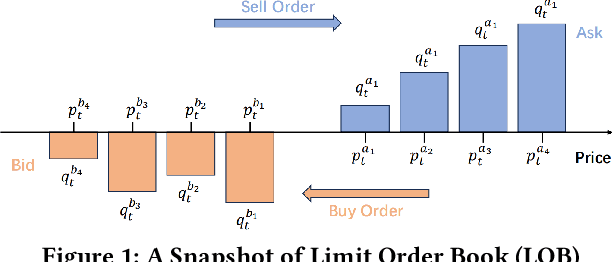
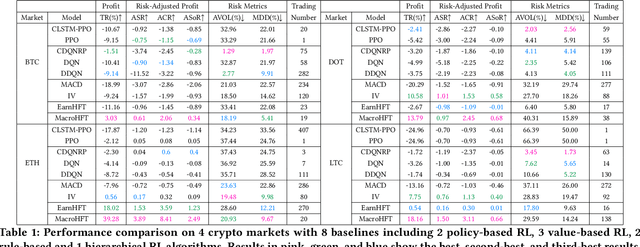
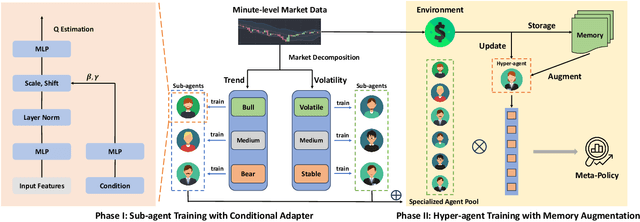
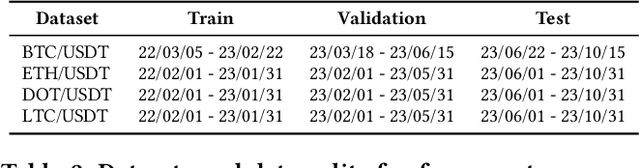
High-frequency trading (HFT) that executes algorithmic trading in short time scales, has recently occupied the majority of cryptocurrency market. Besides traditional quantitative trading methods, reinforcement learning (RL) has become another appealing approach for HFT due to its terrific ability of handling high-dimensional financial data and solving sophisticated sequential decision-making problems, \emph{e.g.,} hierarchical reinforcement learning (HRL) has shown its promising performance on second-level HFT by training a router to select only one sub-agent from the agent pool to execute the current transaction. However, existing RL methods for HFT still have some defects: 1) standard RL-based trading agents suffer from the overfitting issue, preventing them from making effective policy adjustments based on financial context; 2) due to the rapid changes in market conditions, investment decisions made by an individual agent are usually one-sided and highly biased, which might lead to significant loss in extreme markets. To tackle these problems, we propose a novel Memory Augmented Context-aware Reinforcement learning method On HFT, \emph{a.k.a.} MacroHFT, which consists of two training phases: 1) we first train multiple types of sub-agents with the market data decomposed according to various financial indicators, specifically market trend and volatility, where each agent owns a conditional adapter to adjust its trading policy according to market conditions; 2) then we train a hyper-agent to mix the decisions from these sub-agents and output a consistently profitable meta-policy to handle rapid market fluctuations, equipped with a memory mechanism to enhance the capability of decision-making. Extensive experiments on various cryptocurrency markets demonstrate that MacroHFT can achieve state-of-the-art performance on minute-level trading tasks.
A Multimodal Foundation Agent for Financial Trading: Tool-Augmented, Diversified, and Generalist
Feb 29, 2024


Financial trading is a crucial component of the markets, informed by a multimodal information landscape encompassing news, prices, and Kline charts, and encompasses diverse tasks such as quantitative trading and high-frequency trading with various assets. While advanced AI techniques like deep learning and reinforcement learning are extensively utilized in finance, their application in financial trading tasks often faces challenges due to inadequate handling of multimodal data and limited generalizability across various tasks. To address these challenges, we present FinAgent, a multimodal foundational agent with tool augmentation for financial trading. FinAgent's market intelligence module processes a diverse range of data-numerical, textual, and visual-to accurately analyze the financial market. Its unique dual-level reflection module not only enables rapid adaptation to market dynamics but also incorporates a diversified memory retrieval system, enhancing the agent's ability to learn from historical data and improve decision-making processes. The agent's emphasis on reasoning for actions fosters trust in its financial decisions. Moreover, FinAgent integrates established trading strategies and expert insights, ensuring that its trading approaches are both data-driven and rooted in sound financial principles. With comprehensive experiments on 6 financial datasets, including stocks and Crypto, FinAgent significantly outperforms 9 state-of-the-art baselines in terms of 6 financial metrics with over 36% average improvement on profit. Specifically, a 92.27% return (a 84.39% relative improvement) is achieved on one dataset. Notably, FinAgent is the first advanced multimodal foundation agent designed for financial trading tasks.