 Add to Chrome
 Add to Firefox
 Add to Edge
The RoboSense Challenge: Sense Anything, Navigate Anywhere, Adapt Across Platforms
Jan 08, 2026
Autonomous systems are increasingly deployed in open and dynamic environments -- from city streets to aerial and indoor spaces -- where perception models must remain reliable under sensor noise, environmental variation, and platform shifts. However, even state-of-the-art methods often degrade under unseen conditions, highlighting the need for robust and generalizable robot sensing. The RoboSense 2025 Challenge is designed to advance robustness and adaptability in robot perception across diverse sensing scenarios. It unifies five complementary research tracks spanning language-grounded decision making, socially compliant navigation, sensor configuration generalization, cross-view and cross-modal correspondence, and cross-platform 3D perception. Together, these tasks form a comprehensive benchmark for evaluating real-world sensing reliability under domain shifts, sensor failures, and platform discrepancies. RoboSense 2025 provides standardized datasets, baseline models, and unified evaluation protocols, enabling large-scale and reproducible comparison of robust perception methods. The challenge attracted 143 teams from 85 institutions across 16 countries, reflecting broad community engagement. By consolidating insights from 23 winning solutions, this report highlights emerging methodological trends, shared design principles, and open challenges across all tracks, marking a step toward building robots that can sense reliably, act robustly, and adapt across platforms in real-world environments.

Characterization and Generation of 3D Realistic Geological Particles with Metaball Descriptor based on X-Ray Computed Tomography
Feb 05, 2023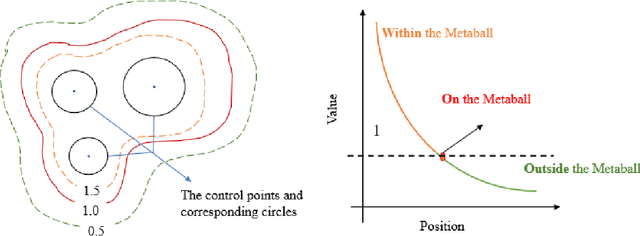
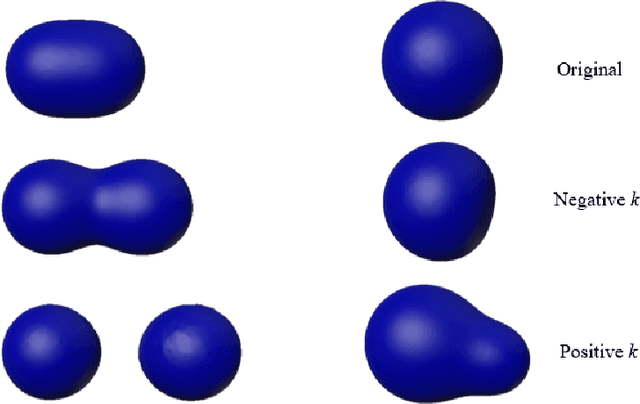
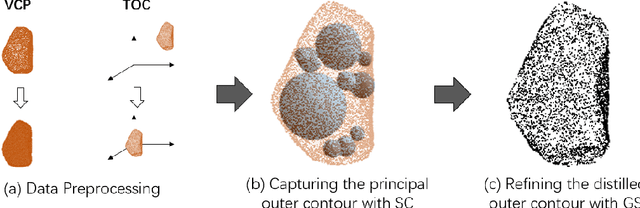
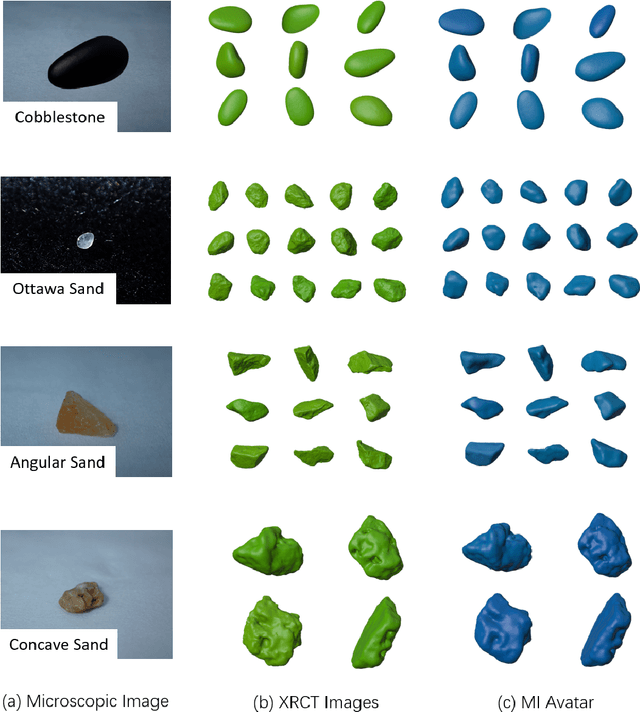
The morphology of geological particles is crucial in determining its granular characteristics and assembly responses. In this paper, Metaball-function based solutions are proposed for morphological characterization and generation of three-dimensional realistic particles according to the X-ray Computed Tomography (XRCT) images. For characterization, we develop a geometric-based Metaball-Imaging algorithm. This algorithm can capture the main contour of parental particles with a series of non-overlapping spheres and refine surface-texture details through gradient search. Four types of particles, hundreds of samples, are applied for evaluations. The result shows good matches on key morphological indicators(i.e., volume, surface area, sphericity, circularity, corey-shape factor, nominal diameter and surface-equivalent-sphere diameter), confirming its characterization precision. For generation, we propose the Metaball Variational Autoencoder. Assisted by deep neural networks, this method can generate 3D particles in Metaball form, while retaining coessential morphological features with parental particles. Additionally, this method allows for control over the generated shapes through an arithmetic pattern, enabling the generation of particles with specific shapes. Two sets of XRCT images different in sample number and geometric features are chosen as parental data. On each training set, one thousand particles are generated for validations. The generation fidelity is demonstrated through comparisons of morphologies and shape-feature distributions between generated and parental particles. Examples are also provided to demonstrate controllability on the generated shapes. With Metaball-based simulations frameworks previously proposed by the authors, these methods have the potential to provide valuable insights into the properties and behavior of actual geological particles.