 Add to Chrome
 Add to Firefox
 Add to Edge
Domain-Expert-Guided Hybrid Mixture-of-Experts for Medical AI: Integrating Data-Driven Learning with Clinical Priors
Jan 25, 2026
Mixture-of-Experts (MoE) models increase representational capacity with modest computational cost, but their effectiveness in specialized domains such as medicine is limited by small datasets. In contrast, clinical practice offers rich expert knowledge, such as physician gaze patterns and diagnostic heuristics, that models cannot reliably learn from limited data. Combining data-driven experts, which capture novel patterns, with domain-expert-guided experts, which encode accumulated clinical insights, provides complementary strengths for robust and clinically meaningful learning. To this end, we propose Domain-Knowledge-Guided Hybrid MoE (DKGH-MoE), a plug-and-play and interpretable module that unifies data-driven learning with domain expertise. DKGH-MoE integrates a data-driven MoE to extract novel features from raw imaging data, and a domain-expert-guided MoE incorporates clinical priors, specifically clinician eye-gaze cues, to emphasize regions of high diagnostic relevance. By integrating domain expert insights with data-driven features, DKGH-MoE improves both performance and interpretability.

ChatCAD+: Towards a Universal and Reliable Interactive CAD using LLMs
May 26, 2023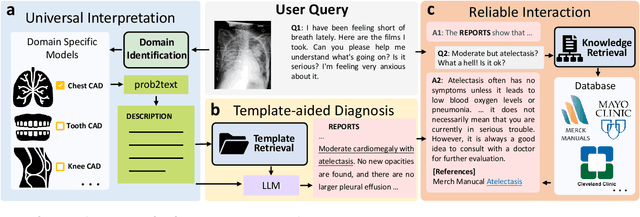
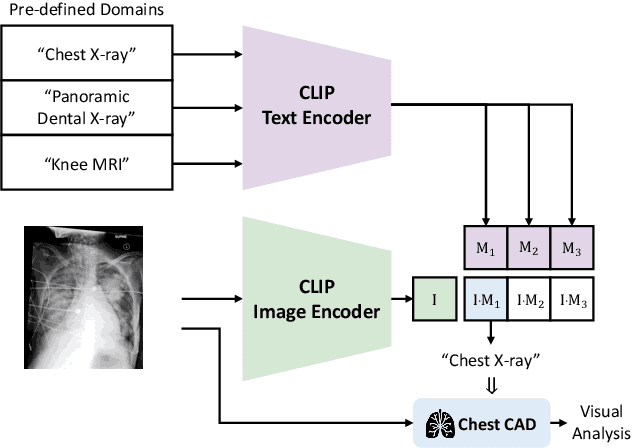
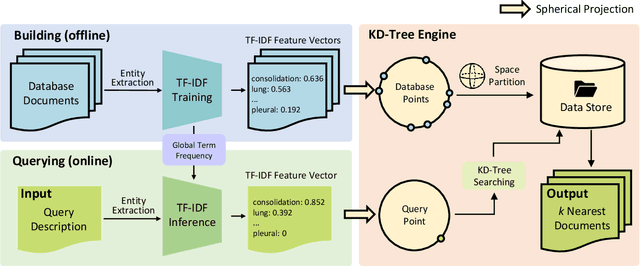
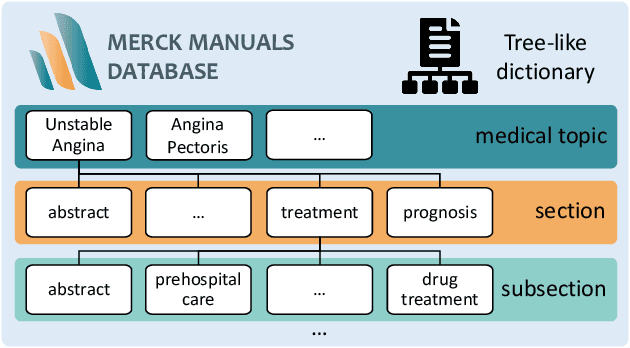
The potential of integrating Computer-Assisted Diagnosis (CAD) with Large Language Models (LLMs) in clinical applications, particularly in digital family doctor and clinic assistant roles, shows promise. However, existing works have limitations in terms of reliability, effectiveness, and their narrow applicability to specific image domains, which restricts their overall processing capabilities. Moreover, the mismatch in writing style between LLMs and radiologists undermines their practical utility. To address these challenges, we present ChatCAD+, an interactive CAD system that is universal, reliable, and capable of handling medical images from diverse domains. ChatCAD+ utilizes current information obtained from reputable medical websites to offer precise medical advice. Additionally, it incorporates a template retrieval system that emulates real-world diagnostic reporting, thereby improving its seamless integration into existing clinical workflows. The source code is available at https://github.com/zhaozh10/ChatCAD. The online demo will be available soon.