 Add to Chrome
 Add to Firefox
 Add to Edge
EoCD: Encoder only Remote Sensing Change Detection
Feb 05, 2026
Being a cornerstone of temporal analysis, change detection has been playing a pivotal role in modern earth observation. Existing change detection methods rely on the Siamese encoder to individually extract temporal features followed by temporal fusion. Subsequently, these methods design sophisticated decoders to improve the change detection performance without taking into consideration the complexity of the model. These aforementioned issues intensify the overall computational cost as well as the network's complexity which is undesirable. Alternatively, few methods utilize the early fusion scheme to combine the temporal images. These methods prevent the extra overhead of Siamese encoder, however, they also rely on sophisticated decoders for better performance. In addition, these methods demonstrate inferior performance as compared to late fusion based methods. To bridge these gaps, we introduce encoder only change detection (EoCD) that is a simple and effective method for the change detection task. The proposed method performs the early fusion of the temporal data and replaces the decoder with a parameter-free multiscale feature fusion module thereby significantly reducing the overall complexity of the model. EoCD demonstrate the optimal balance between the change detection performance and the prediction speed across a variety of encoder architectures. Additionally, EoCD demonstrate that the performance of the model is predominantly dependent on the encoder network, making the decoder an additional component. Extensive experimentation on four challenging change detection datasets reveals the effectiveness of the proposed method.

HyRet-Change: A hybrid retentive network for remote sensing change detection
Jun 15, 2025Recently convolution and transformer-based change detection (CD) methods provide promising performance. However, it remains unclear how the local and global dependencies interact to effectively alleviate the pseudo changes. Moreover, directly utilizing standard self-attention presents intrinsic limitations including governing global feature representations limit to capture subtle changes, quadratic complexity, and restricted training parallelism. To address these limitations, we propose a Siamese-based framework, called HyRet-Change, which can seamlessly integrate the merits of convolution and retention mechanisms at multi-scale features to preserve critical information and enhance adaptability in complex scenes. Specifically, we introduce a novel feature difference module to exploit both convolutions and multi-head retention mechanisms in a parallel manner to capture complementary information. Furthermore, we propose an adaptive local-global interactive context awareness mechanism that enables mutual learning and enhances discrimination capability through information exchange. We perform experiments on three challenging CD datasets and achieve state-of-the-art performance compared to existing methods. Our source code is publicly available at https://github.com/mustansarfiaz/HyRect-Change.
* Accepted at IEEE IGARSS 2025
EarthDial: Turning Multi-sensory Earth Observations to Interactive Dialogues
Dec 19, 2024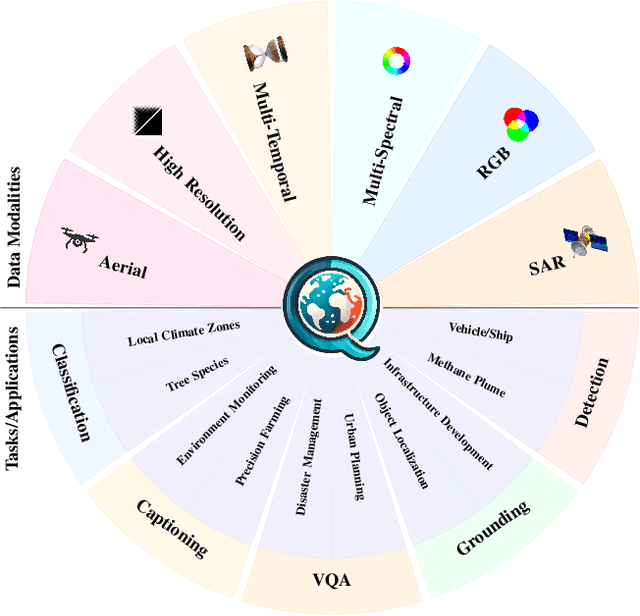
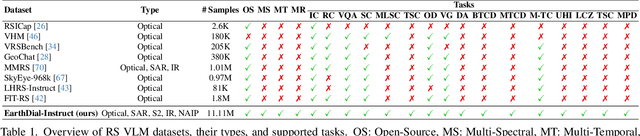


Automated analysis of vast Earth observation data via interactive Vision-Language Models (VLMs) can unlock new opportunities for environmental monitoring, disaster response, and resource management. Existing generic VLMs do not perform well on Remote Sensing data, while the recent Geo-spatial VLMs remain restricted to a fixed resolution and few sensor modalities. In this paper, we introduce EarthDial, a conversational assistant specifically designed for Earth Observation (EO) data, transforming complex, multi-sensory Earth observations into interactive, natural language dialogues. EarthDial supports multi-spectral, multi-temporal, and multi-resolution imagery, enabling a wide range of remote sensing tasks, including classification, detection, captioning, question answering, visual reasoning, and visual grounding. To achieve this, we introduce an extensive instruction tuning dataset comprising over 11.11M instruction pairs covering RGB, Synthetic Aperture Radar (SAR), and multispectral modalities such as Near-Infrared (NIR) and infrared. Furthermore, EarthDial handles bi-temporal and multi-temporal sequence analysis for applications like change detection. Our extensive experimental results on 37 downstream applications demonstrate that EarthDial outperforms existing generic and domain-specific models, achieving better generalization across various EO tasks.