 Add to Chrome
 Add to Firefox
 Add to Edge
Learning Query-Aware Budget-Tier Routing for Runtime Agent Memory
Feb 05, 2026
Memory is increasingly central to Large Language Model (LLM) agents operating beyond a single context window, yet most existing systems rely on offline, query-agnostic memory construction that can be inefficient and may discard query-critical information. Although runtime memory utilization is a natural alternative, prior work often incurs substantial overhead and offers limited explicit control over the performance-cost trade-off. In this work, we present \textbf{BudgetMem}, a runtime agent memory framework for explicit, query-aware performance-cost control. BudgetMem structures memory processing as a set of memory modules, each offered in three budget tiers (i.e., \textsc{Low}/\textsc{Mid}/\textsc{High}). A lightweight router performs budget-tier routing across modules to balance task performance and memory construction cost, which is implemented as a compact neural policy trained with reinforcement learning. Using BudgetMem as a unified testbed, we study three complementary strategies for realizing budget tiers: implementation (method complexity), reasoning (inference behavior), and capacity (module model size). Across LoCoMo, LongMemEval, and HotpotQA, BudgetMem surpasses strong baselines when performance is prioritized (i.e., high-budget setting), and delivers better accuracy-cost frontiers under tighter budgets. Moreover, our analysis disentangles the strengths and weaknesses of different tiering strategies, clarifying when each axis delivers the most favorable trade-offs under varying budget regimes.

MemSkill: Learning and Evolving Memory Skills for Self-Evolving Agents
Feb 02, 2026Most Large Language Model (LLM) agent memory systems rely on a small set of static, hand-designed operations for extracting memory. These fixed procedures hard-code human priors about what to store and how to revise memory, making them rigid under diverse interaction patterns and inefficient on long histories. To this end, we present \textbf{MemSkill}, which reframes these operations as learnable and evolvable memory skills, structured and reusable routines for extracting, consolidating, and pruning information from interaction traces. Inspired by the design philosophy of agent skills, MemSkill employs a \emph{controller} that learns to select a small set of relevant skills, paired with an LLM-based \emph{executor} that produces skill-guided memories. Beyond learning skill selection, MemSkill introduces a \emph{designer} that periodically reviews hard cases where selected skills yield incorrect or incomplete memories, and evolves the skill set by proposing refinements and new skills. Together, MemSkill forms a closed-loop procedure that improves both the skill-selection policy and the skill set itself. Experiments on LoCoMo, LongMemEval, HotpotQA, and ALFWorld demonstrate that MemSkill improves task performance over strong baselines and generalizes well across settings. Further analyses shed light on how skills evolve, offering insights toward more adaptive, self-evolving memory management for LLM agents.
Revolutionizing Encrypted Traffic Classification with MH-Net: A Multi-View Heterogeneous Graph Model
Jan 05, 2025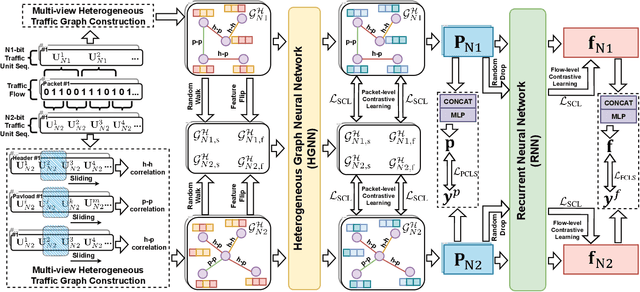
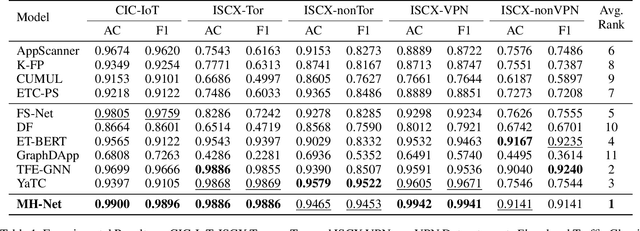
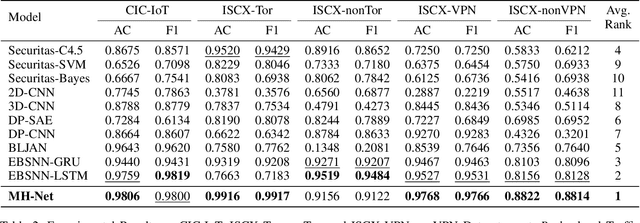
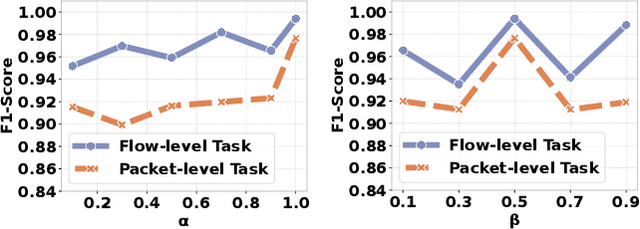
With the growing significance of network security, the classification of encrypted traffic has emerged as an urgent challenge. Traditional byte-based traffic analysis methods are constrained by the rigid granularity of information and fail to fully exploit the diverse correlations between bytes. To address these limitations, this paper introduces MH-Net, a novel approach for classifying network traffic that leverages multi-view heterogeneous traffic graphs to model the intricate relationships between traffic bytes. The essence of MH-Net lies in aggregating varying numbers of traffic bits into multiple types of traffic units, thereby constructing multi-view traffic graphs with diverse information granularities. By accounting for different types of byte correlations, such as header-payload relationships, MH-Net further endows the traffic graph with heterogeneity, significantly enhancing model performance. Notably, we employ contrastive learning in a multi-task manner to strengthen the robustness of the learned traffic unit representations. Experiments conducted on the ISCX and CIC-IoT datasets for both the packet-level and flow-level traffic classification tasks demonstrate that MH-Net achieves the best overall performance compared to dozens of SOTA methods.