 Add to Chrome
 Add to Firefox
 Add to Edge
Learning Query-Aware Budget-Tier Routing for Runtime Agent Memory
Feb 05, 2026
Memory is increasingly central to Large Language Model (LLM) agents operating beyond a single context window, yet most existing systems rely on offline, query-agnostic memory construction that can be inefficient and may discard query-critical information. Although runtime memory utilization is a natural alternative, prior work often incurs substantial overhead and offers limited explicit control over the performance-cost trade-off. In this work, we present \textbf{BudgetMem}, a runtime agent memory framework for explicit, query-aware performance-cost control. BudgetMem structures memory processing as a set of memory modules, each offered in three budget tiers (i.e., \textsc{Low}/\textsc{Mid}/\textsc{High}). A lightweight router performs budget-tier routing across modules to balance task performance and memory construction cost, which is implemented as a compact neural policy trained with reinforcement learning. Using BudgetMem as a unified testbed, we study three complementary strategies for realizing budget tiers: implementation (method complexity), reasoning (inference behavior), and capacity (module model size). Across LoCoMo, LongMemEval, and HotpotQA, BudgetMem surpasses strong baselines when performance is prioritized (i.e., high-budget setting), and delivers better accuracy-cost frontiers under tighter budgets. Moreover, our analysis disentangles the strengths and weaknesses of different tiering strategies, clarifying when each axis delivers the most favorable trade-offs under varying budget regimes.

MemSkill: Learning and Evolving Memory Skills for Self-Evolving Agents
Feb 02, 2026Most Large Language Model (LLM) agent memory systems rely on a small set of static, hand-designed operations for extracting memory. These fixed procedures hard-code human priors about what to store and how to revise memory, making them rigid under diverse interaction patterns and inefficient on long histories. To this end, we present \textbf{MemSkill}, which reframes these operations as learnable and evolvable memory skills, structured and reusable routines for extracting, consolidating, and pruning information from interaction traces. Inspired by the design philosophy of agent skills, MemSkill employs a \emph{controller} that learns to select a small set of relevant skills, paired with an LLM-based \emph{executor} that produces skill-guided memories. Beyond learning skill selection, MemSkill introduces a \emph{designer} that periodically reviews hard cases where selected skills yield incorrect or incomplete memories, and evolves the skill set by proposing refinements and new skills. Together, MemSkill forms a closed-loop procedure that improves both the skill-selection policy and the skill set itself. Experiments on LoCoMo, LongMemEval, HotpotQA, and ALFWorld demonstrate that MemSkill improves task performance over strong baselines and generalizes well across settings. Further analyses shed light on how skills evolve, offering insights toward more adaptive, self-evolving memory management for LLM agents.
Targeted Distillation for Sentiment Analysis
Mar 05, 2025This paper presents a compact model that achieves strong sentiment analysis capabilities through targeted distillation from advanced large language models (LLMs). Our methodology decouples the distillation target into two key components: sentiment-related knowledge and task alignment. To transfer these components, we propose a two-stage distillation framework. The first stage, knowledge-driven distillation (\textsc{KnowDist}), transfers sentiment-related knowledge to enhance fundamental sentiment analysis capabilities. The second stage, in-context learning distillation (\textsc{ICLDist}), transfers task-specific prompt-following abilities to optimize task alignment. For evaluation, we introduce \textsc{SentiBench}, a comprehensive sentiment analysis benchmark comprising 3 task categories across 12 datasets. Experiments on this benchmark demonstrate that our model effectively balances model size and performance, showing strong competitiveness compared to existing small-scale LLMs.
Distilling Fine-grained Sentiment Understanding from Large Language Models
Dec 24, 2024Fine-grained sentiment analysis (FSA) aims to extract and summarize user opinions from vast opinionated text. Recent studies demonstrate that large language models (LLMs) possess exceptional sentiment understanding capabilities. However, directly deploying LLMs for FSA applications incurs high inference costs. Therefore, this paper investigates the distillation of fine-grained sentiment understanding from LLMs into small language models (SLMs). We prompt LLMs to examine and interpret the sentiments of given reviews and then utilize the generated content to pretrain SLMs. Additionally, we develop a comprehensive FSA benchmark to evaluate both SLMs and LLMs. Extensive experiments on this benchmark reveal that: (1) distillation significantly enhances the performance of SLMs in FSA tasks, achieving a 6.00\% improvement in $F_1$-score, and the distilled model can outperform Llama-2-7b with only 220M parameters; (2) distillation equips SLMs with excellent zero-shot sentiment classification capabilities, enabling them to match or even exceed their teacher models. These results suggest that distillation from LLMs is a highly promising direction for FSA. We will release our code, data, and pretrained model weights at \url{https://github.com/HITSZ-HLT/FSA-Distillation}.
Overview of AI-Debater 2023: The Challenges of Argument Generation Tasks
Jul 24, 2024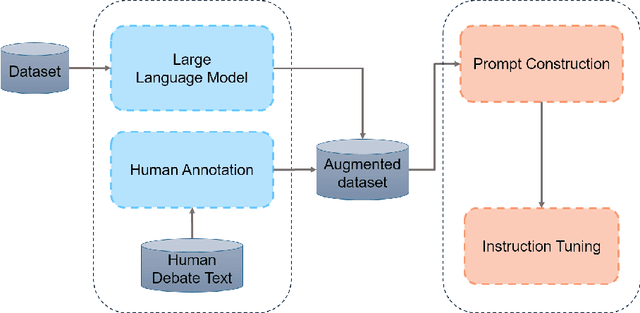
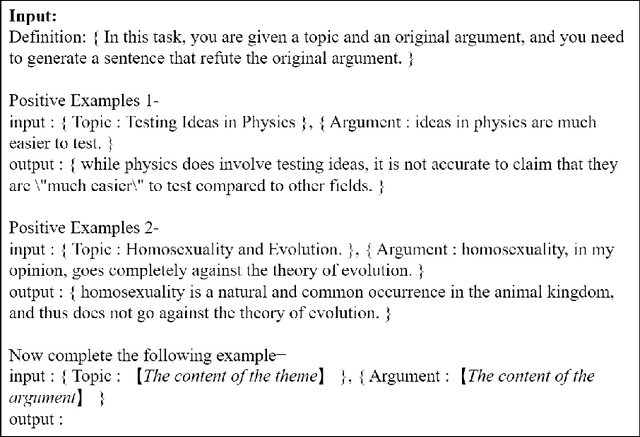
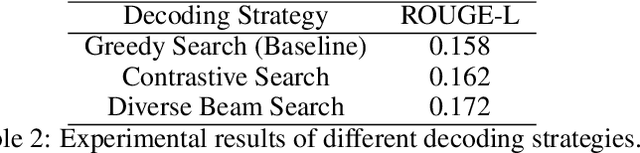
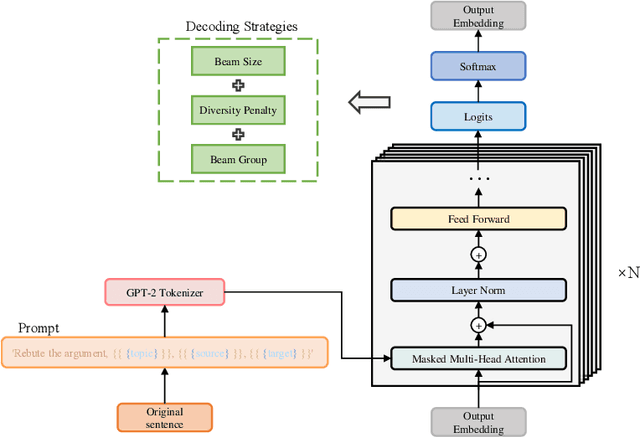
In this paper we present the results of the AI-Debater 2023 Challenge held by the Chinese Conference on Affect Computing (CCAC 2023), and introduce the related datasets. We organize two tracks to handle the argumentative generation tasks in different scenarios, namely, Counter-Argument Generation (Track 1) and Claim-based Argument Generation (Track 2). Each track is equipped with its distinct dataset and baseline model respectively. In total, 32 competing teams register for the challenge, from which we received 11 successful submissions. In this paper, we will present the results of the challenge and a summary of the systems, highlighting commonalities and innovations among participating systems. Datasets and baseline models of the AI-Debater 2023 Challenge have been already released and can be accessed through the official website of the challenge.