 Add to Chrome
 Add to Firefox
 Add to Edge
CoDe-R: Refining Decompiler Output with LLMs via Rationale Guidance and Adaptive Inference
Apr 14, 2026
Binary decompilation is a critical reverse engineering task aimed at reconstructing high-level source code from stripped executables. Although Large Language Models (LLMs) have recently shown promise, they often suffer from "logical hallucinations" and "semantic misalignment" due to the irreversible semantic loss during compilation, resulting in generated code that fails to re-execute. In this study, we propose Cognitive Decompiler Refinement with Robustness (CoDe-R), a lightweight two-stage code refinement framework. The first stage introduces Semantic Cognitive Enhancement (SCE), a Rationale-Guided Semantic Injection strategy that trains the model to recover high-level algorithmic intent alongside code. The second stage introduces a Dynamic Dual-Path Fallback (DDPF) mechanism during inference, which adaptively balances semantic recovery and syntactic stability via a hybrid verification strategy. Evaluation on the HumanEval-Decompile benchmark demonstrates that CoDe-R (using a 1.3B backbone) establishes a new State-of-the-Art (SOTA) in the lightweight regime. Notably, it is the first 1.3B model to exceed an Average Re-executability Rate of 50.00%, significantly outperforming the baseline and effectively bridging the gap between efficient models and expert-level performance. Our code is available at https://github.com/Theaoi/CoDe-R.

Are Multimodal Large Language Models Good Annotators for Image Tagging?
Feb 24, 2026Image tagging, a fundamental vision task, traditionally relies on human-annotated datasets to train multi-label classifiers, which incurs significant labor and costs. While Multimodal Large Language Models (MLLMs) offer promising potential to automate annotation, their capability to replace human annotators remains underexplored. This paper aims to analyze the gap between MLLM-generated and human annotations and to propose an effective solution that enables MLLM-based annotation to replace manual labeling. Our analysis of MLLM annotations reveals that, under a conservative estimate, MLLMs can reduce annotation cost to as low as one-thousandth of the human cost, mainly accounting for GPU usage, which is nearly negligible compared to manual efforts. Their annotation quality reaches about 50\% to 80\% of human performance, while achieving over 90\% performance on downstream training tasks.Motivated by these findings, we propose TagLLM, a novel framework for image tagging, which aims to narrow the gap between MLLM-generated and human annotations. TagLLM comprises two components: Candidates generation, which employs structured group-wise prompting to efficiently produce a compact candidate set that covers as many true labels as possible while reducing subsequent annotation workload; and label disambiguation, which interactively calibrates the semantic concept of categories in the prompts and effectively refines the candidate labels. Extensive experiments show that TagLLM substantially narrows the gap between MLLM-generated and human annotations, especially in downstream training performance, where it closes about 60\% to 80\% of the difference.
Human-Corrected Labels Learning: Enhancing Labels Quality via Human Correction of VLMs Discrepancies
Nov 14, 2025Vision-Language Models (VLMs), with their powerful content generation capabilities, have been successfully applied to data annotation processes. However, the VLM-generated labels exhibit dual limitations: low quality (i.e., label noise) and absence of error correction mechanisms. To enhance label quality, we propose Human-Corrected Labels (HCLs), a novel setting that efficient human correction for VLM-generated noisy labels. As shown in Figure 1(b), HCL strategically deploys human correction only for instances with VLM discrepancies, achieving both higher-quality annotations and reduced labor costs. Specifically, we theoretically derive a risk-consistent estimator that incorporates both human-corrected labels and VLM predictions to train classifiers. Besides, we further propose a conditional probability method to estimate the label distribution using a combination of VLM outputs and model predictions. Extensive experiments demonstrate that our approach achieves superior classification performance and is robust to label noise, validating the effectiveness of HCL in practical weak supervision scenarios. Code https://github.com/Lilianach24/HCL.git
ESA: Example Sieve Approach for Multi-Positive and Unlabeled Learning
Dec 03, 2024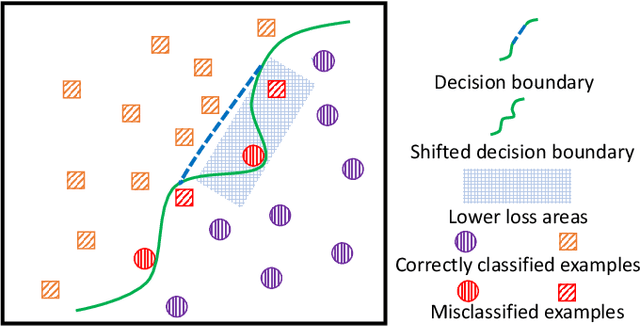
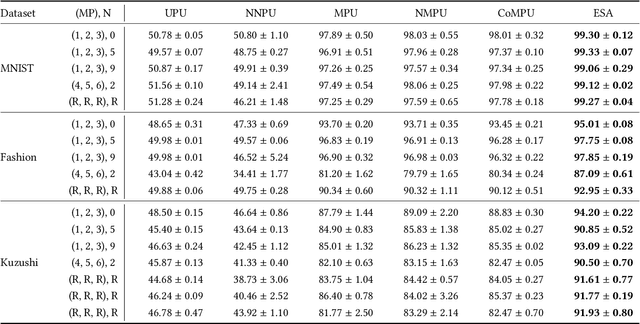
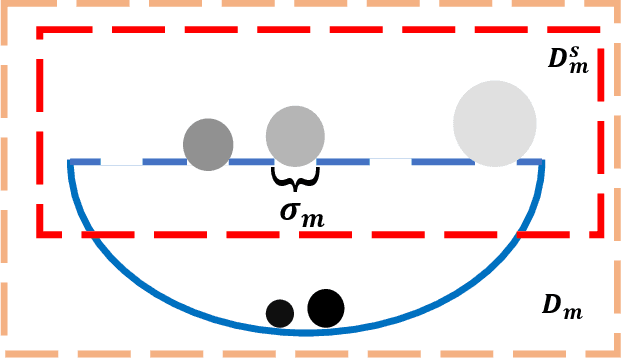
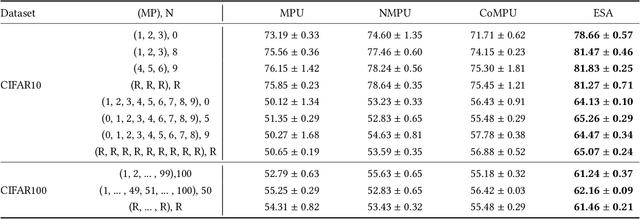
Learning from Multi-Positive and Unlabeled (MPU) data has gradually attracted significant attention from practical applications. Unfortunately, the risk of MPU also suffer from the shift of minimum risk, particularly when the models are very flexible as shown in Fig.\ref{moti}. In this paper, to alleviate the shifting of minimum risk problem, we propose an Example Sieve Approach (ESA) to select examples for training a multi-class classifier. Specifically, we sieve out some examples by utilizing the Certain Loss (CL) value of each example in the training stage and analyze the consistency of the proposed risk estimator. Besides, we show that the estimation error of proposed ESA obtains the optimal parametric convergence rate. Extensive experiments on various real-world datasets show the proposed approach outperforms previous methods.
Learning from Concealed Labels
Dec 03, 2024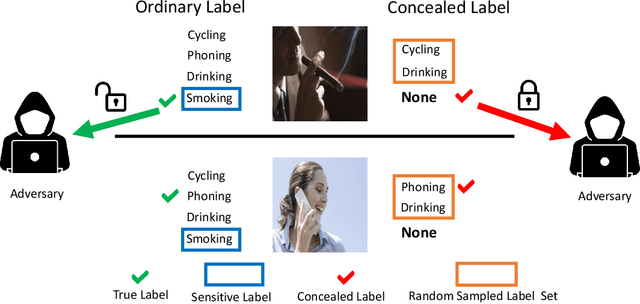
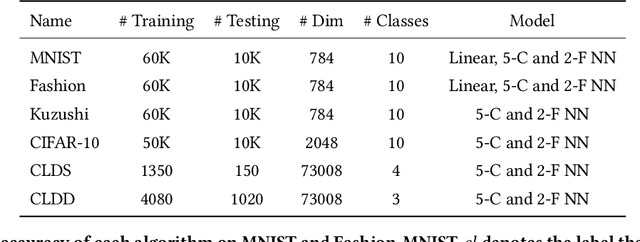
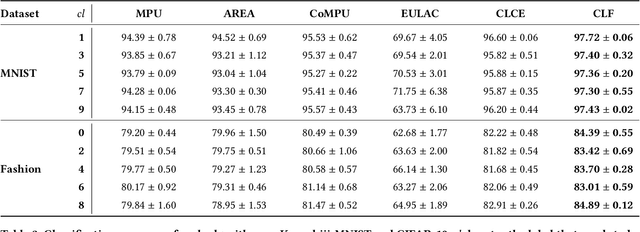
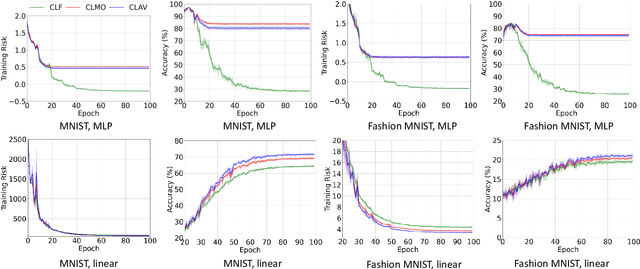
Annotating data for sensitive labels (e.g., disease, smoking) poses a potential threats to individual privacy in many real-world scenarios. To cope with this problem, we propose a novel setting to protect privacy of each instance, namely learning from concealed labels for multi-class classification. Concealed labels prevent sensitive labels from appearing in the label set during the label collection stage, which specifies none and some random sampled insensitive labels as concealed labels set to annotate sensitive data. In this paper, an unbiased estimator can be established from concealed data under mild assumptions, and the learned multi-class classifier can not only classify the instance from insensitive labels accurately but also recognize the instance from the sensitive labels. Moreover, we bound the estimation error and show that the multi-class classifier achieves the optimal parametric convergence rate. Experiments demonstrate the significance and effectiveness of the proposed method for concealed labels in synthetic and real-world datasets.
CoA: Chain-of-Action for Generative Semantic Labels
Nov 26, 2024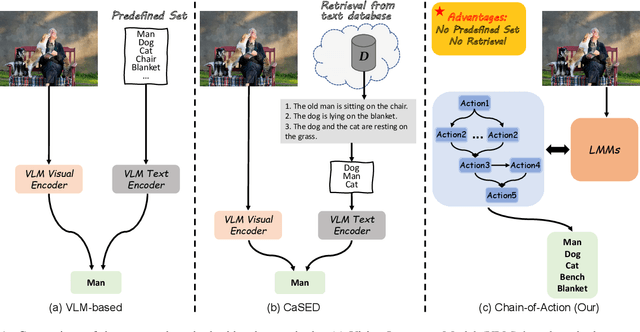
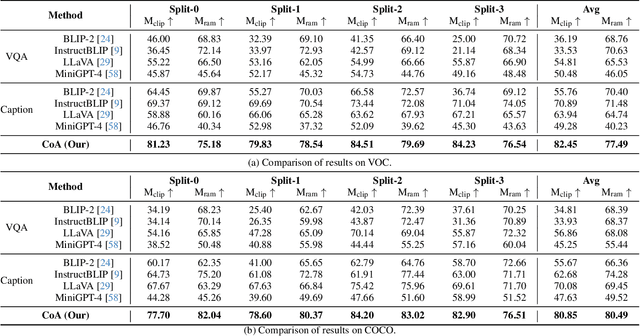
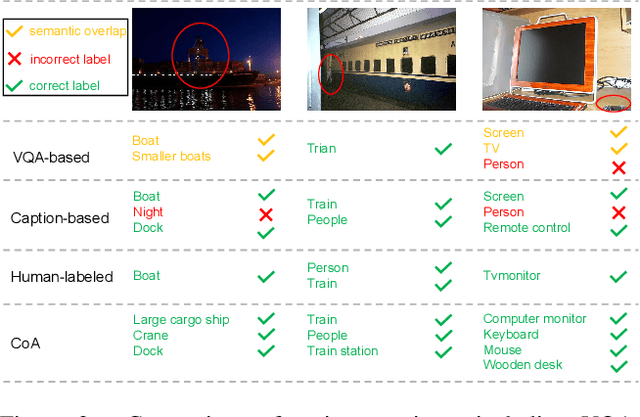
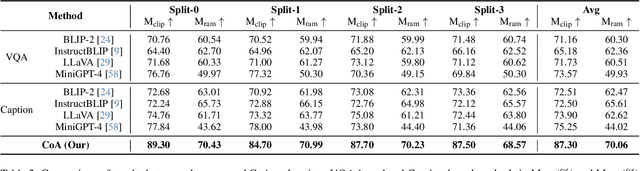
Recent advances in vision-language models (VLM) have demonstrated remarkable capability in image classification. These VLMs leverage a predefined set of categories to construct text prompts for zero-shot reasoning. However, in more open-ended domains like autonomous driving, using a predefined set of labels becomes impractical, as the semantic label space is unknown and constantly evolving. Additionally, fixed embedding text prompts often tend to predict a single label (while in reality, multiple labels commonly exist per image). In this paper, we introduce CoA, an innovative Chain-of-Action (CoA) method that generates labels aligned with all contextually relevant features of an image. CoA is designed based on the observation that enriched and valuable contextual information improves generative performance during inference. Traditional vision-language models tend to output singular and redundant responses. Therefore, we employ a tailored CoA to alleviate this problem. We first break down the generative labeling task into detailed actions and construct an CoA leading to the final generative objective. Each action extracts and merges key information from the previous action and passes the enriched information as context to the next action, ultimately improving the VLM in generating comprehensive and accurate semantic labels. We assess the effectiveness of CoA through comprehensive evaluations on widely-used benchmark datasets and the results demonstrate significant improvements across key performance metrics.
Learning from True-False Labels via Multi-modal Prompt Retrieving
May 24, 2024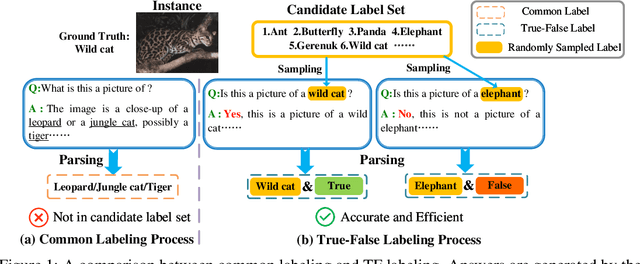
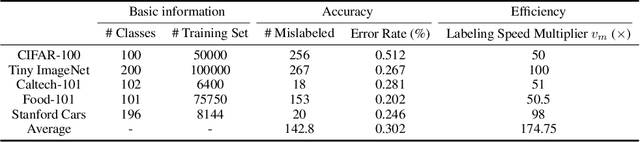
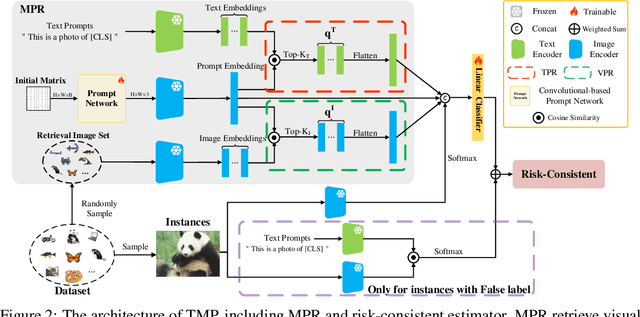
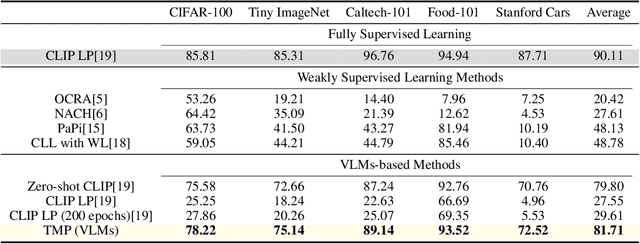
Weakly supervised learning has recently achieved considerable success in reducing annotation costs and label noise. Unfortunately, existing weakly supervised learning methods are short of ability in generating reliable labels via pre-trained vision-language models (VLMs). In this paper, we propose a novel weakly supervised labeling setting, namely True-False Labels (TFLs) which can achieve high accuracy when generated by VLMs. The TFL indicates whether an instance belongs to the label, which is randomly and uniformly sampled from the candidate label set. Specifically, we theoretically derive a risk-consistent estimator to explore and utilize the conditional probability distribution information of TFLs. Besides, we propose a convolutional-based Multi-modal Prompt Retrieving (MRP) method to bridge the gap between the knowledge of VLMs and target learning tasks. Experimental results demonstrate the effectiveness of the proposed TFL setting and MRP learning method. The code to reproduce the experiments is at https://github.com/Tranquilxu/TMP.
Learning from Reduced Labels for Long-Tailed Data
Mar 25, 2024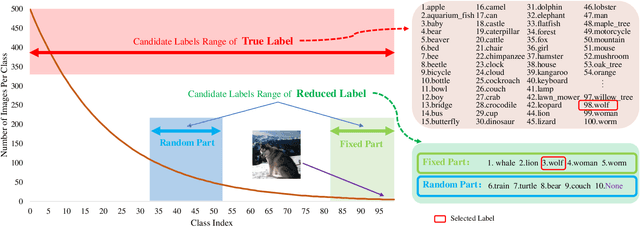
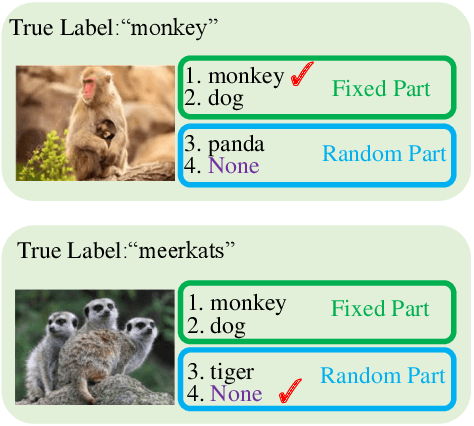
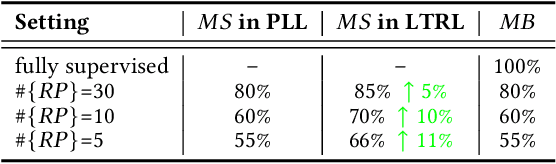
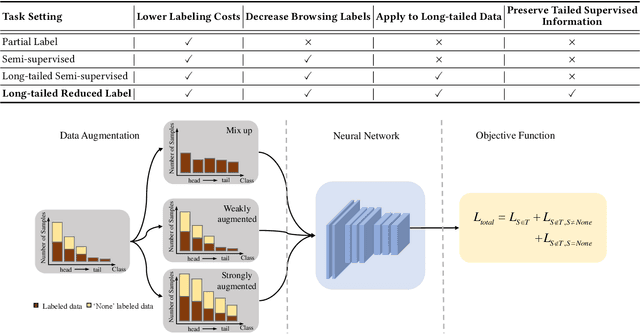
Long-tailed data is prevalent in real-world classification tasks and heavily relies on supervised information, which makes the annotation process exceptionally labor-intensive and time-consuming. Unfortunately, despite being a common approach to mitigate labeling costs, existing weakly supervised learning methods struggle to adequately preserve supervised information for tail samples, resulting in a decline in accuracy for the tail classes. To alleviate this problem, we introduce a novel weakly supervised labeling setting called Reduced Label. The proposed labeling setting not only avoids the decline of supervised information for the tail samples, but also decreases the labeling costs associated with long-tailed data. Additionally, we propose an straightforward and highly efficient unbiased framework with strong theoretical guarantees to learn from these Reduced Labels. Extensive experiments conducted on benchmark datasets including ImageNet validate the effectiveness of our approach, surpassing the performance of state-of-the-art weakly supervised methods.
Determined Multi-Label Learning via Similarity-Based Prompt
Mar 25, 2024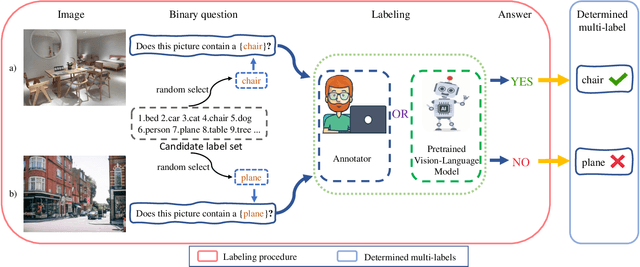
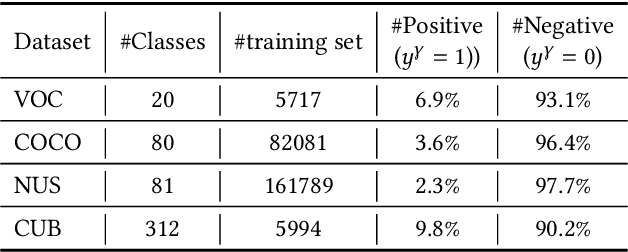
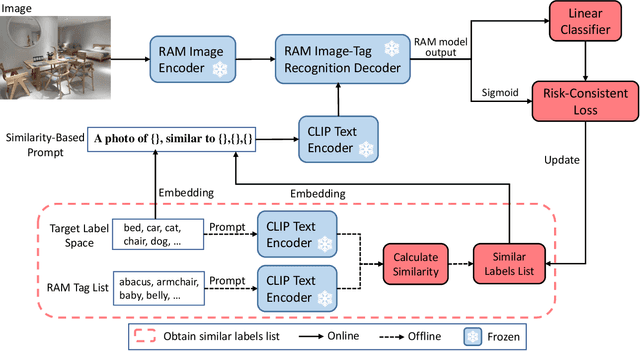
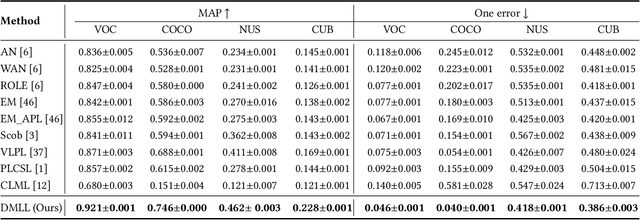
In multi-label classification, each training instance is associated with multiple class labels simultaneously. Unfortunately, collecting the fully precise class labels for each training instance is time- and labor-consuming for real-world applications. To alleviate this problem, a novel labeling setting termed \textit{Determined Multi-Label Learning} (DMLL) is proposed, aiming to effectively alleviate the labeling cost inherent in multi-label tasks. In this novel labeling setting, each training instance is associated with a \textit{determined label} (either "Yes" or "No"), which indicates whether the training instance contains the provided class label. The provided class label is randomly and uniformly selected from the whole candidate labels set. Besides, each training instance only need to be determined once, which significantly reduce the annotation cost of the labeling task for multi-label datasets. In this paper, we theoretically derive an risk-consistent estimator to learn a multi-label classifier from these determined-labeled training data. Additionally, we introduce a similarity-based prompt learning method for the first time, which minimizes the risk-consistent loss of large-scale pre-trained models to learn a supplemental prompt with richer semantic information. Extensive experimental validation underscores the efficacy of our approach, demonstrating superior performance compared to existing state-of-the-art methods.
Multi-label Learning from Privacy-Label
Dec 20, 2023Multi-abel Learning (MLL) often involves the assignment of multiple relevant labels to each instance, which can lead to the leakage of sensitive information (such as smoking, diseases, etc.) about the instances. However, existing MLL suffer from failures in protection for sensitive information. In this paper, we propose a novel setting named Multi-Label Learning from Privacy-Label (MLLPL), which Concealing Labels via Privacy-Label Unit (CLPLU). Specifically, during the labeling phase, each privacy-label is randomly combined with a non-privacy label to form a Privacy-Label Unit (PLU). If any label within a PLU is positive, the unit is labeled as positive; otherwise, it is labeled negative, as shown in Figure 1. PLU ensures that only non-privacy labels are appear in the label set, while the privacy-labels remain concealed. Moreover, we further propose a Privacy-Label Unit Loss (PLUL) to learn the optimal classifier by minimizing the empirical risk of PLU. Experimental results on multiple benchmark datasets demonstrate the effectiveness and superiority of the proposed method.