 Add to Chrome
 Add to Firefox
 Add to Edge
Iterative Refinement Improves Compositional Image Generation
Jan 21, 2026
Text-to-image (T2I) models have achieved remarkable progress, yet they continue to struggle with complex prompts that require simultaneously handling multiple objects, relations, and attributes. Existing inference-time strategies, such as parallel sampling with verifiers or simply increasing denoising steps, can improve prompt alignment but remain inadequate for richly compositional settings where many constraints must be satisfied. Inspired by the success of chain-of-thought reasoning in large language models, we propose an iterative test-time strategy in which a T2I model progressively refines its generations across multiple steps, guided by feedback from a vision-language model as the critic in the loop. Our approach is simple, requires no external tools or priors, and can be flexibly applied to a wide range of image generators and vision-language models. Empirically, we demonstrate consistent gains on image generation across benchmarks: a 16.9% improvement in all-correct rate on ConceptMix (k=7), a 13.8% improvement on T2I-CompBench (3D-Spatial category) and a 12.5% improvement on Visual Jenga scene decomposition compared to compute-matched parallel sampling. Beyond quantitative gains, iterative refinement produces more faithful generations by decomposing complex prompts into sequential corrections, with human evaluators preferring our method 58.7% of the time over 41.3% for the parallel baseline. Together, these findings highlight iterative self-correction as a broadly applicable principle for compositional image generation. Results and visualizations are available at https://iterative-img-gen.github.io/

Adapting Vehicle Detectors for Aerial Imagery to Unseen Domains with Weak Supervision
Jul 28, 2025Detecting vehicles in aerial imagery is a critical task with applications in traffic monitoring, urban planning, and defense intelligence. Deep learning methods have provided state-of-the-art (SOTA) results for this application. However, a significant challenge arises when models trained on data from one geographic region fail to generalize effectively to other areas. Variability in factors such as environmental conditions, urban layouts, road networks, vehicle types, and image acquisition parameters (e.g., resolution, lighting, and angle) leads to domain shifts that degrade model performance. This paper proposes a novel method that uses generative AI to synthesize high-quality aerial images and their labels, improving detector training through data augmentation. Our key contribution is the development of a multi-stage, multi-modal knowledge transfer framework utilizing fine-tuned latent diffusion models (LDMs) to mitigate the distribution gap between the source and target environments. Extensive experiments across diverse aerial imagery domains show consistent performance improvements in AP50 over supervised learning on source domain data, weakly supervised adaptation methods, unsupervised domain adaptation methods, and open-set object detectors by 4-23%, 6-10%, 7-40%, and more than 50%, respectively. Furthermore, we introduce two newly annotated aerial datasets from New Zealand and Utah to support further research in this field. Project page is available at: https://humansensinglab.github.io/AGenDA
Video Diffusion Alignment via Reward Gradients
Jul 11, 2024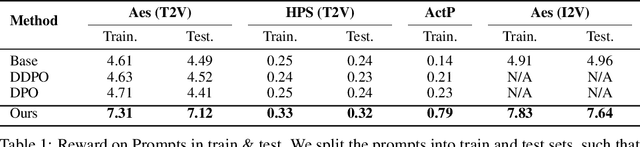
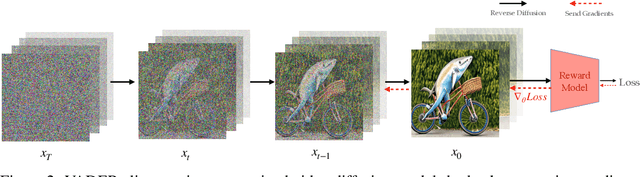
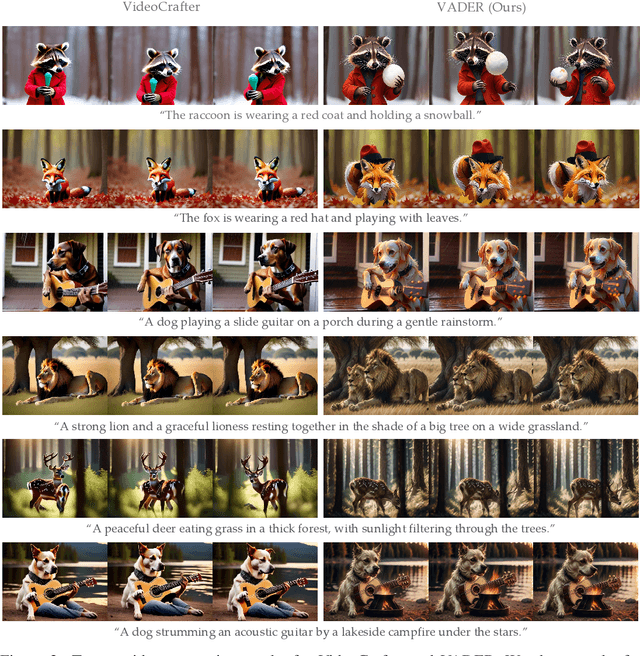
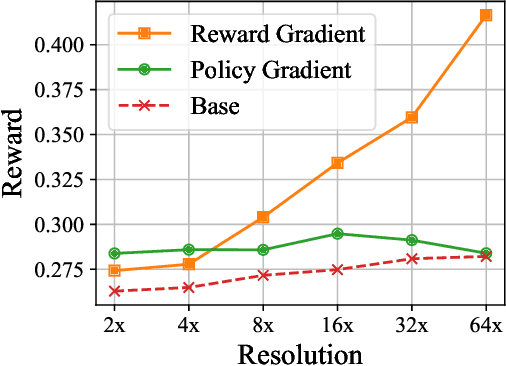
We have made significant progress towards building foundational video diffusion models. As these models are trained using large-scale unsupervised data, it has become crucial to adapt these models to specific downstream tasks. Adapting these models via supervised fine-tuning requires collecting target datasets of videos, which is challenging and tedious. In this work, we utilize pre-trained reward models that are learned via preferences on top of powerful vision discriminative models to adapt video diffusion models. These models contain dense gradient information with respect to generated RGB pixels, which is critical to efficient learning in complex search spaces, such as videos. We show that backpropagating gradients from these reward models to a video diffusion model can allow for compute and sample efficient alignment of the video diffusion model. We show results across a variety of reward models and video diffusion models, demonstrating that our approach can learn much more efficiently in terms of reward queries and computation than prior gradient-free approaches. Our code, model weights,and more visualization are available at https://vader-vid.github.io.