 Add to Chrome
 Add to Firefox
 Add to Edge
ERNIE 5.0 Technical Report
Feb 04, 2026
In this report, we introduce ERNIE 5.0, a natively autoregressive foundation model desinged for unified multimodal understanding and generation across text, image, video, and audio. All modalities are trained from scratch under a unified next-group-of-tokens prediction objective, based on an ultra-sparse mixture-of-experts (MoE) architecture with modality-agnostic expert routing. To address practical challenges in large-scale deployment under diverse resource constraints, ERNIE 5.0 adopts a novel elastic training paradigm. Within a single pre-training run, the model learns a family of sub-models with varying depths, expert capacities, and routing sparsity, enabling flexible trade-offs among performance, model size, and inference latency in memory- or time-constrained scenarios. Moreover, we systematically address the challenges of scaling reinforcement learning to unified foundation models, thereby guaranteeing efficient and stable post-training under ultra-sparse MoE architectures and diverse multimodal settings. Extensive experiments demonstrate that ERNIE 5.0 achieves strong and balanced performance across multiple modalities. To the best of our knowledge, among publicly disclosed models, ERNIE 5.0 represents the first production-scale realization of a trillion-parameter unified autoregressive model that supports both multimodal understanding and generation. To facilitate further research, we present detailed visualizations of modality-agnostic expert routing in the unified model, alongside comprehensive empirical analysis of elastic training, aiming to offer profound insights to the community.

PaddleOCR-VL-1.5: Towards a Multi-Task 0.9B VLM for Robust In-the-Wild Document Parsing
Jan 29, 2026We introduce PaddleOCR-VL-1.5, an upgraded model achieving a new state-of-the-art (SOTA) accuracy of 94.5% on OmniDocBench v1.5. To rigorously evaluate robustness against real-world physical distortions, including scanning, skew, warping, screen-photography, and illumination, we propose the Real5-OmniDocBench benchmark. Experimental results demonstrate that this enhanced model attains SOTA performance on the newly curated benchmark. Furthermore, we extend the model's capabilities by incorporating seal recognition and text spotting tasks, while remaining a 0.9B ultra-compact VLM with high efficiency. Code: https://github.com/PaddlePaddle/PaddleOCR
PaddleOCR-VL: Boosting Multilingual Document Parsing via a 0.9B Ultra-Compact Vision-Language Model
Oct 16, 2025In this report, we propose PaddleOCR-VL, a SOTA and resource-efficient model tailored for document parsing. Its core component is PaddleOCR-VL-0.9B, a compact yet powerful vision-language model (VLM) that integrates a NaViT-style dynamic resolution visual encoder with the ERNIE-4.5-0.3B language model to enable accurate element recognition. This innovative model efficiently supports 109 languages and excels in recognizing complex elements (e.g., text, tables, formulas, and charts), while maintaining minimal resource consumption. Through comprehensive evaluations on widely used public benchmarks and in-house benchmarks, PaddleOCR-VL achieves SOTA performance in both page-level document parsing and element-level recognition. It significantly outperforms existing solutions, exhibits strong competitiveness against top-tier VLMs, and delivers fast inference speeds. These strengths make it highly suitable for practical deployment in real-world scenarios.
TBGC: Task-level Backbone-Oriented Gradient Clip for Multi-Task Foundation Model Learning
Jul 07, 2023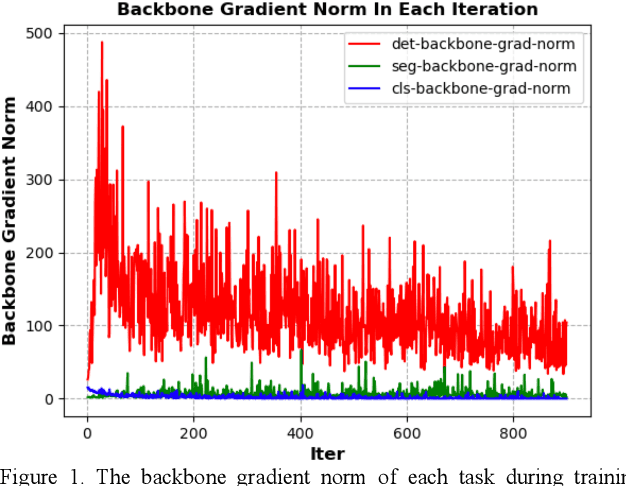
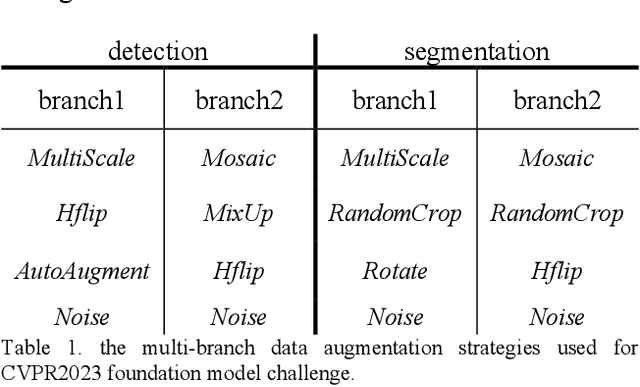
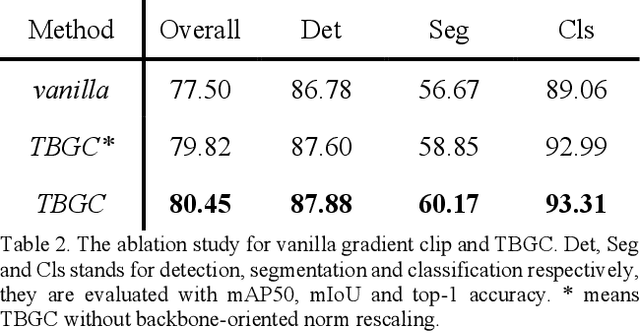
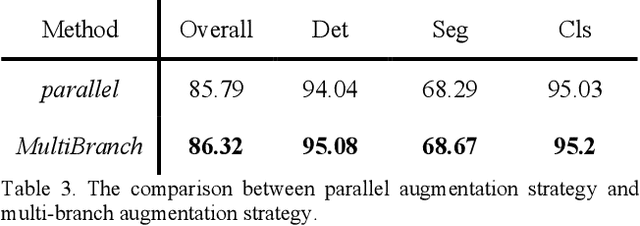
The AllInOne training paradigm squeezes a wide range of tasks into a unified model in a multi-task learning manner. However, optimization in multi-task learning is more challenge than single-task learning, as the gradient norm from different tasks may vary greatly, making the backbone overly biased towards one specific task. To address this issue, we propose the task-level backbone-oriented gradient clip paradigm, compared with the vanilla gradient clip method, it has two points of emphasis:1) gradient clip is performed independently for each task. 2) backbone gradients generated from each task are rescaled to the same norm scale. Based on the experimental results, we argue that the task-level backbone-oriented gradient clip paradigm can relieve the gradient bias problem to some extent. We also propose a novel multi-branch data augmentation strategy where conflict augmentations are placed in different branches. Our approach has been shown to be effective and finally achieve 1st place in the Leaderboard A and 2nd place in the Leaderboard B of the CVPR2023 Foundation Model Challenge. It's worth noting that instead of evaluating all three tasks(detection, segmentation and fine-grained classification) in Leaderboard A, the segmentation task is not evaluated in Leaderboard B, in which our team has a huge advantage.
* Foundation Model Challenge@CVPR2023, Accepted by CVPR2023 Workshop