 Add to Chrome
 Add to Firefox
 Add to Edge
Sparsity-Aware Unlearning for Large Language Models
Jan 31, 2026
Large Language Models (LLMs) inevitably memorize sensitive information during training, posing significant privacy risks. Machine unlearning has emerged as a promising solution to selectively remove such information without full retraining. However, existing methods are designed for dense models and overlook model sparsification-an essential technique for efficient LLM deployment. We find that unlearning effectiveness degrades substantially on sparse models. Through empirical analysis, we reveal that this degradation occurs because existing unlearning methods require updating all parameters, yet sparsification prunes substantial weights to zero, fundamentally limiting the model's forgetting capacity. To address this challenge, we propose Sparsity-Aware Unlearning (SAU), which decouples unlearning from sparsification objectives through gradient masking that redirects updates to surviving weights, combined with importance-aware redistribution to compensate for pruned parameters. Extensive experiments demonstrate that SAU significantly outperforms existing methods on sparse LLMs, achieving effective forgetting while preserving model utility.

Forget by Uncertainty: Orthogonal Entropy Unlearning for Quantized Neural Networks
Jan 31, 2026The deployment of quantized neural networks on edge devices, combined with privacy regulations like GDPR, creates an urgent need for machine unlearning in quantized models. However, existing methods face critical challenges: they induce forgetting by training models to memorize incorrect labels, conflating forgetting with misremembering, and employ scalar gradient reweighting that cannot resolve directional conflicts between gradients. We propose OEU, a novel Orthogonal Entropy Unlearning framework with two key innovations: 1) Entropy-guided unlearning maximizes prediction uncertainty on forgotten data, achieving genuine forgetting rather than confident misprediction, and 2) Gradient orthogonal projection eliminates interference by projecting forgetting gradients onto the orthogonal complement of retain gradients, providing theoretical guarantees for utility preservation under first-order approximation. Extensive experiments demonstrate that OEU outperforms existing methods in both forgetting effectiveness and retain accuracy.
SAGE: Accelerating Vision-Language Models via Entropy-Guided Adaptive Speculative Decoding
Jan 31, 2026Speculative decoding has emerged as a promising approach to accelerate inference in vision-language models (VLMs) by enabling parallel verification of multiple draft tokens. However, existing methods rely on static tree structures that remain fixed throughout the decoding process, failing to adapt to the varying prediction difficulty across generation steps. This leads to suboptimal acceptance lengths and limited speedup. In this paper, we propose SAGE, a novel framework that dynamically adjusts the speculation tree structure based on real-time prediction uncertainty. Our key insight is that output entropy serves as a natural confidence indicator with strong temporal correlation across decoding steps. SAGE constructs deeper-narrower trees for high-confidence predictions to maximize speculation depth, and shallower-wider trees for uncertain predictions to diversify exploration. SAGE improves acceptance lengths and achieves faster acceleration compared to static tree baselines. Experiments on multiple benchmarks demonstrate the effectiveness of SAGE: without any loss in output quality, it delivers up to $3.36\times$ decoding speedup for LLaVA-OneVision-72B and $3.18\times$ for Qwen2.5-VL-72B.
Robust Machine Unlearning for Quantized Neural Networks via Adaptive Gradient Reweighting with Similar Labels
Mar 18, 2025Model quantization enables efficient deployment of deep neural networks on edge devices through low-bit parameter representation, yet raises critical challenges for implementing machine unlearning (MU) under data privacy regulations. Existing MU methods designed for full-precision models fail to address two fundamental limitations in quantized networks: 1) Noise amplification from label mismatch during data processing, and 2) Gradient imbalance between forgotten and retained data during training. These issues are exacerbated by quantized models' constrained parameter space and discrete optimization. We propose Q-MUL, the first dedicated unlearning framework for quantized models. Our method introduces two key innovations: 1) Similar Labels assignment replaces random labels with semantically consistent alternatives to minimize noise injection, and 2) Adaptive Gradient Reweighting dynamically aligns parameter update contributions from forgotten and retained data. Through systematic analysis of quantized model vulnerabilities, we establish theoretical foundations for these mechanisms. Extensive evaluations on benchmark datasets demonstrate Q-MUL's superiority over existing approaches.
JSCDS: A Core Data Selection Method with Jason-Shannon Divergence for Caries RGB Images-Efficient Learning
Jun 29, 2024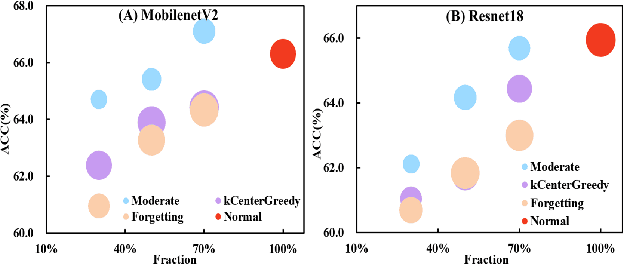
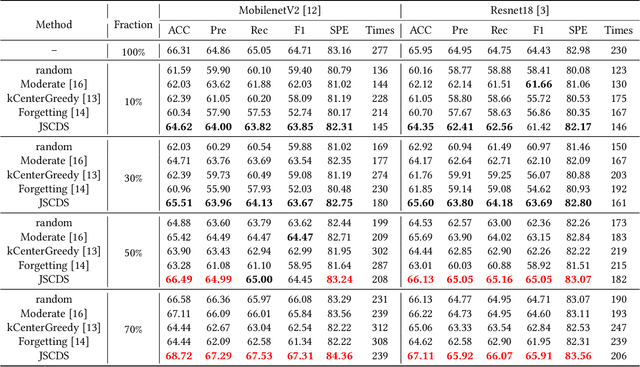
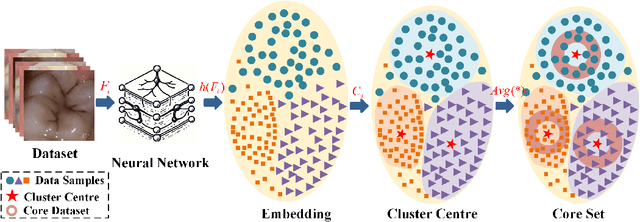
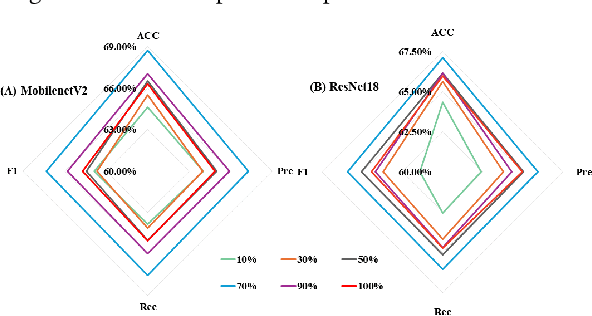
Deep learning-based RGB caries detection improves the efficiency of caries identification and is crucial for preventing oral diseases. The performance of deep learning models depends on high-quality data and requires substantial training resources, making efficient deployment challenging. Core data selection, by eliminating low-quality and confusing data, aims to enhance training efficiency without significantly compromising model performance. However, distance-based data selection methods struggle to distinguish dependencies among high-dimensional caries data. To address this issue, we propose a Core Data Selection Method with Jensen-Shannon Divergence (JSCDS) for efficient caries image learning and caries classification. We describe the core data selection criterion as the distribution of samples in different classes. JSCDS calculates the cluster centers by sample embedding representation in the caries classification network and utilizes Jensen-Shannon Divergence to compute the mutual information between data samples and cluster centers, capturing nonlinear dependencies among high-dimensional data. The average mutual information is calculated to fit the above distribution, serving as the criterion for constructing the core set for model training. Extensive experiments on RGB caries datasets show that JSCDS outperforms other data selection methods in prediction performance and time consumption. Notably, JSCDS exceeds the performance of the full dataset model with only 50% of the core data, with its performance advantage becoming more pronounced in the 70% of core data.