 Add to Chrome
 Add to Firefox
 Add to Edge
Lookahead-then-Verify: Reliable Constrained Decoding for Diffusion LLMs under Context-Free Grammars
Jan 31, 2026
Diffusion Large Language Models (dLLMs) have demonstrated promising generative capabilities and are increasingly used to produce formal languages defined by context-free grammars, such as source code and chemical expressions. However, as probabilistic models, they still struggle to generate syntactically valid outputs reliably. A natural and promising direction to address this issue is to adapt constrained decoding techniques to enforce grammatical correctness during generation. However, applying these techniques faces two primary obstacles. On the one hand, the non-autoregressive nature of dLLMs renders most existing constrained decoding approaches inapplicable. On the other hand, current approaches specifically designed for dLLMs may allow intermediate outputs that are impossible to complete into valid sentences, which significantly limits their reliability in practice. To address these challenges, we present LAVE, a constrained decoding approach specifically designed for dLLMs. Our approach leverages a key property of dLLMs, namely their ability to predict token distributions for all positions in parallel during each forward pass. Whenever a new token is proposed by model, LAVE performs lookahead using these distributions to efficiently and reliably verify the validity of the proposed token. This design ensures reliable constraints by reliably preserving the potential for intermediate outputs to be extended into valid sentences. Extensive experiments across four widely used dLLMs and three representative benchmarks demonstrate that LAVE consistently outperforms existing baselines and achieves substantial improvements in syntactic correctness, while incurring negligible runtime overhead.

Clear Nights Ahead: Towards Multi-Weather Nighttime Image Restoration
May 22, 2025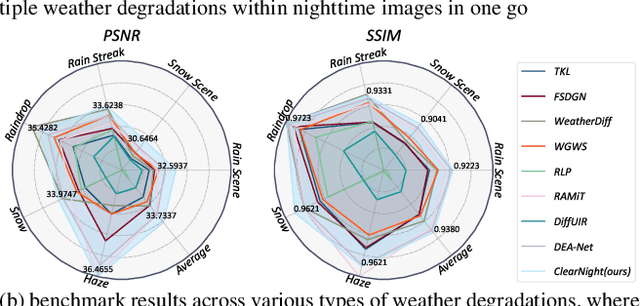
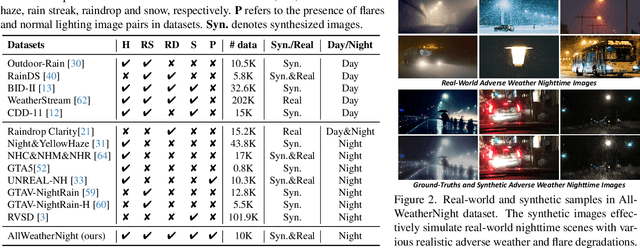

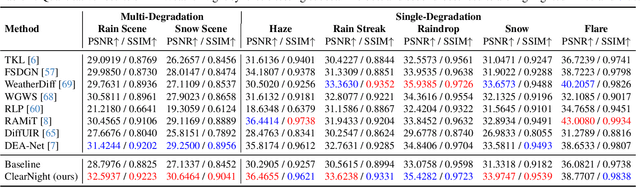
Restoring nighttime images affected by multiple adverse weather conditions is a practical yet under-explored research problem, as multiple weather conditions often coexist in the real world alongside various lighting effects at night. This paper first explores the challenging multi-weather nighttime image restoration task, where various types of weather degradations are intertwined with flare effects. To support the research, we contribute the AllWeatherNight dataset, featuring large-scale high-quality nighttime images with diverse compositional degradations, synthesized using our introduced illumination-aware degradation generation. Moreover, we present ClearNight, a unified nighttime image restoration framework, which effectively removes complex degradations in one go. Specifically, ClearNight extracts Retinex-based dual priors and explicitly guides the network to focus on uneven illumination regions and intrinsic texture contents respectively, thereby enhancing restoration effectiveness in nighttime scenarios. In order to better represent the common and unique characters of multiple weather degradations, we introduce a weather-aware dynamic specific-commonality collaboration method, which identifies weather degradations and adaptively selects optimal candidate units associated with specific weather types. Our ClearNight achieves state-of-the-art performance on both synthetic and real-world images. Comprehensive ablation experiments validate the necessity of AllWeatherNight dataset as well as the effectiveness of ClearNight. Project page: https://henlyta.github.io/ClearNight/mainpage.html
A new fuzzy multi-attribute group decision-making method based on TOPSIS and optimization models
Nov 27, 2023In this paper, a new method based on TOPSIS and optimization models is proposed for multi-attribute group decision-making in the environment of interval-valued intuitionistic fuzzy sets.Firstly, by minimizing the sum of differences between individual evaluations and the overallconsistent evaluations of all experts, a new optimization model is established for determining expert weights. Secondly, based on TOPSIS method, the improved closeness index for evaluating each alternative is obtained. Finally, the attribute weight is determined by establishing an optimization model with the goal of maximizing the closeness of each alternative, and it is brought into the closeness index so that the alternatives can be ranked. Combining all these together, the complete fuzzy multi-attribute group decision-making algorithm is formulated, which can give full play to the advantages of subjective and objective weighting methods. In the end, the feasibility and effectiveness of the provided method are verified by a real case study.