 Add to Chrome
 Add to Firefox
 Add to Edge
Adaptive Global and Fine-Grained Perceptual Fusion for MLLM Embeddings Compatible with Hard Negative Amplification
Feb 05, 2026
Multimodal embeddings serve as a bridge for aligning vision and language, with the two primary implementations -- CLIP-based and MLLM-based embedding models -- both limited to capturing only global semantic information. Although numerous studies have focused on fine-grained understanding, we observe that complex scenarios currently targeted by MLLM embeddings often involve a hybrid perceptual pattern of both global and fine-grained elements, thus necessitating a compatible fusion mechanism. In this paper, we propose Adaptive Global and Fine-grained perceptual Fusion for MLLM Embeddings (AGFF-Embed), a method that prompts the MLLM to generate multiple embeddings focusing on different dimensions of semantic information, which are then adaptively and smoothly aggregated. Furthermore, we adapt AGFF-Embed with the Explicit Gradient Amplification (EGA) technique to achieve in-batch hard negatives enhancement without requiring fine-grained editing of the dataset. Evaluation on the MMEB and MMVP-VLM benchmarks shows that AGFF-Embed comprehensively achieves state-of-the-art performance in both general and fine-grained understanding compared to other multimodal embedding models.

Strictly-ID-Preserved and Controllable Accessory Advertising Image Generation
Apr 07, 2024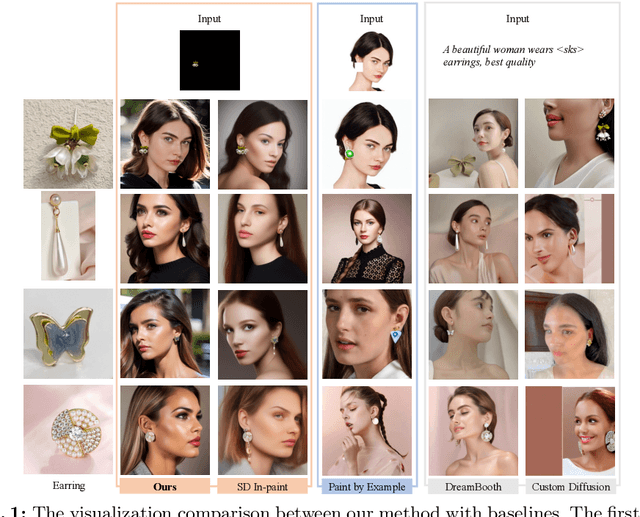
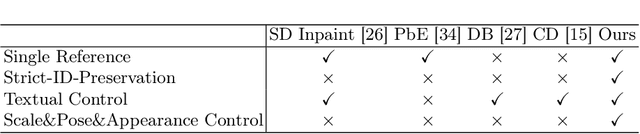
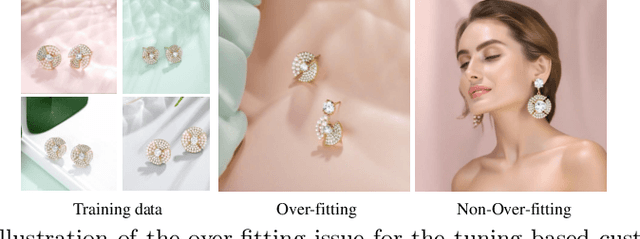
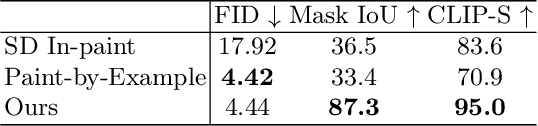
Customized generative text-to-image models have the ability to produce images that closely resemble a given subject. However, in the context of generating advertising images for e-commerce scenarios, it is crucial that the generated subject's identity aligns perfectly with the product being advertised. In order to address the need for strictly-ID preserved advertising image generation, we have developed a Control-Net based customized image generation pipeline and have taken earring model advertising as an example. Our approach facilitates a seamless interaction between the earrings and the model's face, while ensuring that the identity of the earrings remains intact. Furthermore, to achieve a diverse and controllable display, we have proposed a multi-branch cross-attention architecture, which allows for control over the scale, pose, and appearance of the model, going beyond the limitations of text prompts. Our method manages to achieve fine-grained control of the generated model's face, resulting in controllable and captivating advertising effects.