 Add to Chrome
 Add to Firefox
 Add to Edge
Length-Unbiased Sequence Policy Optimization: Revealing and Controlling Response Length Variation in RLVR
Feb 05, 2026
Recent applications of Reinforcement Learning with Verifiable Rewards (RLVR) to Large Language Models (LLMs) and Vision-Language Models (VLMs) have demonstrated significant success in enhancing reasoning capabilities for complex tasks. During RLVR training, an increase in response length is often regarded as a key factor contributing to the growth of reasoning ability. However, the patterns of change in response length vary significantly across different RLVR algorithms during the training process. To provide a fundamental explanation for these variations, this paper conducts an in-depth analysis of the components of mainstream RLVR algorithms. We present a theoretical analysis of the factors influencing response length and validate our theory through extensive experimentation. Building upon these theoretical findings, we propose the Length-Unbiased Sequence Policy Optimization (LUSPO) algorithm. Specifically, we rectify the length bias inherent in Group Sequence Policy Optimization (GSPO), rendering its loss function unbiased with respect to response length and thereby resolving the issue of response length collapse. We conduct extensive experiments across mathematical reasoning benchmarks and multimodal reasoning scenarios, where LUSPO consistently achieves superior performance. Empirical results demonstrate that LUSPO represents a novel, state-of-the-art optimization strategy compared to existing methods such as GRPO and GSPO.

Slow Perception: Let's Perceive Geometric Figures Step-by-step
Dec 30, 2024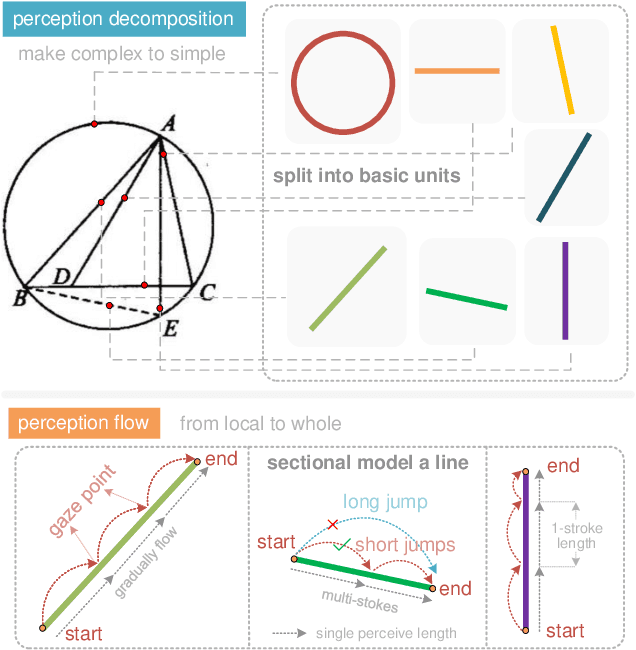
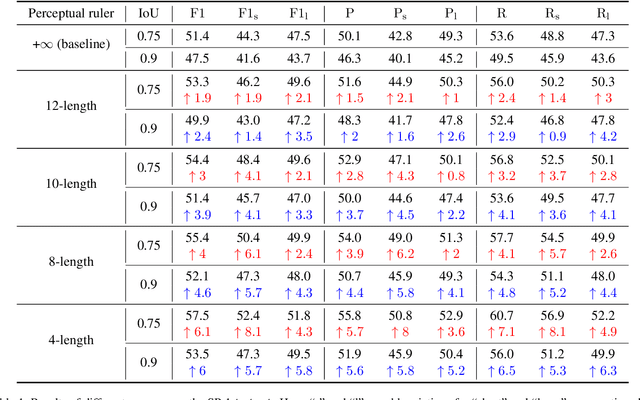
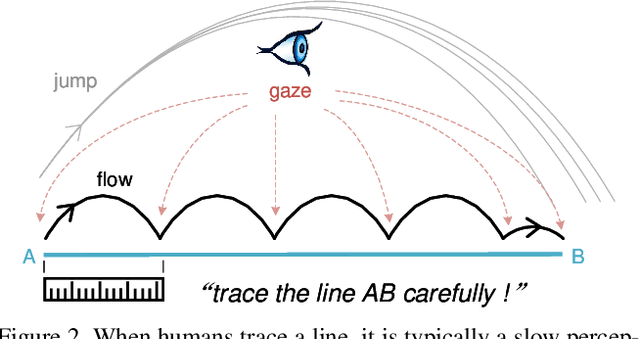
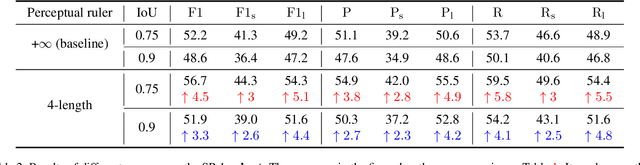
Recently, "visual o1" began to enter people's vision, with expectations that this slow-thinking design can solve visual reasoning tasks, especially geometric math problems. However, the reality is that current LVLMs (Large Vision Language Models) can hardly even accurately copy a geometric figure, let alone truly understand the complex inherent logic and spatial relationships within geometric shapes. We believe accurate copying (strong perception) is the first step to visual o1. Accordingly, we introduce the concept of "slow perception" (SP), which guides the model to gradually perceive basic point-line combinations, as our humans, reconstruct complex geometric structures progressively. There are two-fold stages in SP: a) perception decomposition. Perception is not instantaneous. In this stage, complex geometric figures are broken down into basic simple units to unify geometry representation. b) perception flow, which acknowledges that accurately tracing a line is not an easy task. This stage aims to avoid "long visual jumps" in regressing line segments by using a proposed "perceptual ruler" to trace each line stroke-by-stroke. Surprisingly, such a human-like perception manner enjoys an inference time scaling law -- the slower, the better. Researchers strive to speed up the model's perception in the past, but we slow it down again, allowing the model to read the image step-by-step and carefully.