 Add to Chrome
 Add to Firefox
 Add to Edge
CCR-Bench: A Comprehensive Benchmark for Evaluating LLMs on Complex Constraints, Control Flows, and Real-World Cases
Mar 09, 2026
Enhancing the ability of large language models (LLMs) to follow complex instructions is critical for their deployment in real-world applications. However, existing evaluation methods often oversimplify instruction complexity as a mere additive combination of atomic constraints, failing to adequately capture the high-dimensional complexity arising from the intricate interplay of content and format, logical workflow control, and real-world applications. This leads to a significant gap between current evaluation practices and practical demands. To bridge this gap, we introduce CCR-Bench, a novel benchmark designed to assess LLMs' adherence to complex instructions. CCR-Bench is characterized by: (1) deep entanglement of content and formatting requirements in task specifications; (2) instructions that involve intricate task decomposition, conditional reasoning, and procedural planning; and (3) evaluation samples derived entirely from real-world industrial scenarios. Extensive experiments on CCR-Bench demonstrate that even state-of-the-art models exhibit substantial performance deficiencies, clearly quantifying the gap between current LLM capabilities and the demands of realworld instruction understanding. We believe that CCR-Bench offers a more rigorous and realistic evaluation framework, advancing the development of LLMs toward the next generation of models capable of understanding and executing complex tasks in industrial applications.

Time-Annealed Perturbation Sampling: Diverse Generation for Diffusion Language Models
Jan 30, 2026Diffusion language models (Diffusion-LMs) introduce an explicit temporal dimension into text generation, yet how this structure can be leveraged to control generation diversity for exploring multiple valid semantic or reasoning paths remains underexplored. In this paper, we show that Diffusion-LMs, like diffusion models in image generation, exhibit a temporal division of labor: early denoising steps largely determine the global semantic structure, while later steps focus on local lexical refinement. Building on this insight, we propose Time-Annealed Perturbation Sampling (TAPS), a training-free inference strategy that encourages semantic branching early in the diffusion process while progressively reducing perturbations to preserve fluency and instruction adherence. TAPS is compatible with both non-autoregressive and semi-autoregressive Diffusion backbones, demonstrated on LLaDA and TraDo in our paper, and consistently improves output diversity across creative writing and reasoning benchmarks without compromising generation quality.
CaveAgent: Transforming LLMs into Stateful Runtime Operators
Jan 04, 2026LLM-based agents are increasingly capable of complex task execution, yet current agentic systems remain constrained by text-centric paradigms. Traditional approaches rely on procedural JSON-based function calling, which often struggles with long-horizon tasks due to fragile multi-turn dependencies and context drift. In this paper, we present CaveAgent, a framework that transforms the paradigm from "LLM-as-Text-Generator" to "LLM-as-Runtime-Operator." We introduce a Dual-stream Context Architecture that decouples state management into a lightweight semantic stream for reasoning and a persistent, deterministic Python Runtime stream for execution. In addition to leveraging code generation to efficiently resolve interdependent sub-tasks (e.g., loops, conditionals) in a single step, we introduce \textit{Stateful Runtime Management} in CaveAgent. Distinct from existing code-based approaches that remain text-bound and lack the support for external object injection and retrieval, CaveAgent injects, manipulates, and retrieves complex Python objects (e.g., DataFrames, database connections) that persist across turns. This persistence mechanism acts as a high-fidelity external memory to eliminate context drift, avoid catastrophic forgetting, while ensuring that processed data flows losslessly to downstream applications. Comprehensive evaluations on Tau$^2$-bench, BFCL and various case studies across representative SOTA LLMs demonstrate CaveAgent's superiority. Specifically, our framework achieves a 10.5\% success rate improvement on retail tasks and reduces total token consumption by 28.4\% in multi-turn scenarios. On data-intensive tasks, direct variable storage and retrieval reduces token consumption by 59\%, allowing CaveAgent to handle large-scale data that causes context overflow failures in both JSON-based and Code-based agents.
Overview of the Amphion Toolkit (v0.2)
Jan 26, 2025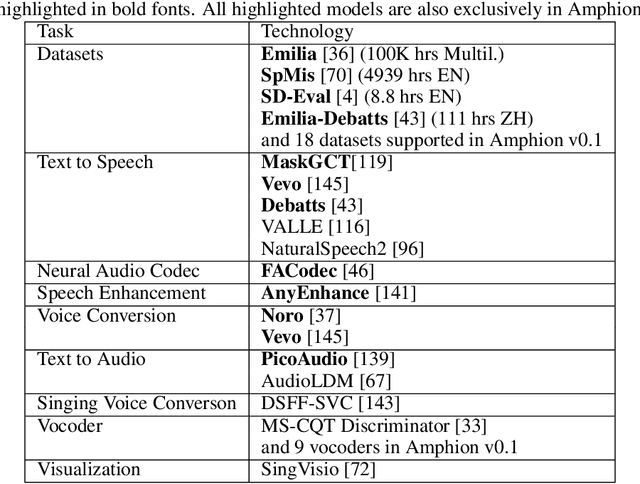
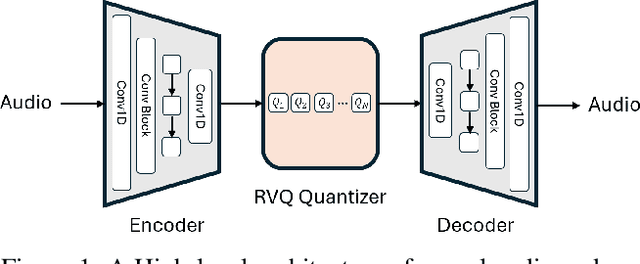
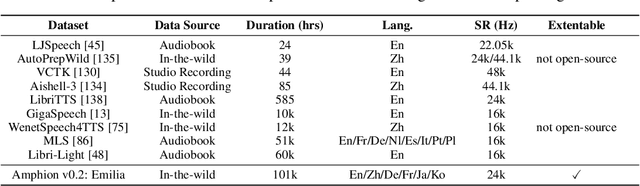
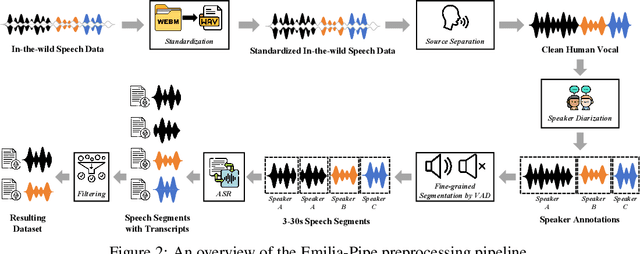
Amphion is an open-source toolkit for Audio, Music, and Speech Generation, designed to lower the entry barrier for junior researchers and engineers in these fields. It provides a versatile framework that supports a variety of generation tasks and models. In this report, we introduce Amphion v0.2, the second major release developed in 2024. This release features a 100K-hour open-source multilingual dataset, a robust data preparation pipeline, and novel models for tasks such as text-to-speech, audio coding, and voice conversion. Furthermore, the report includes multiple tutorials that guide users through the functionalities and usage of the newly released models.
Debatts: Zero-Shot Debating Text-to-Speech Synthesis
Nov 10, 2024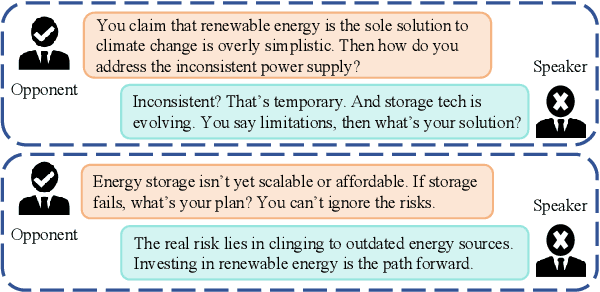
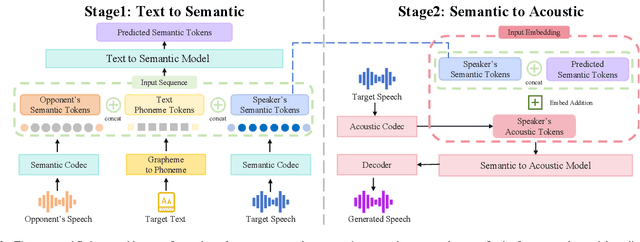
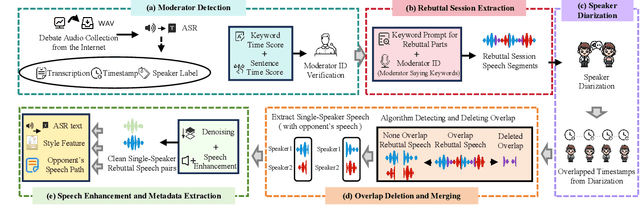
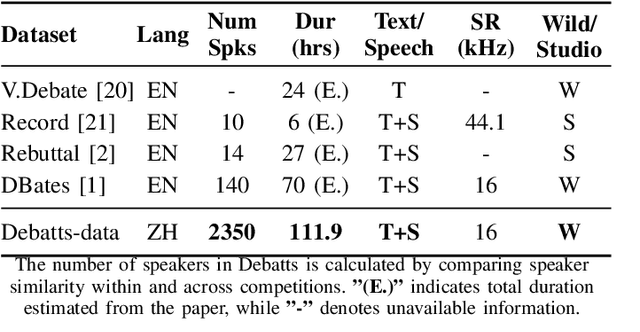
In debating, rebuttal is one of the most critical stages, where a speaker addresses the arguments presented by the opposing side. During this process, the speaker synthesizes their own persuasive articulation given the context from the opposing side. This work proposes a novel zero-shot text-to-speech synthesis system for rebuttal, namely Debatts. Debatts takes two speech prompts, one from the opposing side (i.e. opponent) and one from the speaker. The prompt from the opponent is supposed to provide debating style prosody, and the prompt from the speaker provides identity information. In particular, we pretrain the Debatts system from in-the-wild dataset, and integrate an additional reference encoder to take debating prompt for style. In addition, we also create a debating dataset to develop Debatts. In this setting, Debatts can generate a debating-style speech in rebuttal for any voices. Experimental results confirm the effectiveness of the proposed system in comparison with the classic zero-shot TTS systems.