 Add to Chrome
 Add to Firefox
 Add to Edge
Why Attention Patterns Exist: A Unifying Temporal Perspective Analysis
Jan 29, 2026
Attention patterns play a crucial role in both training and inference of large language models (LLMs). Prior works have identified individual patterns such as retrieval heads, sink heads, and diagonal traces, yet these observations remain fragmented and lack a unifying explanation. To bridge this gap, we introduce \textbf{Temporal Attention Pattern Predictability Analysis (TAPPA), a unifying framework that explains diverse attention patterns by analyzing their underlying mathematical formulations} from a temporally continuous perspective. TAPPA both deepens the understanding of attention behavior and guides inference acceleration approaches. Specifically, TAPPA characterizes attention patterns as predictable patterns with clear regularities and unpredictable patterns that appear effectively random. Our analysis further reveals that this distinction can be explained by the degree of query self-similarity along the temporal dimension. Focusing on the predictable patterns, we further provide a detailed mathematical analysis of three representative cases through the joint effect of queries, keys, and Rotary Positional Embeddings (RoPE). We validate TAPPA by applying its insights to KV cache compression and LLM pruning tasks. Across these tasks, a simple metric motivated by TAPPA consistently improves performance over baseline methods. The code is available at https://github.com/MIRALab-USTC/LLM-TAPPA.

A Circuit Domain Generalization Framework for Efficient Logic Synthesis in Chip Design
Aug 22, 2023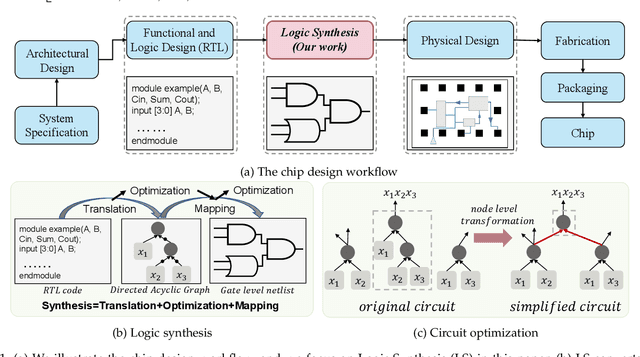
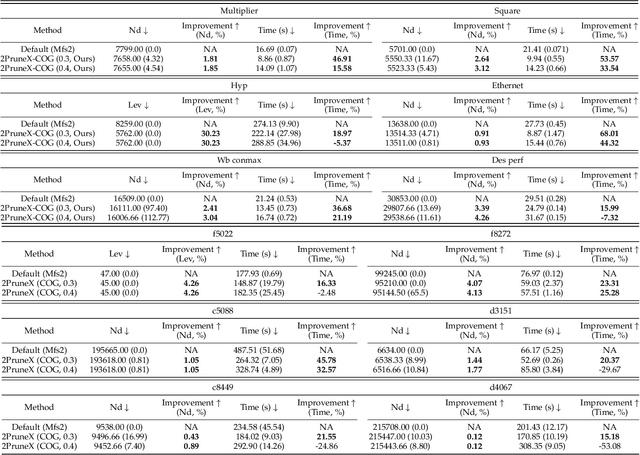
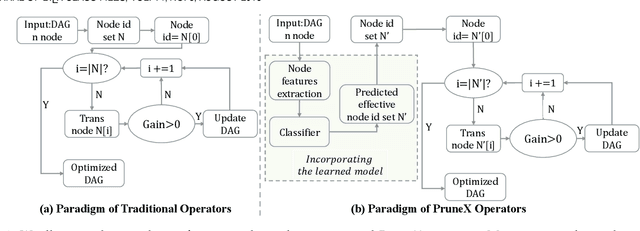
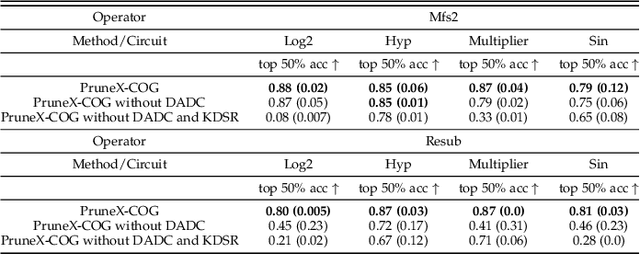
Logic Synthesis (LS) plays a vital role in chip design -- a cornerstone of the semiconductor industry. A key task in LS is to transform circuits -- modeled by directed acyclic graphs (DAGs) -- into simplified circuits with equivalent functionalities. To tackle this task, many LS operators apply transformations to subgraphs -- rooted at each node on an input DAG -- sequentially. However, we found that a large number of transformations are ineffective, which makes applying these operators highly time-consuming. In particular, we notice that the runtime of the Resub and Mfs2 operators often dominates the overall runtime of LS optimization processes. To address this challenge, we propose a novel data-driven LS operator paradigm, namely PruneX, to reduce ineffective transformations. The major challenge of developing PruneX is to learn models that well generalize to unseen circuits, i.e., the out-of-distribution (OOD) generalization problem. Thus, the major technical contribution of PruneX is the novel circuit domain generalization framework, which learns domain-invariant representations based on the transformation-invariant domain-knowledge. To the best of our knowledge, PruneX is the first approach to tackle the OOD problem in LS operators. We integrate PruneX with the aforementioned Resub and Mfs2 operators. Experiments demonstrate that PruneX significantly improves their efficiency while keeping comparable optimization performance on industrial and very large-scale circuits, achieving up to $3.1\times$ faster runtime.