 Add to Chrome
 Add to Firefox
 Add to Edge
The Llama 4 Herd: Architecture, Training, Evaluation, and Deployment Notes
Jan 15, 2026
This document consolidates publicly reported technical details about Metas Llama 4 model family. It summarizes (i) released variants (Scout and Maverick) and the broader herd context including the previewed Behemoth teacher model, (ii) architectural characteristics beyond a high-level MoE description covering routed/shared-expert structure, early-fusion multimodality, and long-context design elements reported for Scout (iRoPE and length generalization strategies), (iii) training disclosures spanning pre-training, mid-training for long-context extension, and post-training methodology (lightweight SFT, online RL, and lightweight DPO) as described in release materials, (iv) developer-reported benchmark results for both base and instruction-tuned checkpoints, and (v) practical deployment constraints observed across major serving environments, including provider-specific context limits and quantization packaging. The manuscript also summarizes licensing obligations relevant to redistribution and derivative naming, and reviews publicly described safeguards and evaluation practices. The goal is to provide a compact technical reference for researchers and practitioners who need precise, source-backed facts about Llama 4.

Inter-Level Cooperation in Hierarchical Reinforcement Learning
Dec 05, 2019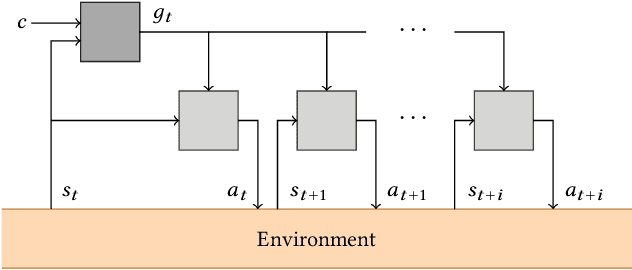
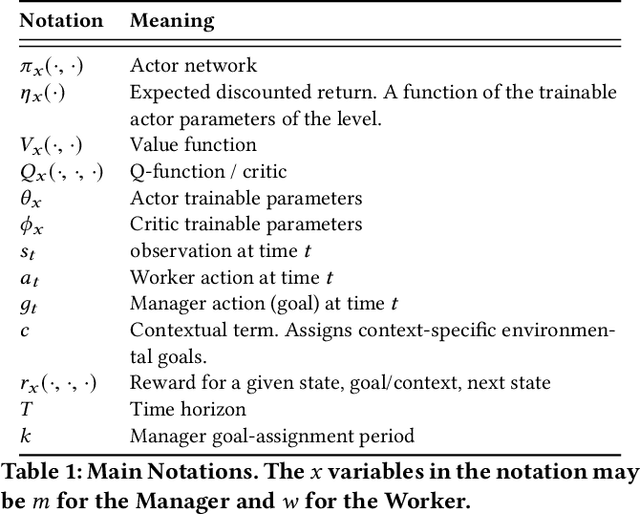


This article presents a novel algorithm for promoting cooperation between internal actors in a goal-conditioned hierarchical reinforcement learning (HRL) policy. Current techniques for HRL policy optimization treat the higher and lower level policies as separate entities which are trained to maximize different objective functions, rendering the HRL problem formulation more similar to a general sum game than a single-agent task. Within this setting, we hypothesize that improved cooperation between the internal agents of a hierarchy can simplify the credit assignment problem from the perspective of the high-level policies, thereby leading to significant improvements to training in situations where intricate sets of action primitives must be performed to yield improvements in performance. In order to promote cooperation within this setting, we propose the inclusion of a connected gradient term to the gradient computations of the higher level policies. Our method is demonstrated to achieve superior results to existing techniques in a set of difficult long time horizon tasks.