 Add to Chrome
 Add to Firefox
 Add to Edge
Smooth Operator: Smooth Verifiable Reward Activates Spatial Reasoning Ability of Vision-Language Model
Jan 12, 2026
Vision-Language Models (VLMs) face a critical bottleneck in achieving precise numerical prediction for 3D scene understanding. Traditional reinforcement learning (RL) approaches, primarily based on relative ranking, often suffer from severe reward sparsity and gradient instability, failing to effectively exploit the verifiable signals provided by 3D physical constraints. Notably, in standard GRPO frameworks, relative normalization causes "near-miss" samples (characterized by small but non-zero errors) to suffer from advantage collapse. This leads to a severe data utilization bottleneck where valuable boundary samples are discarded during optimization. To address this, we introduce the Smooth Numerical Reward Activation (SNRA) operator and the Absolute-Preserving GRPO (AP-GRPO) framework. SNRA employs a dynamically parameterized Sigmoid function to transform raw feedback into a dense, continuous reward continuum. Concurrently, AP-GRPO integrates absolute scalar gradients to mitigate the numerical information loss inherent in conventional relative-ranking mechanisms. By leveraging this approach, we constructed Numerical3D-50k, a dataset comprising 50,000 verifiable 3D subtasks. Empirical results indicate that AP-GRPO achieves performance parity with large-scale supervised methods while maintaining higher data efficiency, effectively activating latent 3D reasoning in VLMs without requiring architectural modifications.

Alt-MoE: Multimodal Alignment via Alternating Optimization of Multi-directional MoE with Unimodal Models
Sep 09, 2024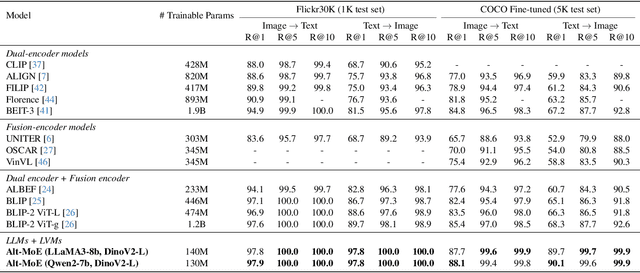
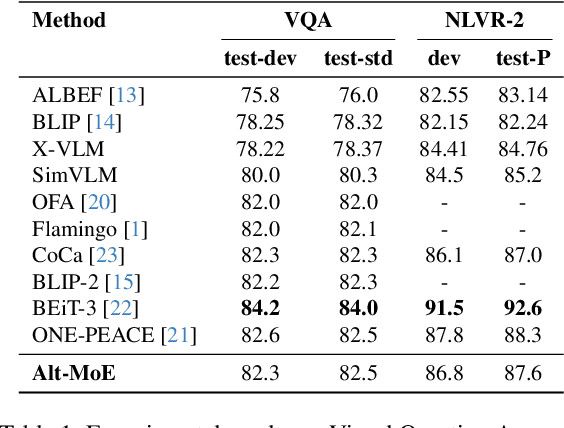
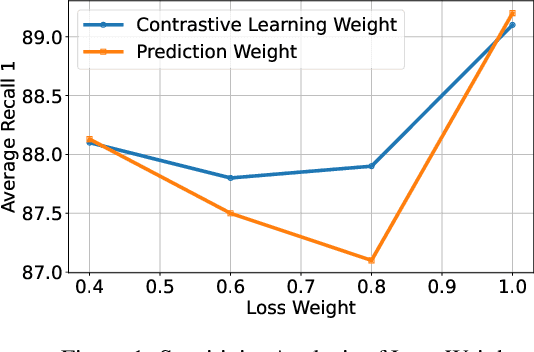
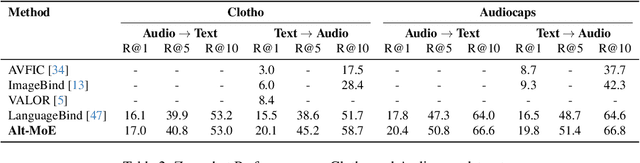
Recent Large Multi-Modal Models (LMMs) have made significant advancements in multi-modal alignment by employing lightweight connection modules to facilitate the representation and fusion of knowledge from existing pre-trained uni-modal models. However, these methods still rely on modality-specific and direction-specific connectors, leading to compartmentalized knowledge representations and reduced computational efficiency, which limits the model's ability to form unified multi-modal representations. To address these issues, we introduce a novel training framework, Alt-MoE, which employs the Mixture of Experts (MoE) as a unified multi-directional connector across modalities, and employs a multi-step sequential alternating unidirectional alignment strategy, which converges to bidirectional alignment over iterations. The extensive empirical studies revealed the following key points: 1) Alt-MoE achieves competitive results by integrating diverse knowledge representations from uni-modal models. This approach seamlessly fuses the specialized expertise of existing high-performance uni-modal models, effectively synthesizing their domain-specific knowledge into a cohesive multi-modal representation. 2) Alt-MoE efficiently scales to new tasks and modalities without altering its model architecture or training strategy. Furthermore, Alt-MoE operates in latent space, supporting vector pre-storage and real-time retrieval via lightweight multi-directional MoE, thereby facilitating massive data processing. Our methodology has been validated on several well-performing uni-modal models (LLAMA3, Qwen2, and DINOv2), achieving competitive results on a wide range of downstream tasks and datasets.