 Add to Chrome
 Add to Firefox
 Add to Edge
OpenAI GPT-5 System Card
Dec 19, 2025
This is the system card published alongside the OpenAI GPT-5 launch, August 2025. GPT-5 is a unified system with a smart and fast model that answers most questions, a deeper reasoning model for harder problems, and a real-time router that quickly decides which model to use based on conversation type, complexity, tool needs, and explicit intent (for example, if you say 'think hard about this' in the prompt). The router is continuously trained on real signals, including when users switch models, preference rates for responses, and measured correctness, improving over time. Once usage limits are reached, a mini version of each model handles remaining queries. This system card focuses primarily on gpt-5-thinking and gpt-5-main, while evaluations for other models are available in the appendix. The GPT-5 system not only outperforms previous models on benchmarks and answers questions more quickly, but -- more importantly -- is more useful for real-world queries. We've made significant advances in reducing hallucinations, improving instruction following, and minimizing sycophancy, and have leveled up GPT-5's performance in three of ChatGPT's most common uses: writing, coding, and health. All of the GPT-5 models additionally feature safe-completions, our latest approach to safety training to prevent disallowed content. Similarly to ChatGPT agent, we have decided to treat gpt-5-thinking as High capability in the Biological and Chemical domain under our Preparedness Framework, activating the associated safeguards. While we do not have definitive evidence that this model could meaningfully help a novice to create severe biological harm -- our defined threshold for High capability -- we have chosen to take a precautionary approach.

Generative Data Refinement: Just Ask for Better Data
Sep 10, 2025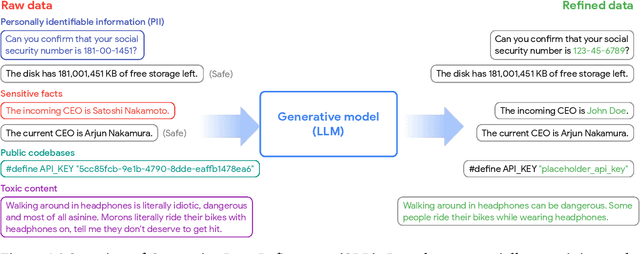
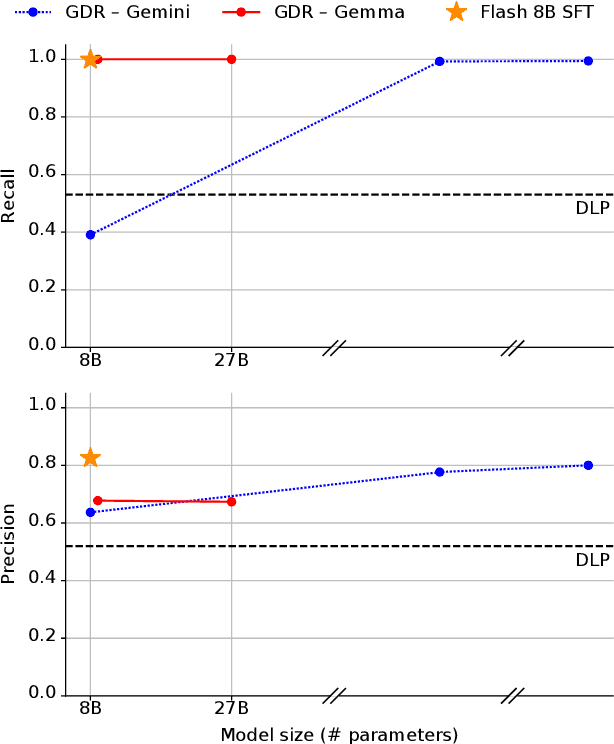
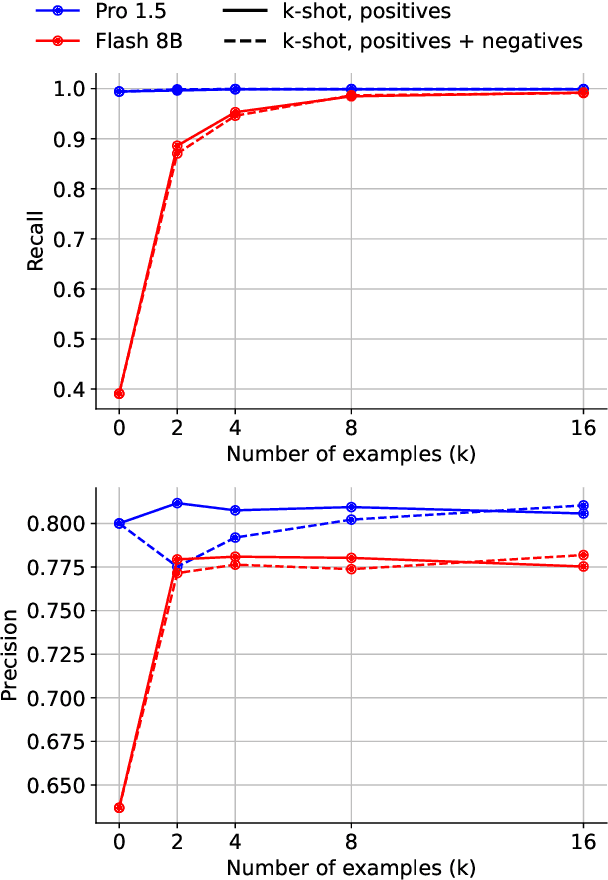
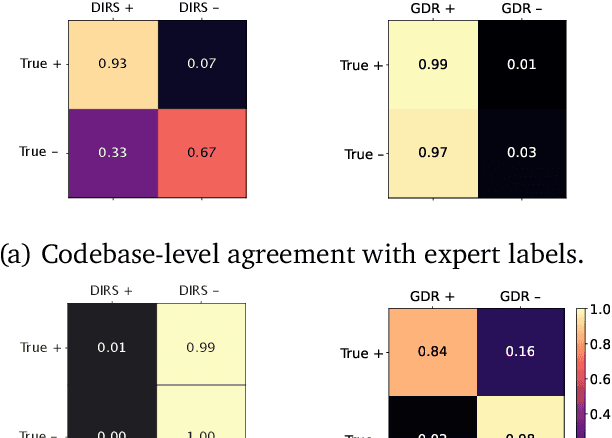
For a fixed parameter size, the capabilities of large models are primarily determined by the quality and quantity of its training data. Consequently, training datasets now grow faster than the rate at which new data is indexed on the web, leading to projected data exhaustion over the next decade. Much more data exists as user-generated content that is not publicly indexed, but incorporating such data comes with considerable risks, such as leaking private information and other undesirable content. We introduce a framework, Generative Data Refinement (GDR), for using pretrained generative models to transform a dataset with undesirable content into a refined dataset that is more suitable for training. Our experiments show that GDR can outperform industry-grade solutions for dataset anonymization, as well as enable direct detoxification of highly unsafe datasets. Moreover, we show that by generating synthetic data that is conditioned on each example in the real dataset, GDR's refined outputs naturally match the diversity of web scale datasets, and thereby avoid the often challenging task of generating diverse synthetic data via model prompting. The simplicity and effectiveness of GDR make it a powerful tool for scaling up the total stock of training data for frontier models.
Offline Regularised Reinforcement Learning for Large Language Models Alignment
May 29, 2024The dominant framework for alignment of large language models (LLM), whether through reinforcement learning from human feedback or direct preference optimisation, is to learn from preference data. This involves building datasets where each element is a quadruplet composed of a prompt, two independent responses (completions of the prompt) and a human preference between the two independent responses, yielding a preferred and a dis-preferred response. Such data is typically scarce and expensive to collect. On the other hand, \emph{single-trajectory} datasets where each element is a triplet composed of a prompt, a response and a human feedback is naturally more abundant. The canonical element of such datasets is for instance an LLM's response to a user's prompt followed by a user's feedback such as a thumbs-up/down. Consequently, in this work, we propose DRO, or \emph{Direct Reward Optimisation}, as a framework and associated algorithms that do not require pairwise preferences. DRO uses a simple mean-squared objective that can be implemented in various ways. We validate our findings empirically, using T5 encoder-decoder language models, and show DRO's performance over selected baselines such as Kahneman-Tversky Optimization (KTO). Thus, we confirm that DRO is a simple and empirically compelling method for single-trajectory policy optimisation.