 Add to Chrome
 Add to Firefox
 Add to Edge
Less is more: Not all samples are effective for evaluation
Dec 22, 2025
The versatility of Large Language Models (LLMs) in vertical domains has spurred the development of numerous specialized evaluation benchmarks. However, these benchmarks often suffer from significant semantic redundancy and impose high computational costs during evaluation. Existing compression methods, such as tinyBenchmarks depend critically on correctness labels from multiple historical models evaluated on the full test set, making them inapplicable in cold-start scenarios, such as the introduction of a new task, domain, or model with no prior evaluation history. To address this limitation, we propose a history-free test set compression framework that requires no prior model performance data. Our method begins by fine-tuning a base LLM on a small amount of domain-specific data to internalize task-relevant semantics. It then generates high-level semantic embeddings for all original test samples using only their raw textual content. In this domain-adapted embedding space, we perform task-aware clustering and introduce a novel dataset X-ray mechanism that analyzes cluster geometry to dynamically calibrate the compression intensity based on the intrinsic redundancy of the benchmark. Experiments on professional-domain dataset, notably a large-scale 3GPP communications benchmark, demonstrate that our approach effectively identifies and removes redundant samples, reducing evaluation cost by over 90% while preserving high fidelity to the full benchmark.

A Quality-Centric Framework for Generic Deepfake Detection
Nov 08, 2024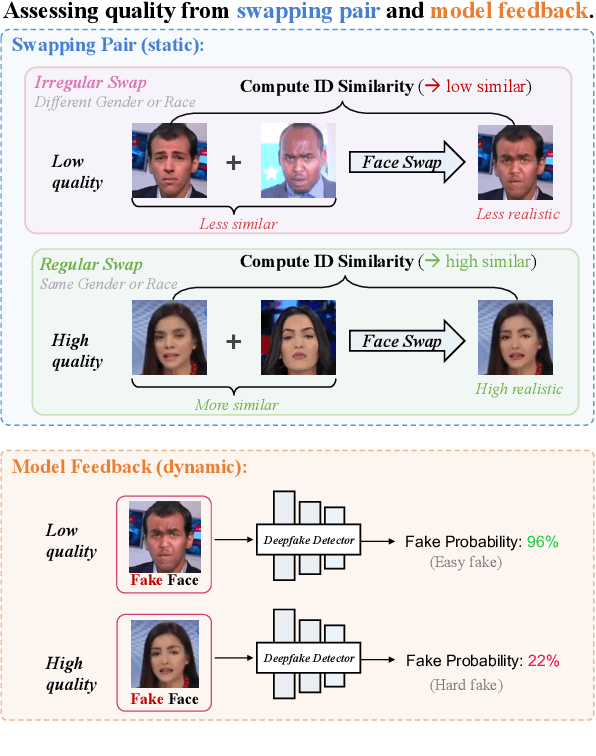
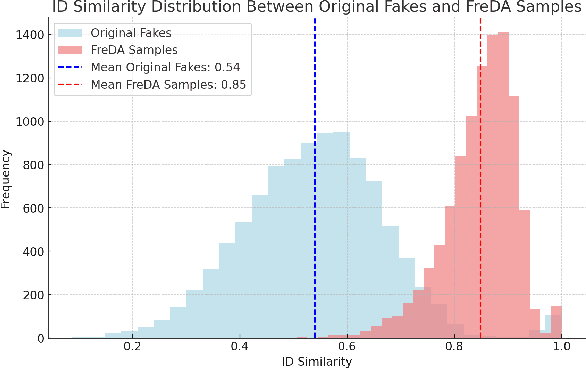
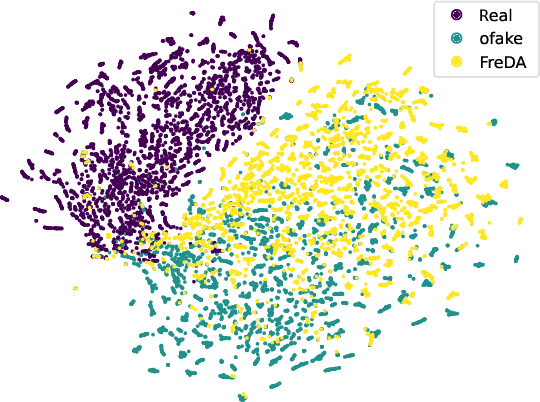
This paper addresses the generalization issue in deepfake detection by harnessing forgery quality in training data. Generally, the forgery quality of different deepfakes varies: some have easily recognizable forgery clues, while others are highly realistic. Existing works often train detectors on a mix of deepfakes with varying forgery qualities, potentially leading detectors to short-cut the easy-to-spot artifacts from low-quality forgery samples, thereby hurting generalization performance. To tackle this issue, we propose a novel quality-centric framework for generic deepfake detection, which is composed of a Quality Evaluator, a low-quality data enhancement module, and a learning pacing strategy that explicitly incorporates forgery quality into the training process. The framework is inspired by curriculum learning, which is designed to gradually enable the detector to learn more challenging deepfake samples, starting with easier samples and progressing to more realistic ones. We employ both static and dynamic assessments to assess the forgery quality, combining their scores to produce a final rating for each training sample. The rating score guides the selection of deepfake samples for training, with higher-rated samples having a higher probability of being chosen. Furthermore, we propose a novel frequency data augmentation method specifically designed for low-quality forgery samples, which helps to reduce obvious forgery traces and improve their overall realism. Extensive experiments show that our method can be applied in a plug-and-play manner and significantly enhance the generalization performance.
Towards General Deepfake Detection with Dynamic Curriculum
Oct 15, 2024Most previous deepfake detection methods bent their efforts to discriminate artifacts by end-to-end training. However, the learned networks often fail to mine the general face forgery information efficiently due to ignoring the data hardness. In this work, we propose to introduce the sample hardness into the training of deepfake detectors via the curriculum learning paradigm. Specifically, we present a novel simple yet effective strategy, named Dynamic Facial Forensic Curriculum (DFFC), which makes the model gradually focus on hard samples during the training. Firstly, we propose Dynamic Forensic Hardness (DFH) which integrates the facial quality score and instantaneous instance loss to dynamically measure sample hardness during the training. Furthermore, we present a pacing function to control the data subsets from easy to hard throughout the training process based on DFH. Comprehensive experiments show that DFFC can improve both within- and cross-dataset performance of various kinds of end-to-end deepfake detectors through a plug-and-play approach. It indicates that DFFC can help deepfake detectors learn general forgery discriminative features by effectively exploiting the information from hard samples.
Fake It till You Make It: Curricular Dynamic Forgery Augmentations towards General Deepfake Detection
Sep 22, 2024Previous studies in deepfake detection have shown promising results when testing face forgeries from the same dataset as the training. However, the problem remains challenging when one tries to generalize the detector to forgeries from unseen datasets and created by unseen methods. In this work, we present a novel general deepfake detection method, called \textbf{C}urricular \textbf{D}ynamic \textbf{F}orgery \textbf{A}ugmentation (CDFA), which jointly trains a deepfake detector with a forgery augmentation policy network. Unlike the previous works, we propose to progressively apply forgery augmentations following a monotonic curriculum during the training. We further propose a dynamic forgery searching strategy to select one suitable forgery augmentation operation for each image varying between training stages, producing a forgery augmentation policy optimized for better generalization. In addition, we propose a novel forgery augmentation named self-shifted blending image to simply imitate the temporal inconsistency of deepfake generation. Comprehensive experiments show that CDFA can significantly improve both cross-datasets and cross-manipulations performances of various naive deepfake detectors in a plug-and-play way, and make them attain superior performances over the existing methods in several benchmark datasets.