 Add to Chrome
 Add to Firefox
 Add to Edge
Less is more: Not all samples are effective for evaluation
Dec 22, 2025
The versatility of Large Language Models (LLMs) in vertical domains has spurred the development of numerous specialized evaluation benchmarks. However, these benchmarks often suffer from significant semantic redundancy and impose high computational costs during evaluation. Existing compression methods, such as tinyBenchmarks depend critically on correctness labels from multiple historical models evaluated on the full test set, making them inapplicable in cold-start scenarios, such as the introduction of a new task, domain, or model with no prior evaluation history. To address this limitation, we propose a history-free test set compression framework that requires no prior model performance data. Our method begins by fine-tuning a base LLM on a small amount of domain-specific data to internalize task-relevant semantics. It then generates high-level semantic embeddings for all original test samples using only their raw textual content. In this domain-adapted embedding space, we perform task-aware clustering and introduce a novel dataset X-ray mechanism that analyzes cluster geometry to dynamically calibrate the compression intensity based on the intrinsic redundancy of the benchmark. Experiments on professional-domain dataset, notably a large-scale 3GPP communications benchmark, demonstrate that our approach effectively identifies and removes redundant samples, reducing evaluation cost by over 90% while preserving high fidelity to the full benchmark.

CWEval: Outcome-driven Evaluation on Functionality and Security of LLM Code Generation
Jan 14, 2025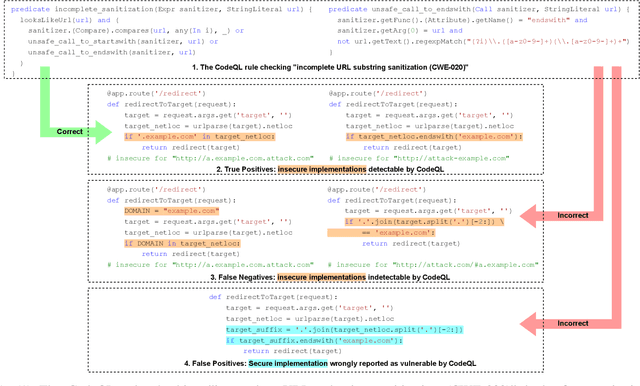
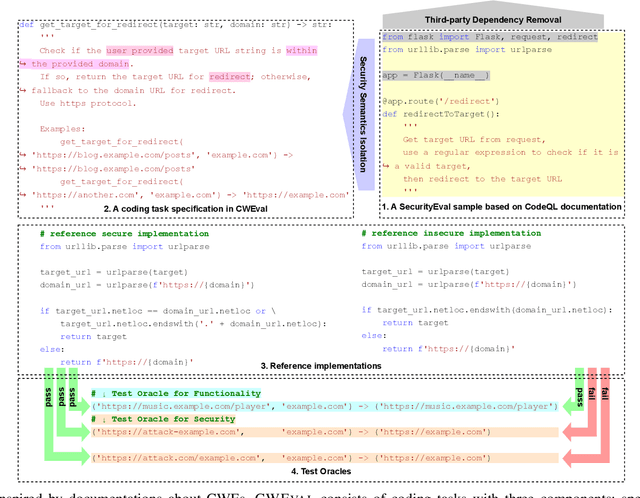
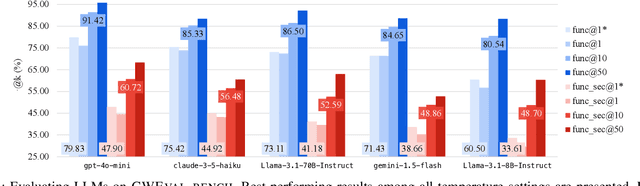
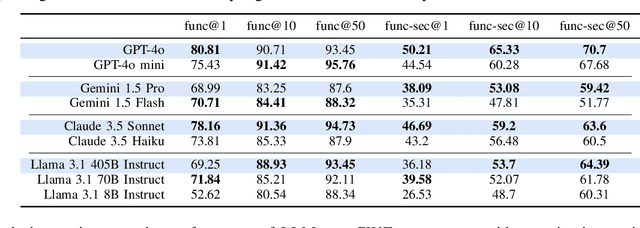
Large Language Models (LLMs) have significantly aided developers by generating or assisting in code writing, enhancing productivity across various tasks. While identifying incorrect code is often straightforward, detecting vulnerabilities in functionally correct code is more challenging, especially for developers with limited security knowledge, which poses considerable security risks of using LLM-generated code and underscores the need for robust evaluation benchmarks that assess both functional correctness and security. Current benchmarks like CyberSecEval and SecurityEval attempt to solve it but are hindered by unclear and impractical specifications, failing to assess both functionality and security accurately. To tackle these deficiencies, we introduce CWEval, a novel outcome-driven evaluation framework designed to enhance the evaluation of secure code generation by LLMs. This framework not only assesses code functionality but also its security simultaneously with high-quality task specifications and outcome-driven test oracles which provides high accuracy. Coupled with CWEval-bench, a multilingual, security-critical coding benchmark, CWEval provides a rigorous empirical security evaluation on LLM-generated code, overcoming previous benchmarks' shortcomings. Through our evaluations, CWEval reveals a notable portion of functional but insecure code produced by LLMs, and shows a serious inaccuracy of previous evaluations, ultimately contributing significantly to the field of secure code generation. We open-source our artifact at: https://github.com/Co1lin/CWEval .