 Add to Chrome
 Add to Firefox
 Add to Edge
DS-CIM: Digital Stochastic Computing-In-Memory Featuring Accurate OR-Accumulation via Sample Region Remapping for Edge AI Models
Jan 10, 2026
Stochastic computing (SC) offers hardware simplicity but suffers from low throughput, while high-throughput Digital Computing-in-Memory (DCIM) is bottlenecked by costly adder logic for matrix-vector multiplication (MVM). To address this trade-off, this paper introduces a digital stochastic CIM (DS-CIM) architecture that achieves both high accuracy and efficiency. We implement signed multiply-accumulation (MAC) in a compact, unsigned OR-based circuit by modifying the data representation. Throughput is enhanced by replicating this low-cost circuit 64 times with only a 1x area increase. Our core strategy, a shared Pseudo Random Number Generator (PRNG) with 2D partitioning, enables single-cycle mutually exclusive activation to eliminate OR-gate collisions. We also resolve the 1s saturation issue via stochastic process analysis and data remapping, significantly improving accuracy and resilience to input sparsity. Our high-accuracy DS-CIM1 variant achieves 94.45% accuracy for INT8 ResNet18 on CIFAR-10 with a root-mean-squared error (RMSE) of just 0.74%. Meanwhile, our high-efficiency DS-CIM2 variant attains an energy efficiency of 3566.1 TOPS/W and an area efficiency of 363.7 TOPS/mm^2, while maintaining a low RMSE of 3.81%. The DS-CIM capability with larger models is further demonstrated through experiments with INT8 ResNet50 on ImageNet and the FP8 LLaMA-7B model.

MetaPruning: Meta Learning for Automatic Neural Network Channel Pruning
Apr 03, 2019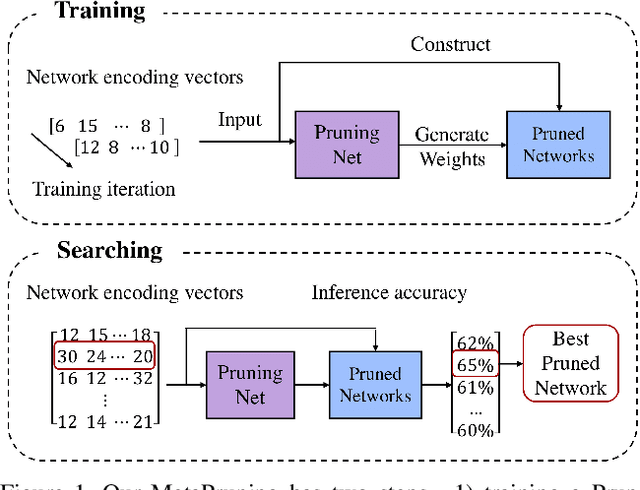
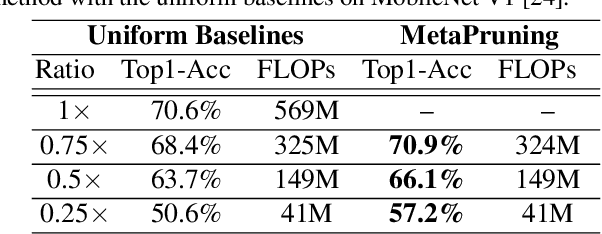
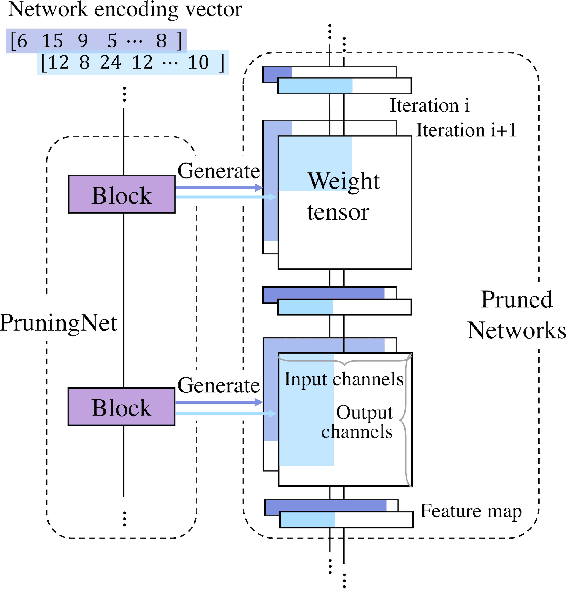
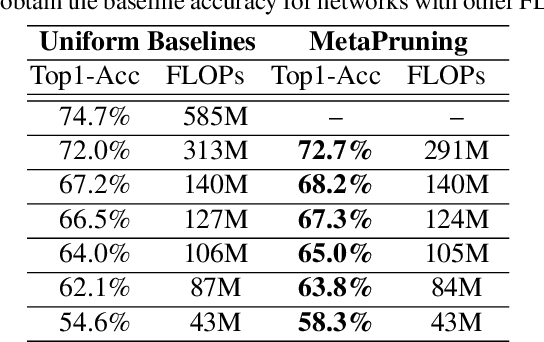
In this paper, we propose a novel meta learning approach for automatic channel pruning of very deep neural networks. We first train a PruningNet, a kind of meta network, which is able to generate weight parameters for any pruned structure given the target network. We use a simple stochastic structure sampling method for training the PruningNet. Then, we apply an evolutionary procedure to search for good-performing pruned networks. The search is highly efficient because the weights are directly generated by the trained PruningNet and we do not need any finetuning. With a single PruningNet trained for the target network, we can search for various Pruned Networks under different constraints with little human participation. We have demonstrated competitive performances on MobileNet V1/V2 networks, up to 9.0/9.9 higher ImageNet accuracy than V1/V2. Compared to the previous state-of-the-art AutoML-based pruning methods, like AMC and NetAdapt, we achieve higher or comparable accuracy under various conditions.