 Add to Chrome
 Add to Firefox
 Add to Edge
MiroThinker: Pushing the Performance Boundaries of Open-Source Research Agents via Model, Context, and Interactive Scaling
Nov 18, 2025
We present MiroThinker v1.0, an open-source research agent designed to advance tool-augmented reasoning and information-seeking capabilities. Unlike previous agents that only scale up model size or context length, MiroThinker explores interaction scaling at the model level, systematically training the model to handle deeper and more frequent agent-environment interactions as a third dimension of performance improvement. Unlike LLM test-time scaling, which operates in isolation and risks degradation with longer reasoning chains, interactive scaling leverages environment feedback and external information acquisition to correct errors and refine trajectories. Through reinforcement learning, the model achieves efficient interaction scaling: with a 256K context window, it can perform up to 600 tool calls per task, enabling sustained multi-turn reasoning and complex real-world research workflows. Across four representative benchmarks-GAIA, HLE, BrowseComp, and BrowseComp-ZH-the 72B variant achieves up to 81.9%, 37.7%, 47.1%, and 55.6% accuracy respectively, surpassing previous open-source agents and approaching commercial counterparts such as GPT-5-high. Our analysis reveals that MiroThinker benefits from interactive scaling consistently: research performance improves predictably as the model engages in deeper and more frequent agent-environment interactions, demonstrating that interaction depth exhibits scaling behaviors analogous to model size and context length. These findings establish interaction scaling as a third critical dimension for building next-generation open research agents, complementing model capacity and context windows.

Needle In A Multimodal Haystack
Jun 11, 2024With the rapid advancement of multimodal large language models (MLLMs), their evaluation has become increasingly comprehensive. However, understanding long multimodal content, as a foundational ability for real-world applications, remains underexplored. In this work, we present Needle In A Multimodal Haystack (MM-NIAH), the first benchmark specifically designed to systematically evaluate the capability of existing MLLMs to comprehend long multimodal documents. Our benchmark includes three types of evaluation tasks: multimodal retrieval, counting, and reasoning. In each task, the model is required to answer the questions according to different key information scattered throughout the given multimodal document. Evaluating the leading MLLMs on MM-NIAH, we observe that existing models still have significant room for improvement on these tasks, especially on vision-centric evaluation. We hope this work can provide a platform for further research on long multimodal document comprehension and contribute to the advancement of MLLMs. Code and benchmark are released at https://github.com/OpenGVLab/MM-NIAH.
The All-Seeing Project V2: Towards General Relation Comprehension of the Open World
Feb 29, 2024
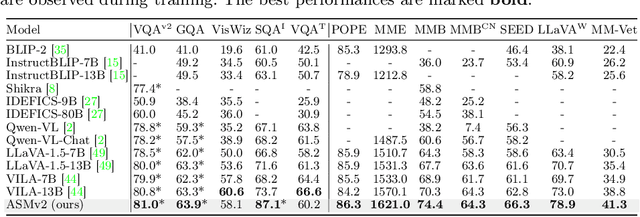
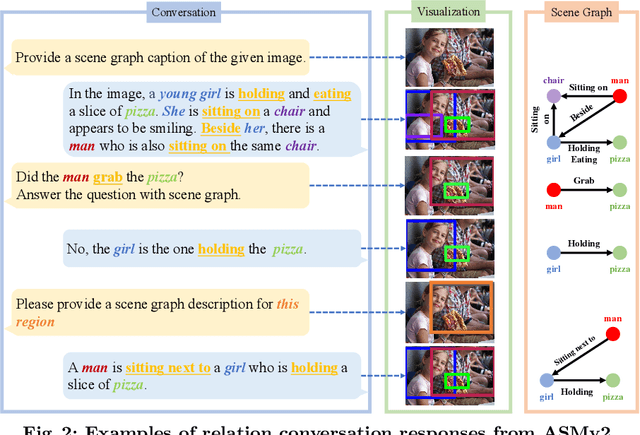
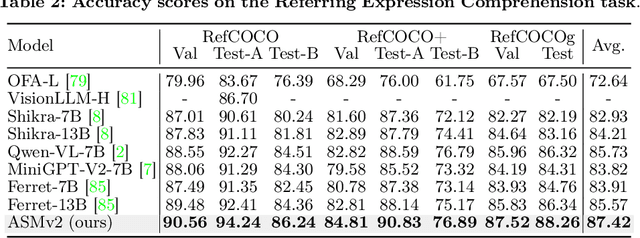
We present the All-Seeing Project V2: a new model and dataset designed for understanding object relations in images. Specifically, we propose the All-Seeing Model V2 (ASMv2) that integrates the formulation of text generation, object localization, and relation comprehension into a relation conversation (ReC) task. Leveraging this unified task, our model excels not only in perceiving and recognizing all objects within the image but also in grasping the intricate relation graph between them, diminishing the relation hallucination often encountered by Multi-modal Large Language Models (MLLMs). To facilitate training and evaluation of MLLMs in relation understanding, we created the first high-quality ReC dataset ({AS-V2) which is aligned with the format of standard instruction tuning data. In addition, we design a new benchmark, termed Circular-based Relation Probing Evaluation (CRPE) for comprehensively evaluating the relation comprehension capabilities of MLLMs. Notably, our ASMv2 achieves an overall accuracy of 52.04 on this relation-aware benchmark, surpassing the 43.14 of LLaVA-1.5 by a large margin. We hope that our work can inspire more future research and contribute to the evolution towards artificial general intelligence. Our project is released at https://github.com/OpenGVLab/all-seeing.