 Add to Chrome
 Add to Firefox
 Add to Edge
ToolGate: Contract-Grounded and Verified Tool Execution for LLMs
Jan 08, 2026
Large Language Models (LLMs) augmented with external tools have demonstrated remarkable capabilities in complex reasoning tasks. However, existing frameworks rely heavily on natural language reasoning to determine when tools can be invoked and whether their results should be committed, lacking formal guarantees for logical safety and verifiability. We present \textbf{ToolGate}, a forward execution framework that provides logical safety guarantees and verifiable state evolution for LLM tool calling. ToolGate maintains an explicit symbolic state space as a typed key-value mapping representing trusted world information throughout the reasoning process. Each tool is formalized as a Hoare-style contract consisting of a precondition and a postcondition, where the precondition gates tool invocation by checking whether the current state satisfies the required conditions, and the postcondition determines whether the tool's result can be committed to update the state through runtime verification. Our approach guarantees that the symbolic state evolves only through verified tool executions, preventing invalid or hallucinated results from corrupting the world representation. Experimental validation demonstrates that ToolGate significantly improves the reliability and verifiability of tool-augmented LLM systems while maintaining competitive performance on complex multi-step reasoning tasks. This work establishes a foundation for building more trustworthy and debuggable AI systems that integrate language models with external tools.

NC2C: Automated Convexification of Generic Non-Convex Optimization Problems
Jan 08, 2026Non-convex optimization problems are pervasive across mathematical programming, engineering design, and scientific computing, often posing intractable challenges for traditional solvers due to their complex objective functions and constrained landscapes. To address the inefficiency of manual convexification and the over-reliance on expert knowledge, we propose NC2C, an LLM-based end-to-end automated framework designed to transform generic non-convex optimization problems into solvable convex forms using large language models. NC2C leverages LLMs' mathematical reasoning capabilities to autonomously detect non-convex components, select optimal convexification strategies, and generate rigorous convex equivalents. The framework integrates symbolic reasoning, adaptive transformation techniques, and iterative validation, equipped with error correction loops and feasibility domain correction mechanisms to ensure the robustness and validity of transformed problems. Experimental results on a diverse dataset of 100 generic non-convex problems demonstrate that NC2C achieves an 89.3\% execution rate and a 76\% success rate in producing feasible, high-quality convex transformations. This outperforms baseline methods by a significant margin, highlighting NC2C's ability to leverage LLMs for automated non-convex to convex transformation, reduce expert dependency, and enable efficient deployment of convex solvers for previously intractable optimization tasks.
MemDPT: Differential Privacy for Memory Efficient Language Models
Jun 16, 2024
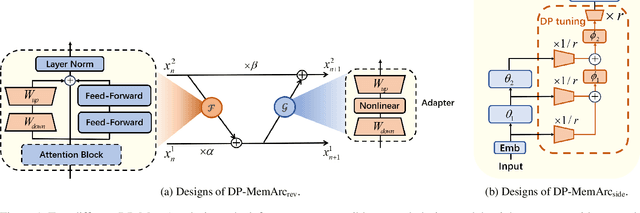
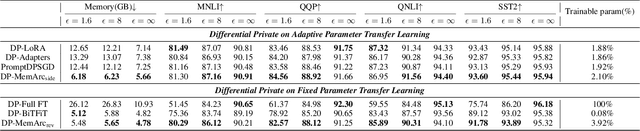
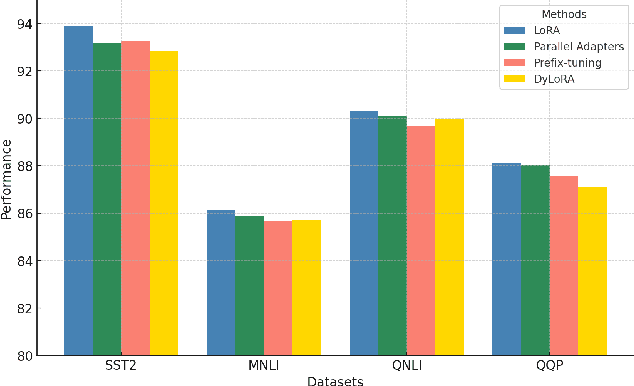
Large language models have consistently demonstrated remarkable performance across a wide spectrum of applications. Nonetheless, the deployment of these models can inadvertently expose user privacy to potential risks. The substantial memory demands of these models during training represent a significant resource consumption challenge. The sheer size of these models imposes a considerable burden on memory resources, which is a matter of significant concern in practice. In this paper, we present an innovative training framework MemDPT that not only reduces the memory cost of large language models but also places a strong emphasis on safeguarding user data privacy. MemDPT provides edge network and reverse network designs to accommodate various differential privacy memory-efficient fine-tuning schemes. Our approach not only achieves $2 \sim 3 \times$ memory optimization but also provides robust privacy protection, ensuring that user data remains secure and confidential. Extensive experiments have demonstrated that MemDPT can effectively provide differential privacy efficient fine-tuning across various task scenarios.