 Add to Chrome
 Add to Firefox
 Add to Edge
When Domains Interact: Asymmetric and Order-Sensitive Cross-Domain Effects in Reinforcement Learning for Reasoning
Feb 01, 2026
Group Relative Policy Optimization (GRPO) has become a key technique for improving reasoning abilities in large language models, yet its behavior under different domain sequencing strategies is poorly understood. In particular, the impact of sequential (one domain at a time) versus mixed-domain (multiple domain at a time) training in GRPO has not been systematically studied. We provide the first systematic analysis of training-order effects across math, science, logic, and puzzle reasoning tasks. We found (1) single-domain generalization is highly asymmetric: training on other domains improves math reasoning by approximately 25\% accuracy, while yielding negligible transfer to logic and puzzle; (2) cross-domain interactions are highly order-dependent: training in the order math$\rightarrow$science achieves 83\% / 41\% accuracy on math / science, while reversing the order to science$\rightarrow$math degrades performance to 77\% / 25\%; (3) no single strategy is universally optimal in multi-domain training: sequential training favors math (up to 84\%), mixed training favors science and logic, and poor ordering can incur large performance gaps (from 70\% to 56\%). Overall, our findings demonstrate that GRPO under multi-domain settings exhibits pronounced asymmetry, order sensitivity, and strategy dependence, highlighting the necessity of domain-aware and order-aware training design.

Mid-Think: Training-Free Intermediate-Budget Reasoning via Token-Level Triggers
Jan 11, 2026Hybrid reasoning language models are commonly controlled through high-level Think/No-think instructions to regulate reasoning behavior, yet we found that such mode switching is largely driven by a small set of trigger tokens rather than the instructions themselves. Through attention analysis and controlled prompting experiments, we show that a leading ``Okay'' token induces reasoning behavior, while the newline pattern following ``</think>'' suppresses it. Based on this observation, we propose Mid-Think, a simple training-free prompting format that combines these triggers to achieve intermediate-budget reasoning, consistently outperforming fixed-token and prompt-based baselines in terms of the accuracy-length trade-off. Furthermore, applying Mid-Think to RL training after SFT reduces training time by approximately 15% while improving final performance of Qwen3-8B on AIME from 69.8% to 72.4% and on GPQA from 58.5% to 61.1%, demonstrating its effectiveness for both inference-time control and RL-based reasoning training.
Demystifying Hybrid Thinking: Can LLMs Truly Switch Between Think and No-Think?
Oct 14, 2025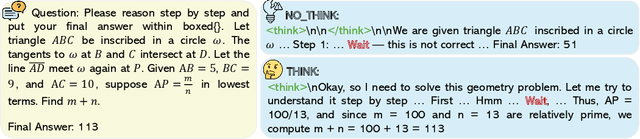
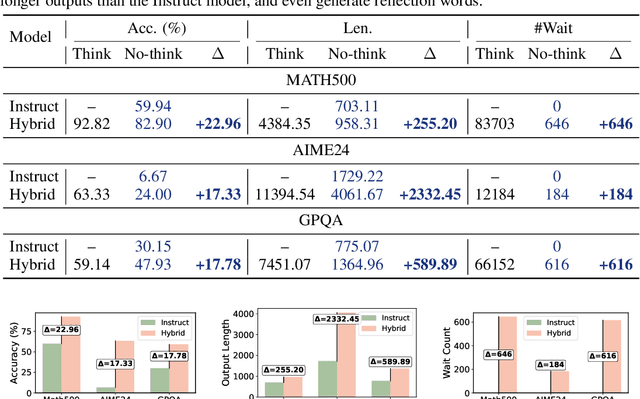
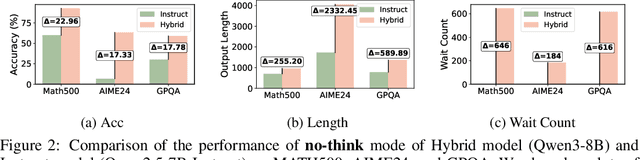
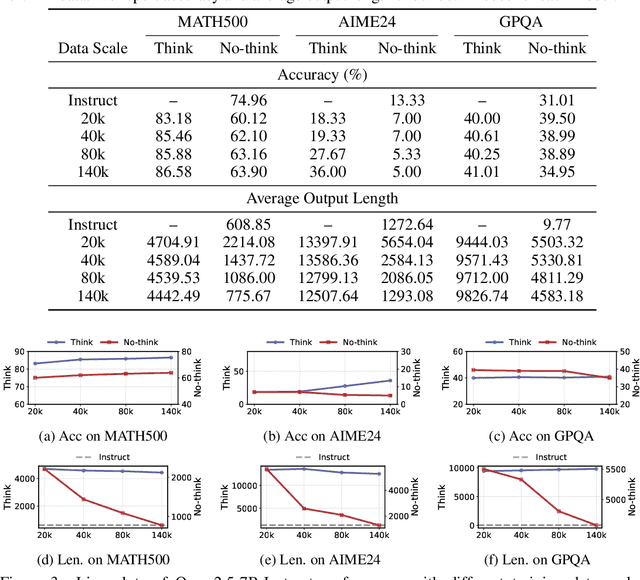
Hybrid thinking enables LLMs to switch between reasoning and direct answering, offering a balance between efficiency and reasoning capability. Yet our experiments reveal that current hybrid thinking LLMs only achieve partial mode separation: reasoning behaviors often leak into the no-think mode. To understand and mitigate this, we analyze the factors influencing controllability and identify four that matter most: (1) larger data scale, (2) using think and no-think answers from different questions rather than the same question, (3) a moderate increase in no-think data number, and (4) a two-phase strategy that first trains reasoning ability and then applies hybrid think training. Building on these findings, we propose a practical recipe that, compared to standard training, can maintain accuracy in both modes while significantly reducing no-think output length (from $1085$ to $585$ on MATH500) and occurrences of reasoning-supportive tokens such as ``\texttt{wait}'' (from $5917$ to $522$ on MATH500). Our findings highlight the limitations of current hybrid thinking and offer directions for strengthening its controllability.
Enhancing Player Enjoyment with a Two-Tier DRL and LLM-Based Agent System for Fighting Games
Apr 10, 2025Deep reinforcement learning (DRL) has effectively enhanced gameplay experiences and game design across various game genres. However, few studies on fighting game agents have focused explicitly on enhancing player enjoyment, a critical factor for both developers and players. To address this gap and establish a practical baseline for designing enjoyability-focused agents, we propose a two-tier agent (TTA) system and conducted experiments in the classic fighting game Street Fighter II. The first tier of TTA employs a task-oriented network architecture, modularized reward functions, and hybrid training to produce diverse and skilled DRL agents. In the second tier of TTA, a Large Language Model Hyper-Agent, leveraging players' playing data and feedback, dynamically selects suitable DRL opponents. In addition, we investigate and model several key factors that affect the enjoyability of the opponent. The experiments demonstrate improvements from 64. 36% to 156. 36% in the execution of advanced skills over baseline methods. The trained agents also exhibit distinct game-playing styles. Additionally, we conducted a small-scale user study, and the overall enjoyment in the player's feedback validates the effectiveness of our TTA system.