 Add to Chrome
 Add to Firefox
 Add to Edge
MMDeepResearch-Bench: A Benchmark for Multimodal Deep Research Agents
Jan 18, 2026
Deep Research Agents (DRAs) generate citation-rich reports via multi-step search and synthesis, yet existing benchmarks mainly target text-only settings or short-form multimodal QA, missing end-to-end multimodal evidence use. We introduce MMDeepResearch-Bench (MMDR-Bench), a benchmark of 140 expert-crafted tasks across 21 domains, where each task provides an image-text bundle to evaluate multimodal understanding and citation-grounded report generation. Compared to prior setups, MMDR-Bench emphasizes report-style synthesis with explicit evidence use, where models must connect visual artifacts to sourced claims and maintain consistency across narrative, citations, and visual references. We further propose a unified, interpretable evaluation pipeline: Formula-LLM Adaptive Evaluation (FLAE) for report quality, Trustworthy Retrieval-Aligned Citation Evaluation (TRACE) for citation-grounded evidence alignment, and Multimodal Support-Aligned Integrity Check (MOSAIC) for text-visual integrity, each producing fine-grained signals that support error diagnosis beyond a single overall score. Experiments across 25 state-of-the-art models reveal systematic trade-offs between generation quality, citation discipline, and multimodal grounding, highlighting that strong prose alone does not guarantee faithful evidence use and that multimodal integrity remains a key bottleneck for deep research agents.

Unsupervised Deep Unrolled Reconstruction Using Regularization by Denoising
May 07, 2022
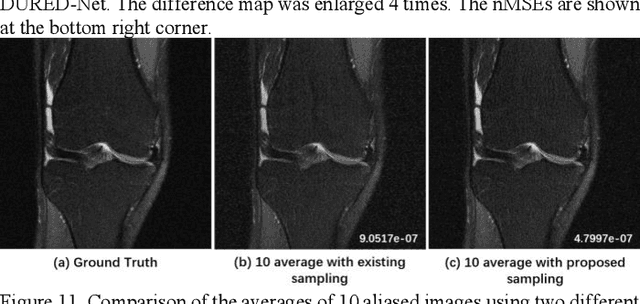


Deep learning methods have been successfully used in various computer vision tasks. Inspired by that success, deep learning has been explored in magnetic resonance imaging (MRI) reconstruction. In particular, integrating deep learning and model-based optimization methods has shown considerable advantages. However, a large amount of labeled training data is typically needed for high reconstruction quality, which is challenging for some MRI applications. In this paper, we propose a novel reconstruction method, named DURED-Net, that enables interpretable unsupervised learning for MR image reconstruction by combining an unsupervised denoising network and a plug-and-play method. We aim to boost the reconstruction performance of unsupervised learning by adding an explicit prior that utilizes imaging physics. Specifically, the leverage of a denoising network for MRI reconstruction is achieved using Regularization by Denoising (RED). Experiment results demonstrate that the proposed method requires a reduced amount of training data to achieve high reconstruction quality.