 Add to Chrome
 Add to Firefox
 Add to Edge
Beyond Forgetting: Machine Unlearning Elicits Controllable Side Behaviors and Capabilities
Jan 29, 2026
We consider representation misdirection (RM), a class of LLM unlearning methods that achieves forgetting by manipulating the forget-representations, that is, latent representations of forget samples. Despite being important, the roles of target vectors used in RM, however, remain underexplored. Here, we approach and revisit RM through the lens of the linear representation hypothesis. Specifically, if one can somehow identify a one-dimensional representation corresponding to a high-level concept, the linear representation hypothesis enables linear operations on this concept vector within the forget-representation space. Under this view, we hypothesize that, beyond forgetting, machine unlearning elicits controllable side behaviors and stronger side capabilities corresponding to the high-level concept. Our hypothesis is empirically validated across a wide range of tasks, including behavioral control (e.g., controlling unlearned models' truth, sentiment, and refusal) and capability enhancement (e.g., improving unlearned models' in-context learning capability). Our findings reveal that this fairly attractive phenomenon could be either a hidden risk if misused or a mechanism that can be harnessed for developing models that require stronger capabilities and controllable behaviors.

Improving Chain-of-Thought for Logical Reasoning via Attention-Aware Intervention
Jan 14, 2026Modern logical reasoning with LLMs primarily relies on employing complex interactive frameworks that decompose the reasoning process into subtasks solved through carefully designed prompts or requiring external resources (e.g., symbolic solvers) to exploit their strong logical structures. While interactive approaches introduce additional overhead, hybrid approaches depend on external components, which limit their scalability. A non-interactive, end-to-end framework enables reasoning to emerge within the model itself -- improving generalization while preserving analyzability without any external resources. In this work, we introduce a non-interactive, end-to-end framework for reasoning tasks. We show that introducing structural information into the few-shot prompt activates a subset of attention heads that patterns aligned with logical reasoning operators. Building on this insight, we propose Attention-Aware Intervention (AAI), an inference-time intervention method that reweights attention scores across selected heads identified by their logical patterns. AAI offers an efficient way to steer the model's reasoning toward leveraging prior knowledge through attention modulation. Extensive experiments show that AAI enhances logical reasoning performance across diverse benchmarks and model architectures, while incurring negligible additional computational overhead. Code is available at https://github.com/phuongnm94/aai_for_logical_reasoning.
Data Augmented Pipeline for Legal Information Extraction and Reasoning
Jan 09, 2026In this paper, we propose a pipeline leveraging Large Language Models (LLMs) for data augmentation in Information Extraction tasks within the legal domain. The proposed method is both simple and effective, significantly reducing the manual effort required for data annotation while enhancing the robustness of Information Extraction systems. Furthermore, the method is generalizable, making it applicable to various Natural Language Processing (NLP) tasks beyond the legal domain.
A Summary of the ALQAC 2021 Competition
Apr 25, 2022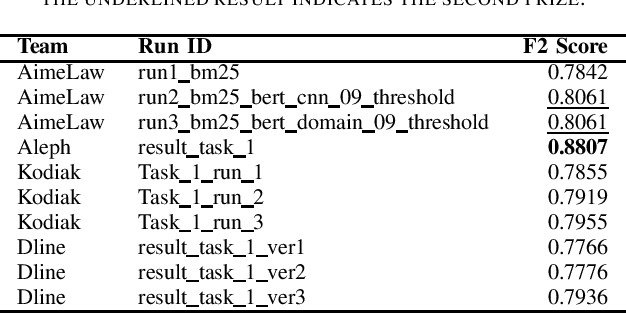
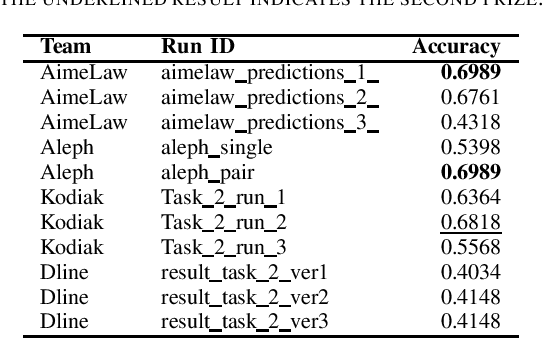
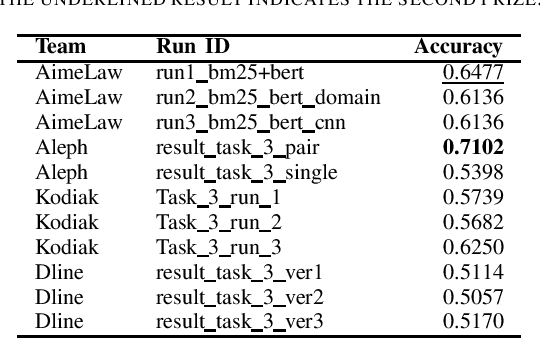
We summarize the evaluation of the first Automated Legal Question Answering Competition (ALQAC 2021). The competition this year contains three tasks, which aims at processing the statute law document, which are Legal Text Information Retrieval (Task 1), Legal Text Entailment Prediction (Task 2), and Legal Text Question Answering (Task 3). The final goal of these tasks is to build a system that can automatically determine whether a particular statement is lawful. There is no limit to the approaches of the participating teams. This year, there are 5 teams participating in Task 1, 6 teams participating in Task 2, and 5 teams participating in Task 3. There are in total 36 runs submitted to the organizer. In this paper, we summarize each team's approaches, official results, and some discussion about the competition. Only results of the teams who successfully submit their approach description paper are reported in this paper.