 Add to Chrome
 Add to Firefox
 Add to Edge
Beyond Forgetting: Machine Unlearning Elicits Controllable Side Behaviors and Capabilities
Jan 29, 2026
We consider representation misdirection (RM), a class of LLM unlearning methods that achieves forgetting by manipulating the forget-representations, that is, latent representations of forget samples. Despite being important, the roles of target vectors used in RM, however, remain underexplored. Here, we approach and revisit RM through the lens of the linear representation hypothesis. Specifically, if one can somehow identify a one-dimensional representation corresponding to a high-level concept, the linear representation hypothesis enables linear operations on this concept vector within the forget-representation space. Under this view, we hypothesize that, beyond forgetting, machine unlearning elicits controllable side behaviors and stronger side capabilities corresponding to the high-level concept. Our hypothesis is empirically validated across a wide range of tasks, including behavioral control (e.g., controlling unlearned models' truth, sentiment, and refusal) and capability enhancement (e.g., improving unlearned models' in-context learning capability). Our findings reveal that this fairly attractive phenomenon could be either a hidden risk if misused or a mechanism that can be harnessed for developing models that require stronger capabilities and controllable behaviors.

EquiHGNN: Scalable Rotationally Equivariant Hypergraph Neural Networks
May 08, 2025Molecular interactions often involve high-order relationships that cannot be fully captured by traditional graph-based models limited to pairwise connections. Hypergraphs naturally extend graphs by enabling multi-way interactions, making them well-suited for modeling complex molecular systems. In this work, we introduce EquiHGNN, an Equivariant HyperGraph Neural Network framework that integrates symmetry-aware representations to improve molecular modeling. By enforcing the equivariance under relevant transformation groups, our approach preserves geometric and topological properties, leading to more robust and physically meaningful representations. We examine a range of equivariant architectures and demonstrate that integrating symmetry constraints leads to notable performance gains on large-scale molecular datasets. Experiments on both small and large molecules show that high-order interactions offer limited benefits for small molecules but consistently outperform 2D graphs on larger ones. Adding geometric features to these high-order structures further improves the performance, emphasizing the value of spatial information in molecular learning. Our source code is available at https://github.com/HySonLab/EquiHGNN/
Multimodal Contrastive Representation Learning in Augmented Biomedical Knowledge Graphs
Jan 03, 2025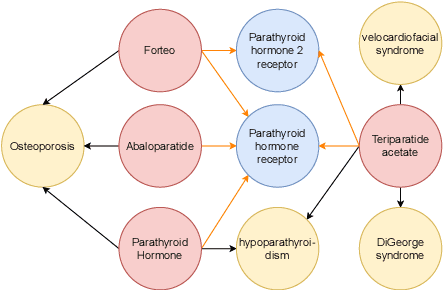

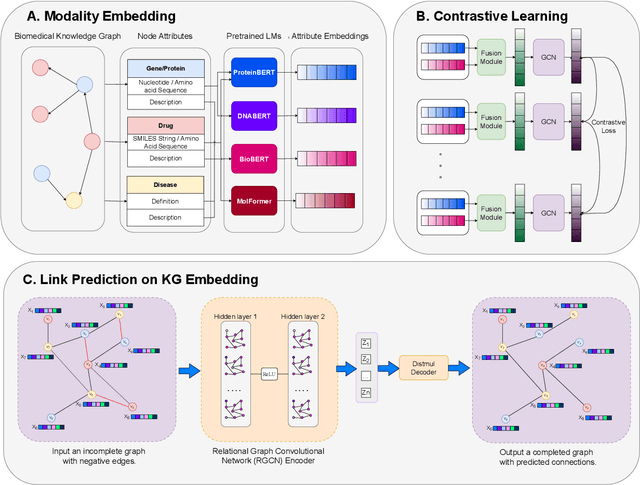
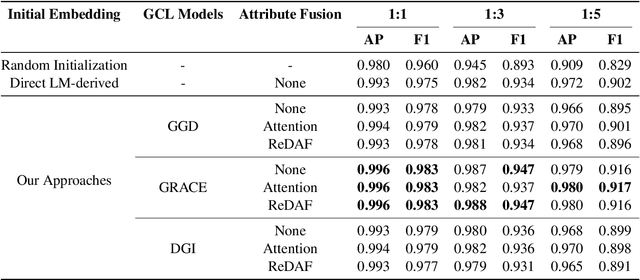
Biomedical Knowledge Graphs (BKGs) integrate diverse datasets to elucidate complex relationships within the biomedical field. Effective link prediction on these graphs can uncover valuable connections, such as potential novel drug-disease relations. We introduce a novel multimodal approach that unifies embeddings from specialized Language Models (LMs) with Graph Contrastive Learning (GCL) to enhance intra-entity relationships while employing a Knowledge Graph Embedding (KGE) model to capture inter-entity relationships for effective link prediction. To address limitations in existing BKGs, we present PrimeKG++, an enriched knowledge graph incorporating multimodal data, including biological sequences and textual descriptions for each entity type. By combining semantic and relational information in a unified representation, our approach demonstrates strong generalizability, enabling accurate link predictions even for unseen nodes. Experimental results on PrimeKG++ and the DrugBank drug-target interaction dataset demonstrate the effectiveness and robustness of our method across diverse biomedical datasets. Our source code, pre-trained models, and data are publicly available at https://github.com/HySonLab/BioMedKG