 Add to Chrome
 Add to Firefox
 Add to Edge
Unveiling Implicit Advantage Symmetry: Why GRPO Struggles with Exploration and Difficulty Adaptation
Feb 05, 2026
Reinforcement Learning with Verifiable Rewards (RLVR), particularly GRPO, has become the standard for eliciting LLM reasoning. However, its efficiency in exploration and difficulty adaptation remains an open challenge. In this work, we argue that these bottlenecks stem from an implicit advantage symmetry inherent in Group Relative Advantage Estimation (GRAE). This symmetry induces two critical limitations: (i) at the group level, strict symmetry in weights between correct and incorrect trajectories leaves unsampled action logits unchanged, thereby hindering exploration of novel correct solution. (ii) at the sample level, the algorithm implicitly prioritizes medium-difficulty samples, remaining agnostic to the non-stationary demands of difficulty focus. Through controlled experiments, we reveal that this symmetric property is sub-optimal, yielding two pivotal insights: (i) asymmetrically suppressing the advantages of correct trajectories encourages essential exploration. (ii) learning efficiency is maximized by a curriculum-like transition-prioritizing simpler samples initially before gradually shifting to complex ones. Motivated by these findings, we propose Asymmetric GRAE (A-GRAE), which dynamically modulates exploration incentives and sample-difficulty focus. Experiments across seven benchmarks demonstrate that A-GRAE consistently improves GRPO and its variants across both LLMs and MLLMs.

Boosting Overlapping Organoid Instance Segmentation Using Pseudo-Label Unmixing and Synthesis-Assisted Learning
Jan 10, 2026Organoids, sophisticated in vitro models of human tissues, are crucial for medical research due to their ability to simulate organ functions and assess drug responses accurately. Accurate organoid instance segmentation is critical for quantifying their dynamic behaviors, yet remains profoundly limited by high-quality annotated datasets and pervasive overlap in microscopy imaging. While semi-supervised learning (SSL) offers a solution to alleviate reliance on scarce labeled data, conventional SSL frameworks suffer from biases induced by noisy pseudo-labels, particularly in overlapping regions. Synthesis-assisted SSL (SA-SSL) has been proposed for mitigating training biases in semi-supervised semantic segmentation. We present the first adaptation of SA-SSL to organoid instance segmentation and reveal that SA-SSL struggles to disentangle intertwined organoids, often misrepresenting overlapping instances as a single entity. To overcome this, we propose Pseudo-Label Unmixing (PLU), which identifies erroneous pseudo-labels for overlapping instances and then regenerates organoid labels through instance decomposition. For image synthesis, we apply a contour-based approach to synthesize organoid instances efficiently, particularly for overlapping cases. Instance-level augmentations (IA) on pseudo-labels before image synthesis further enhances the effect of synthetic data (SD). Rigorous experiments on two organoid datasets demonstrate our method's effectiveness, achieving performance comparable to fully supervised models using only 10% labeled data, and state-of-the-art results. Ablation studies validate the contributions of PLU, contour-based synthesis, and augmentation-aware training. By addressing overlap at both pseudo-label and synthesis levels, our work advances scalable, label-efficient organoid analysis, unlocking new potential for high-throughput applications in precision medicine.
QSMnet-INR: Single-Orientation Quantitative Susceptibility Mapping via Implicit Neural Representation in k-Space
Dec 10, 2025Quantitative Susceptibility Mapping (QSM) quantifies tissue magnetic susceptibility from magnetic-resonance phase data and plays a crucial role in brain microstructure imaging, iron-deposition assessment, and neurological-disease research. However, single-orientation QSM inversion remains highly ill-posed because the dipole kernel exhibits a cone-null region in the Fourier domain, leading to streaking artifacts and structural loss. To overcome this limitation, we propose QSMnet-INR, a deep, physics-informed framework that integrates an Implicit Neural Representation (INR) into the k-space domain. The INR module continuously models multi-directional dipole responses and explicitly completes the cone-null region, while a frequency-domain residual-weighted Dipole Loss enforces physical consistency. The overall network combines a 3D U-Net-based QSMnet backbone with the INR module through alternating optimization for end-to-end joint training. Experiments on the 2016 QSM Reconstruction Challenge, a multi-orientation GRE dataset, and both in-house and public single-orientation clinical data demonstrate that QSMnet-INR consistently outperforms conventional and recent deep-learning approaches across multiple quantitative metrics. The proposed framework shows notable advantages in structural recovery within cone-null regions and in artifact suppression. Ablation studies further confirm the complementary contributions of the INR module and Dipole Loss to detail preservation and physical stability. Overall, QSMnet-INR effectively alleviates the ill-posedness of single-orientation QSM without requiring multi-orientation acquisition, achieving high accuracy, robustness, and strong cross-scenario generalization-highlighting its potential for clinical translation.
Functional Graph Contrastive Learning of Hyperscanning EEG Reveals Emotional Contagion Evoked by Stereotype-Based Stressors
Aug 22, 2023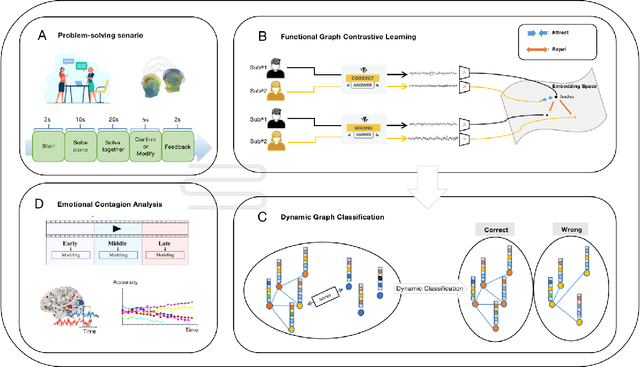

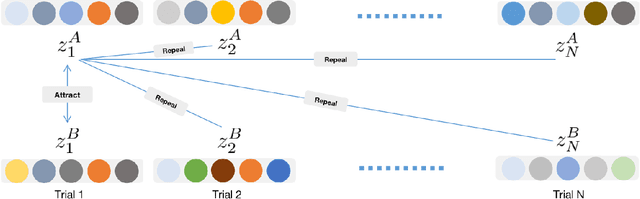

This study delves into the intricacies of emotional contagion and its impact on performance within dyadic interactions. Specifically, it focuses on the context of stereotype-based stress (SBS) during collaborative problem-solving tasks among female pairs. Through an exploration of emotional contagion, the research seeks to unveil its underlying mechanisms and effects. Leveraging EEG-based hyperscanning technology, the study introduces an innovative approach known as functional Graph Contrastive Learning (fGCL), which extracts subject-invariant representations of neural activity patterns. These representations are further subjected to analysis using the Dynamic Graph Classification (DGC) model, aimed at dissecting the process of emotional contagion. By scrutinizing brain synchronization and connectivity, the study reveals the intricate interplay between emotional contagion and cognitive functioning. The results underscore the substantial role of emotional contagion in shaping the trajectories of participants' performance during collaborative tasks in the presence of SBS conditions. Overall, this research contributes invaluable insights into the neural underpinnings of emotional contagion, thereby enriching our comprehension of the complexities underlying social interactions and emotional dynamics.