 Add to Chrome
 Add to Firefox
 Add to Edge
Unveiling Implicit Advantage Symmetry: Why GRPO Struggles with Exploration and Difficulty Adaptation
Feb 05, 2026
Reinforcement Learning with Verifiable Rewards (RLVR), particularly GRPO, has become the standard for eliciting LLM reasoning. However, its efficiency in exploration and difficulty adaptation remains an open challenge. In this work, we argue that these bottlenecks stem from an implicit advantage symmetry inherent in Group Relative Advantage Estimation (GRAE). This symmetry induces two critical limitations: (i) at the group level, strict symmetry in weights between correct and incorrect trajectories leaves unsampled action logits unchanged, thereby hindering exploration of novel correct solution. (ii) at the sample level, the algorithm implicitly prioritizes medium-difficulty samples, remaining agnostic to the non-stationary demands of difficulty focus. Through controlled experiments, we reveal that this symmetric property is sub-optimal, yielding two pivotal insights: (i) asymmetrically suppressing the advantages of correct trajectories encourages essential exploration. (ii) learning efficiency is maximized by a curriculum-like transition-prioritizing simpler samples initially before gradually shifting to complex ones. Motivated by these findings, we propose Asymmetric GRAE (A-GRAE), which dynamically modulates exploration incentives and sample-difficulty focus. Experiments across seven benchmarks demonstrate that A-GRAE consistently improves GRPO and its variants across both LLMs and MLLMs.

A Comprehensive Survey on Source-free Domain Adaptation
Feb 23, 2023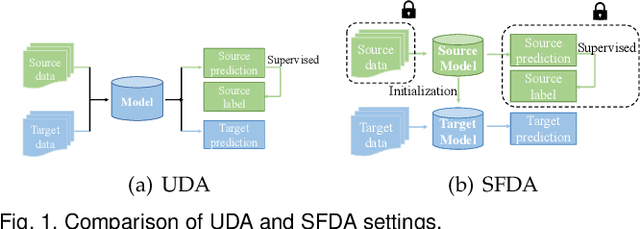
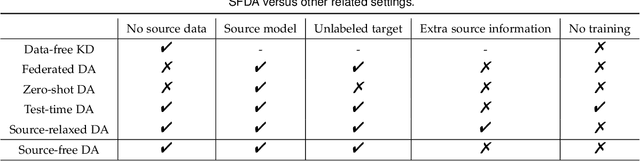
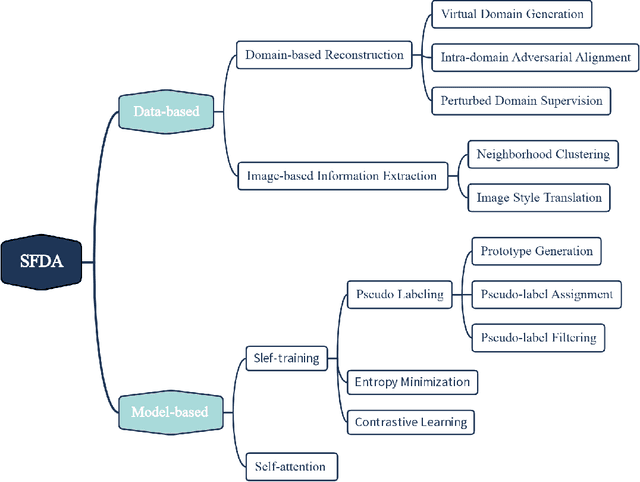
Over the past decade, domain adaptation has become a widely studied branch of transfer learning that aims to improve performance on target domains by leveraging knowledge from the source domain. Conventional domain adaptation methods often assume access to both source and target domain data simultaneously, which may not be feasible in real-world scenarios due to privacy and confidentiality concerns. As a result, the research of Source-Free Domain Adaptation (SFDA) has drawn growing attention in recent years, which only utilizes the source-trained model and unlabeled target data to adapt to the target domain. Despite the rapid explosion of SFDA work, yet there has no timely and comprehensive survey in the field. To fill this gap, we provide a comprehensive survey of recent advances in SFDA and organize them into a unified categorization scheme based on the framework of transfer learning. Instead of presenting each approach independently, we modularize several components of each method to more clearly illustrate their relationships and mechanics in light of the composite properties of each method. Furthermore, we compare the results of more than 30 representative SFDA methods on three popular classification benchmarks, namely Office-31, Office-home, and VisDA, to explore the effectiveness of various technical routes and the combination effects among them. Additionally, we briefly introduce the applications of SFDA and related fields. Drawing from our analysis of the challenges facing SFDA, we offer some insights into future research directions and potential settings.