 Add to Chrome
 Add to Firefox
 Add to Edge
Focus-dLLM: Accelerating Long-Context Diffusion LLM Inference via Confidence-Guided Context Focusing
Feb 02, 2026
Diffusion Large Language Models (dLLMs) deliver strong long-context processing capability in a non-autoregressive decoding paradigm. However, the considerable computational cost of bidirectional full attention limits the inference efficiency. Although sparse attention is promising, existing methods remain ineffective. This stems from the need to estimate attention importance for tokens yet to be decoded, while the unmasked token positions are unknown during diffusion. In this paper, we present Focus-dLLM, a novel training-free attention sparsification framework tailored for accurate and efficient long-context dLLM inference. Based on the finding that token confidence strongly correlates across adjacent steps, we first design a past confidence-guided indicator to predict unmasked regions. Built upon this, we propose a sink-aware pruning strategy to accurately estimate and remove redundant attention computation, while preserving highly influential attention sinks. To further reduce overhead, this strategy reuses identified sink locations across layers, leveraging the observed cross-layer consistency. Experimental results show that our method offers more than $29\times$ lossless speedup under $32K$ context length. The code is publicly available at: https://github.com/Longxmas/Focus-dLLM

SlimInfer: Accelerating Long-Context LLM Inference via Dynamic Token Pruning
Aug 08, 2025Long-context inference for Large Language Models (LLMs) is heavily limited by high computational demands. While several existing methods optimize attention computation, they still process the full set of hidden states at each layer, limiting overall efficiency. In this work, we propose SlimInfer, an innovative framework that aims to accelerate inference by directly pruning less critical prompt tokens during the forward pass. Our key insight is an information diffusion phenomenon: As information from critical tokens propagates through layers, it becomes distributed across the entire sequence. This diffusion process suggests that LLMs can maintain their semantic integrity when excessive tokens, even including these critical ones, are pruned in hidden states. Motivated by this, SlimInfer introduces a dynamic fine-grained pruning mechanism that accurately removes redundant tokens of hidden state at intermediate layers. This layer-wise pruning naturally enables an asynchronous KV cache manager that prefetches required token blocks without complex predictors, reducing both memory usage and I/O costs. Extensive experiments show that SlimInfer can achieve up to $\mathbf{2.53\times}$ time-to-first-token (TTFT) speedup and $\mathbf{1.88\times}$ end-to-end latency reduction for LLaMA3.1-8B-Instruct on a single RTX 4090, without sacrificing performance on LongBench. Our code will be released upon acceptance.
TinyFormer: Efficient Transformer Design and Deployment on Tiny Devices
Nov 03, 2023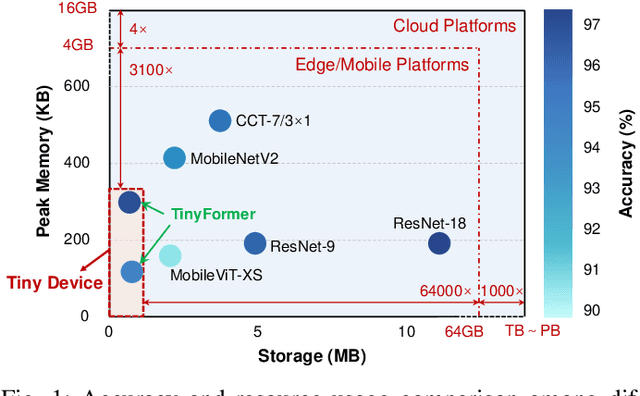
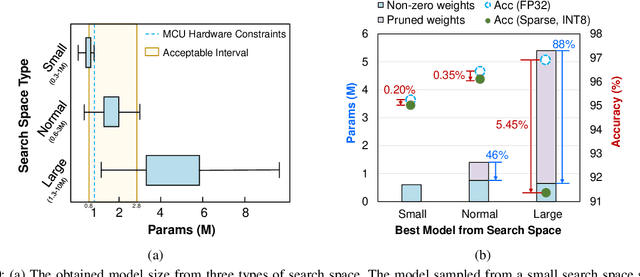
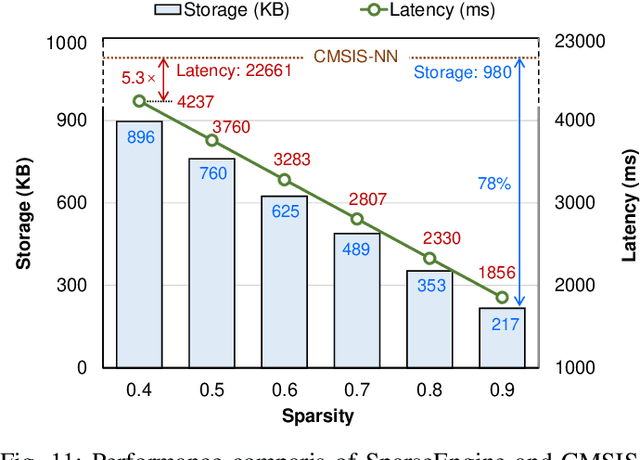
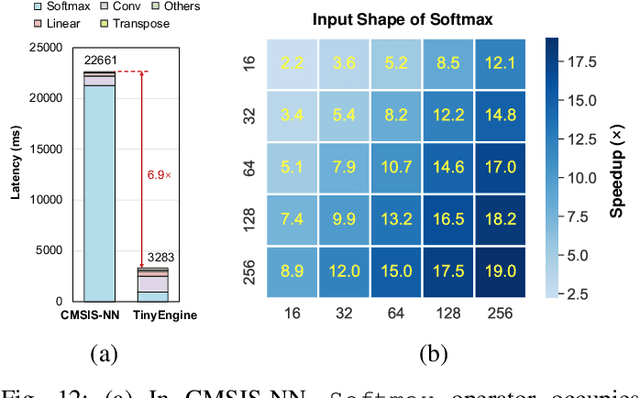
Developing deep learning models on tiny devices (e.g. Microcontroller units, MCUs) has attracted much attention in various embedded IoT applications. However, it is challenging to efficiently design and deploy recent advanced models (e.g. transformers) on tiny devices due to their severe hardware resource constraints. In this work, we propose TinyFormer, a framework specifically designed to develop and deploy resource-efficient transformers on MCUs. TinyFormer mainly consists of SuperNAS, SparseNAS and SparseEngine. Separately, SuperNAS aims to search for an appropriate supernet from a vast search space. SparseNAS evaluates the best sparse single-path model including transformer architecture from the identified supernet. Finally, SparseEngine efficiently deploys the searched sparse models onto MCUs. To the best of our knowledge, SparseEngine is the first deployment framework capable of performing inference of sparse models with transformer on MCUs. Evaluation results on the CIFAR-10 dataset demonstrate that TinyFormer can develop efficient transformers with an accuracy of $96.1\%$ while adhering to hardware constraints of $1$MB storage and $320$KB memory. Additionally, TinyFormer achieves significant speedups in sparse inference, up to $12.2\times$, when compared to the CMSIS-NN library. TinyFormer is believed to bring powerful transformers into TinyML scenarios and greatly expand the scope of deep learning applications.