 Add to Chrome
 Add to Firefox
 Add to Edge
A Practical Framework of Key Performance Indicators for Multi-Robot Lunar and Planetary Field Tests
Jan 28, 2026
Robotic prospecting for critical resources on the Moon, such as ilmenite, rare earth elements, and water ice, requires robust exploration methods given the diverse terrain and harsh environmental conditions. Although numerous analog field trials address these goals, comparing their results remains challenging because of differences in robot platforms and experimental setups. These missions typically assess performance using selected, scenario-specific engineering metrics that fail to establish a clear link between field performance and science-driven objectives. In this paper, we address this gap by deriving a structured framework of KPI from three realistic multi-robot lunar scenarios reflecting scientific objectives and operational constraints. Our framework emphasizes scenario-dependent priorities in efficiency, robustness, and precision, and is explicitly designed for practical applicability in field deployments. We validated the framework in a multi-robot field test and found it practical and easy to apply for efficiency- and robustness-related KPI, whereas precision-oriented KPI require reliable ground-truth data that is not always feasible to obtain in outdoor analog environments. Overall, we propose this framework as a common evaluation standard enabling consistent, goal-oriented comparison of multi-robot field trials and supporting systematic development of robotic systems for future planetary exploration.

Large-Scale Autonomous Gas Monitoring for Volcanic Environments: A Legged Robot on Mount Etna
Jan 12, 2026Volcanic gas emissions are key precursors of eruptive activity. Yet, obtaining accurate near-surface measurements remains hazardous and logistically challenging, motivating the need for autonomous solutions. Limited mobility in rough volcanic terrain has prevented wheeled systems from performing reliable in situ gas measurements, reducing their usefulness as sensing platforms. We present a legged robotic system for autonomous volcanic gas analysis, utilizing the quadruped ANYmal, equipped with a quadrupole mass spectrometer system. Our modular autonomy stack integrates a mission planning interface, global planner, localization framework, and terrain-aware local navigation. We evaluated the system on Mount Etna across three autonomous missions in varied terrain, achieving successful gas-source detections with autonomy rates of 93-100%. In addition, we conducted a teleoperated mission in which the robot measured natural fumaroles, detecting sulfur dioxide and carbon dioxide. We discuss lessons learned from the gas-analysis and autonomy perspectives, emphasizing the need for adaptive sensing strategies, tighter integration of global and local planning, and improved hardware design.
Multi-Objective Global Path Planning for Lunar Exploration With a Quadruped Robot
Jun 24, 2024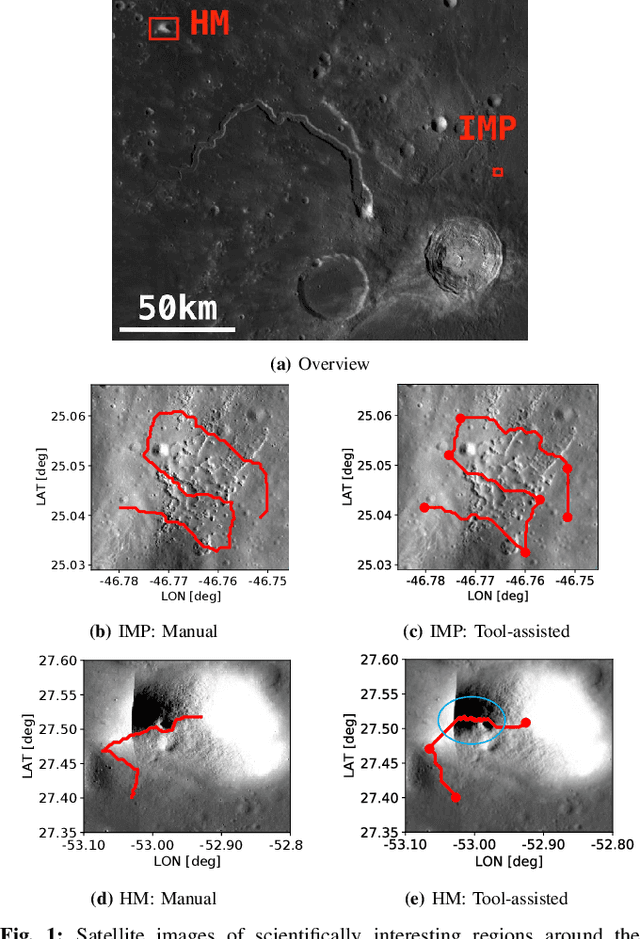
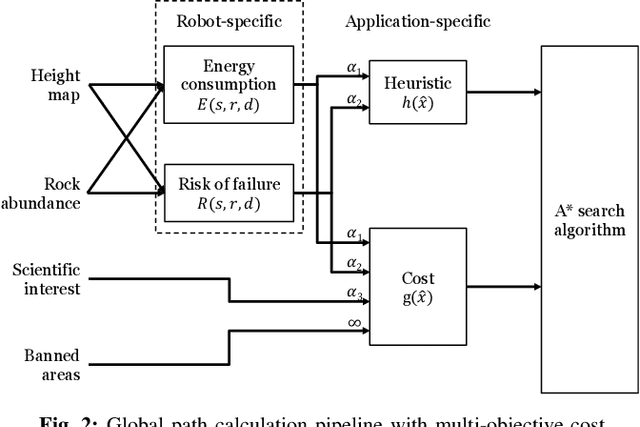
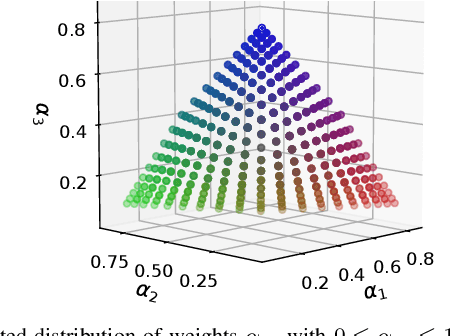
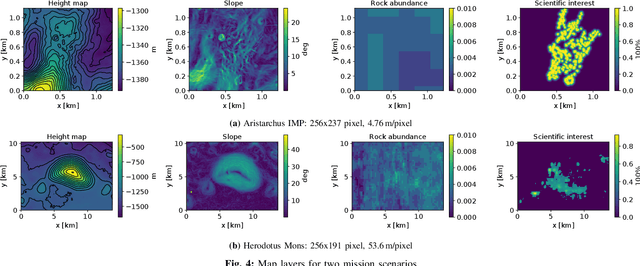
In unstructured environments the best path is not always the shortest, but needs to consider various objectives like energy efficiency, risk of failure or scientific outcome. This paper proposes a global planner, based on the A* algorithm, capable of individually considering multiple layers of map data for different cost objectives. We introduce weights between the objectives, which can be adapted to achieve a variety of optimal paths. In order to find the best of these paths, a tool for statistical path analysis is presented. Our planner was tested on exemplary lunar topographies to propose two trajectories for exploring the Aristarchus Plateau. The optimized paths significantly reduce the risk of failure while yielding more scientific value compared to a manually planned paths in the same area. The planner and analysis tool are made open-source in order to simplify mission planning for planetary scientists.