 Add to Chrome
 Add to Firefox
 Add to Edge
DiRL: An Efficient Post-Training Framework for Diffusion Language Models
Dec 23, 2025
Diffusion Language Models (dLLMs) have emerged as promising alternatives to Auto-Regressive (AR) models. While recent efforts have validated their pre-training potential and accelerated inference speeds, the post-training landscape for dLLMs remains underdeveloped. Existing methods suffer from computational inefficiency and objective mismatches between training and inference, severely limiting performance on complex reasoning tasks such as mathematics. To address this, we introduce DiRL, an efficient post-training framework that tightly integrates FlexAttention-accelerated blockwise training with LMDeploy-optimized inference. This architecture enables a streamlined online model update loop, facilitating efficient two-stage post-training (Supervised Fine-Tuning followed by Reinforcement Learning). Building on this framework, we propose DiPO, the first unbiased Group Relative Policy Optimization (GRPO) implementation tailored for dLLMs. We validate our approach by training DiRL-8B-Instruct on high-quality math data. Our model achieves state-of-the-art math performance among dLLMs and surpasses comparable models in the Qwen2.5 series on several benchmarks.

UNSCT-HRNet: Modeling Anatomical Uncertainty for Landmark Detection in Total Hip Arthroplasty
Nov 13, 2024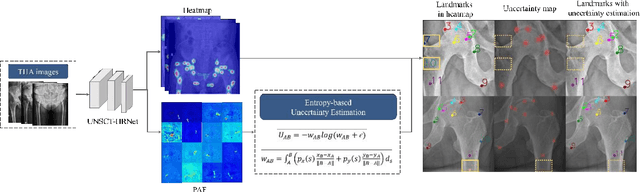
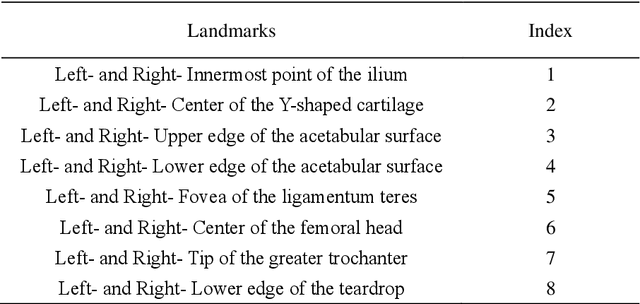
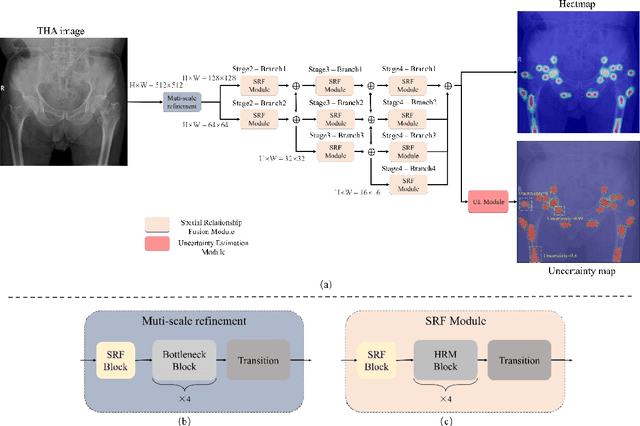
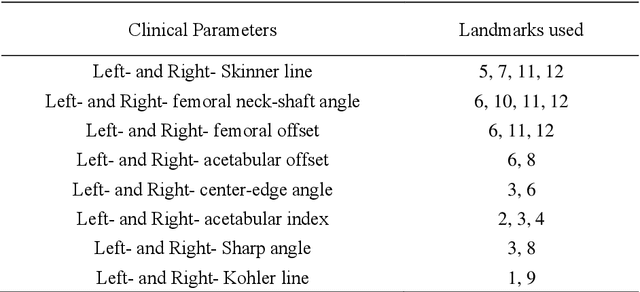
Total hip arthroplasty (THA) relies on accurate landmark detection from radiographic images, but unstructured data caused by irregular patient postures or occluded anatomical markers pose significant challenges for existing methods. To address this, we propose UNSCT-HRNet (Unstructured CT - High-Resolution Net), a deep learning-based framework that integrates a Spatial Relationship Fusion (SRF) module and an Uncertainty Estimation (UE) module. The SRF module, utilizing coordinate convolution and polarized attention, enhances the model's ability to capture complex spatial relationships. Meanwhile, the UE module which based on entropy ensures predictions are anatomically relevant. For unstructured data, the proposed method can predict landmarks without relying on the fixed number of points, which shows higher accuracy and better robustness comparing with the existing methods. Our UNSCT-HRNet demonstrates over a 60% improvement across multiple metrics in unstructured data. The experimental results also reveal that our approach maintains good performance on the structured dataset. Overall, the proposed UNSCT-HRNet has the potential to be used as a new reliable, automated solution for THA surgical planning and postoperative monitoring.