 Add to Chrome
 Add to Firefox
 Add to Edge
Dr. Assistant: Enhancing Clinical Diagnostic Inquiry via Structured Diagnostic Reasoning Data and Reinforcement Learning
Jan 20, 2026
Clinical Decision Support Systems (CDSSs) provide reasoning and inquiry guidance for physicians, yet they face notable challenges, including high maintenance costs and low generalization capability. Recently, Large Language Models (LLMs) have been widely adopted in healthcare due to their extensive knowledge reserves, retrieval, and communication capabilities. While LLMs show promise and excel at medical benchmarks, their diagnostic reasoning and inquiry skills are constrained. To mitigate this issue, we propose (1) Clinical Diagnostic Reasoning Data (CDRD) structure to capture abstract clinical reasoning logic, and a pipeline for its construction, and (2) the Dr. Assistant, a clinical diagnostic model equipped with clinical reasoning and inquiry skills. Its training involves a two-stage process: SFT, followed by RL with a tailored reward function. We also introduce a benchmark to evaluate both diagnostic reasoning and inquiry. Our experiments demonstrate that the Dr. Assistant outperforms open-source models and achieves competitive performance to closed-source models, providing an effective solution for clinical diagnostic inquiry guidance.

Breaking the Exploration Bottleneck: Rubric-Scaffolded Reinforcement Learning for General LLM Reasoning
Aug 23, 2025Recent advances in Large Language Models (LLMs) have underscored the potential of Reinforcement Learning (RL) to facilitate the emergence of reasoning capabilities. Despite the encouraging results, a fundamental dilemma persists as RL improvement relies on learning from high-quality samples, yet the exploration for such samples remains bounded by the inherent limitations of LLMs. This, in effect, creates an undesirable cycle in which what cannot be explored cannot be learned. In this work, we propose Rubric-Scaffolded Reinforcement Learning (RuscaRL), a novel instructional scaffolding framework designed to break the exploration bottleneck for general LLM reasoning. Specifically, RuscaRL introduces checklist-style rubrics as (1) explicit scaffolding for exploration during rollout generation, where different rubrics are provided as external guidance within task instructions to steer diverse high-quality responses. This guidance is gradually decayed over time, encouraging the model to internalize the underlying reasoning patterns; (2) verifiable rewards for exploitation during model training, where we can obtain robust LLM-as-a-Judge scores using rubrics as references, enabling effective RL on general reasoning tasks. Extensive experiments demonstrate the superiority of the proposed RuscaRL across various benchmarks, effectively expanding reasoning boundaries under the best-of-N evaluation. Notably, RuscaRL significantly boosts Qwen-2.5-7B-Instruct from 23.6 to 50.3 on HealthBench-500, surpassing GPT-4.1. Furthermore, our fine-tuned variant on Qwen3-30B-A3B-Instruct achieves 61.1 on HealthBench-500, outperforming leading LLMs including OpenAI-o3.
MUSIED: A Benchmark for Event Detection from Multi-Source Heterogeneous Informal Texts
Nov 25, 2022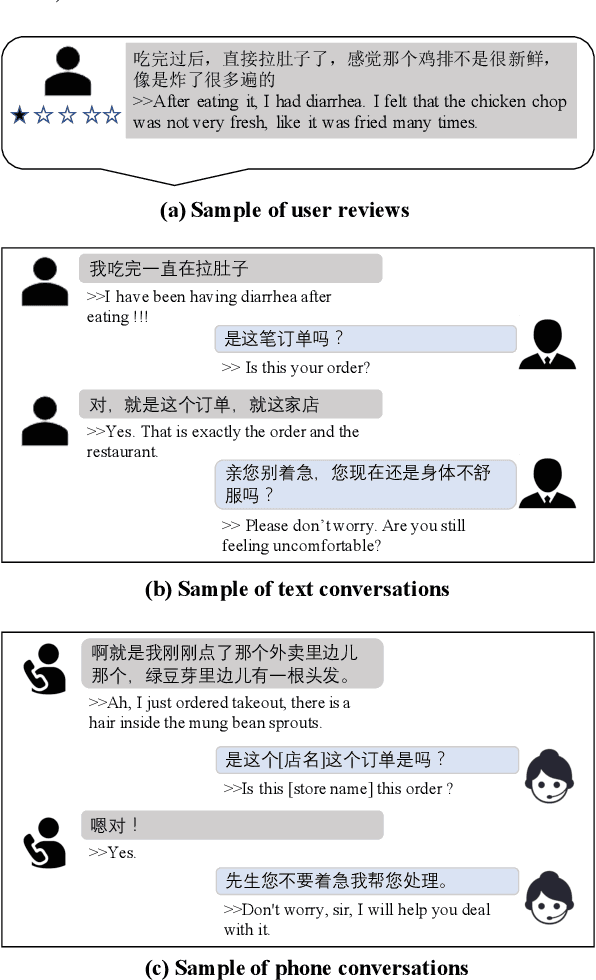
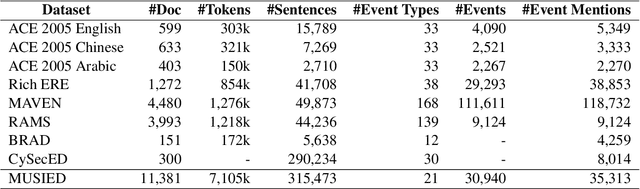

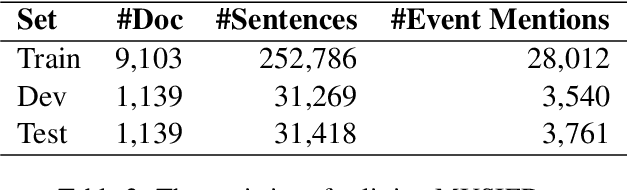
Event detection (ED) identifies and classifies event triggers from unstructured texts, serving as a fundamental task for information extraction. Despite the remarkable progress achieved in the past several years, most research efforts focus on detecting events from formal texts (e.g., news articles, Wikipedia documents, financial announcements). Moreover, the texts in each dataset are either from a single source or multiple yet relatively homogeneous sources. With massive amounts of user-generated text accumulating on the Web and inside enterprises, identifying meaningful events in these informal texts, usually from multiple heterogeneous sources, has become a problem of significant practical value. As a pioneering exploration that expands event detection to the scenarios involving informal and heterogeneous texts, we propose a new large-scale Chinese event detection dataset based on user reviews, text conversations, and phone conversations in a leading e-commerce platform for food service. We carefully investigate the proposed dataset's textual informality and multi-source heterogeneity characteristics by inspecting data samples quantitatively and qualitatively. Extensive experiments with state-of-the-art event detection methods verify the unique challenges posed by these characteristics, indicating that multi-source informal event detection remains an open problem and requires further efforts. Our benchmark and code are released at \url{https://github.com/myeclipse/MUSIED}.