 Add to Chrome
 Add to Firefox
 Add to Edge
Can Large Language Models Understand, Reason About, and Generate Code-Switched Text?
Jan 12, 2026
Code-switching is a pervasive phenomenon in multilingual communication, yet the robustness of large language models (LLMs) in mixed-language settings remains insufficiently understood. In this work, we present a comprehensive evaluation of LLM capabilities in understanding, reasoning over, and generating code-switched text. We introduce CodeMixQA a novel benchmark with high-quality human annotations, comprising 16 diverse parallel code-switched language-pair variants that span multiple geographic regions and code-switching patterns, and include both original scripts and their transliterated forms. Using this benchmark, we analyze the reasoning behavior of LLMs on code-switched question-answering tasks, shedding light on how models process and reason over mixed-language inputs. We further conduct a systematic evaluation of LLM-generated synthetic code-switched text, focusing on both naturalness and semantic fidelity, and uncover key limitations in current generation capabilities. Our findings reveal persistent challenges in both reasoning and generation under code-switching conditions and provide actionable insights for building more robust multilingual LLMs. We release the dataset and code as open source.

Tonguescape: Exploring Language Models Understanding of Vowel Articulation
Jan 29, 2025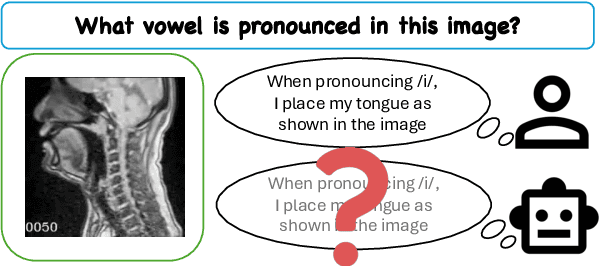
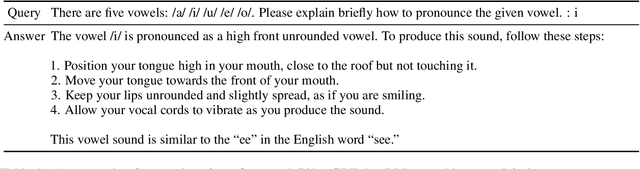
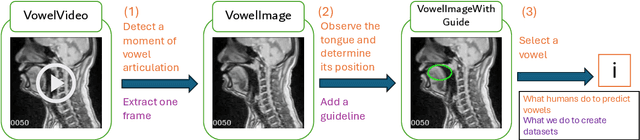

Vowels are primarily characterized by tongue position. Humans have discovered these features of vowel articulation through their own experience and explicit objective observation such as using MRI. With this knowledge and our experience, we can explain and understand the relationship between tongue positions and vowels, and this knowledge is helpful for language learners to learn pronunciation. Since language models (LMs) are trained on a large amount of data that includes linguistic and medical fields, our preliminary studies indicate that an LM is able to explain the pronunciation mechanisms of vowels. However, it is unclear whether multi-modal LMs, such as vision LMs, align textual information with visual information. One question arises: do LMs associate real tongue positions with vowel articulation? In this study, we created video and image datasets from the existing real-time MRI dataset and investigated whether LMs can understand vowel articulation based on tongue positions using vision-based information. Our findings suggest that LMs exhibit potential for understanding vowels and tongue positions when reference examples are provided while they have difficulties without them. Our code for dataset building is available on GitHub.