 Add to Chrome
 Add to Firefox
 Add to Edge
QuaMo: Quaternion Motions for Vision-based 3D Human Kinematics Capture
Jan 27, 2026
Vision-based 3D human motion capture from videos remains a challenge in computer vision. Traditional 3D pose estimation approaches often ignore the temporal consistency between frames, causing implausible and jittery motion. The emerging field of kinematics-based 3D motion capture addresses these issues by estimating the temporal transitioning between poses instead. A major drawback in current kinematics approaches is their reliance on Euler angles. Despite their simplicity, Euler angles suffer from discontinuity that leads to unstable motion reconstructions, especially in online settings where trajectory refinement is unavailable. Contrarily, quaternions have no discontinuity and can produce continuous transitions between poses. In this paper, we propose QuaMo, a novel Quaternion Motions method using quaternion differential equations (QDE) for human kinematics capture. We utilize the state-space model, an effective system for describing real-time kinematics estimations, with quaternion state and the QDE describing quaternion velocity. The corresponding angular acceleration is computed from a meta-PD controller with a novel acceleration enhancement that adaptively regulates the control signals as the human quickly changes to a new pose. Unlike previous work, our QDE is solved under the quaternion unit-sphere constraint that results in more accurate estimations. Experimental results show that our novel formulation of the QDE with acceleration enhancement accurately estimates 3D human kinematics with no discontinuity and minimal implausibilities. QuaMo outperforms comparable state-of-the-art methods on multiple datasets, namely Human3.6M, Fit3D, SportsPose and AIST. The code is available at https://github.com/cuongle1206/QuaMo

Flow Matching for Probabilistic Monocular 3D Human Pose Estimation
Jan 23, 2026Recovering 3D human poses from a monocular camera view is a highly ill-posed problem due to the depth ambiguity. Earlier studies on 3D human pose lifting from 2D often contain incorrect-yet-overconfident 3D estimations. To mitigate the problem, emerging probabilistic approaches treat the 3D estimations as a distribution, taking into account the uncertainty measurement of the poses. Falling in a similar category, we proposed FMPose, a probabilistic 3D human pose estimation method based on the flow matching generative approach. Conditioned on the 2D cues, the flow matching scheme learns the optimal transport from a simple source distribution to the plausible 3D human pose distribution via continuous normalizing flows. The 2D lifting condition is modeled via graph convolutional networks, leveraging the learnable connections between human body joints as the graph structure for feature aggregation. Compared to diffusion-based methods, the FMPose with optimal transport produces faster and more accurate 3D pose generations. Experimental results show major improvements of our FMPose over current state-of-the-art methods on three common benchmarks for 3D human pose estimation, namely Human3.6M, MPI-INF-3DHP and 3DPW.
On the Role of Rotation Equivariance in Monocular 3D Human Pose Estimation
Jan 20, 2026Estimating 3D from 2D is one of the central tasks in computer vision. In this work, we consider the monocular setting, i.e. single-view input, for 3D human pose estimation (HPE). Here, the task is to predict a 3D point set of human skeletal joints from a single 2D input image. While by definition this is an ill-posed problem, recent work has presented methods that solve it with up to several-centimetre error. Typically, these methods employ a two-step approach, where the first step is to detect the 2D skeletal joints in the input image, followed by the step of 2D-to-3D lifting. We find that common lifting models fail when encountering a rotated input. We argue that learning a single human pose along with its in-plane rotations is considerably easier and more geometrically grounded than directly learning a point-to-point mapping. Furthermore, our intuition is that endowing the model with the notion of rotation equivariance without explicitly constraining its parameter space should lead to a more straightforward learning process than one with equivariance by design. Utilising the common HPE benchmarks, we confirm that the 2D rotation equivariance per se improves the model performance on human poses akin to rotations in the image plane, and can be efficiently and straightforwardly learned by augmentation, outperforming state-of-the-art equivariant-by-design methods.
Physics-informed Ground Reaction Dynamics from Human Motion Capture
Jul 02, 2025Body dynamics are crucial information for the analysis of human motions in important research fields, ranging from biomechanics, sports science to computer vision and graphics. Modern approaches collect the body dynamics, external reactive force specifically, via force plates, synchronizing with human motion capture data, and learn to estimate the dynamics from a black-box deep learning model. Being specialized devices, force plates can only be installed in laboratory setups, imposing a significant limitation on the learning of human dynamics. To this end, we propose a novel method for estimating human ground reaction dynamics directly from the more reliable motion capture data with physics laws and computational simulation as constrains. We introduce a highly accurate and robust method for computing ground reaction forces from motion capture data using Euler's integration scheme and PD algorithm. The physics-based reactive forces are used to inform the learning model about the physics-informed motion dynamics thus improving the estimation accuracy. The proposed approach was tested on the GroundLink dataset, outperforming the baseline model on: 1) the ground reaction force estimation accuracy compared to the force plates measurement; and 2) our simulated root trajectory precision. The implementation code is available at https://github.com/cuongle1206/Phys-GRD
Optimal-State Dynamics Estimation for Physics-based Human Motion Capture from Videos
Oct 10, 2024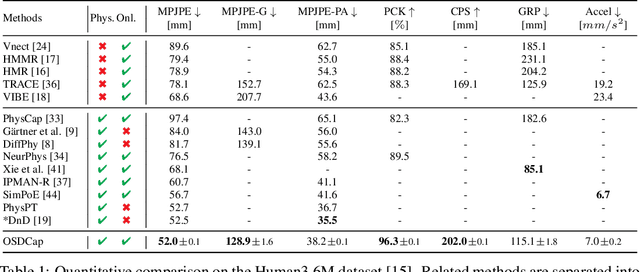
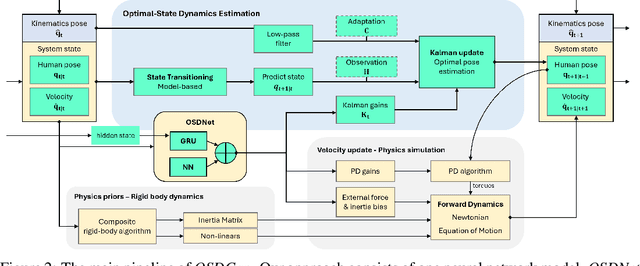
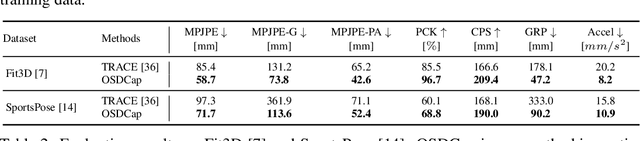
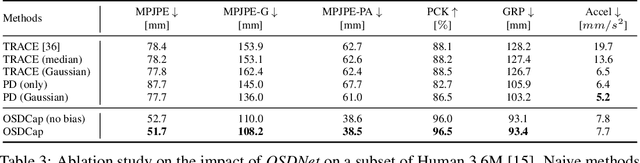
Human motion capture from monocular videos has made significant progress in recent years. However, modern approaches often produce temporal artifacts, e.g. in form of jittery motion and struggle to achieve smooth and physically plausible motions. Explicitly integrating physics, in form of internal forces and exterior torques, helps alleviating these artifacts. Current state-of-the-art approaches make use of an automatic PD controller to predict torques and reaction forces in order to re-simulate the input kinematics, i.e. the joint angles of a predefined skeleton. However, due to imperfect physical models, these methods often require simplifying assumptions and extensive preprocessing of the input kinematics to achieve good performance. To this end, we propose a novel method to selectively incorporate the physics models with the kinematics observations in an online setting, inspired by a neural Kalman-filtering approach. We develop a control loop as a meta-PD controller to predict internal joint torques and external reaction forces, followed by a physics-based motion simulation. A recurrent neural network is introduced to realize a Kalman filter that attentively balances the kinematics input and simulated motion, resulting in an optimal-state dynamics prediction. We show that this filtering step is crucial to provide an online supervision that helps balancing the shortcoming of the respective input motions, thus being important for not only capturing accurate global motion trajectories but also producing physically plausible human poses. The proposed approach excels in the physics-based human pose estimation task and demonstrates the physical plausibility of the predictive dynamics, compared to state of the art. The code is available on https://github.com/cuongle1206/OSDCap
Deep Equivariant Hyperspheres
May 24, 2023This paper presents an approach to learning nD features equivariant under orthogonal transformations for point cloud analysis, utilizing hyperspheres and regular n-simplexes. Our main contributions are theoretical and tackle major issues in geometric deep learning such as equivariance and invariance under geometric transformations. Namely, we enrich the recently developed theory of steerable 3D spherical neurons -- SO(3)-equivariant filter banks based on neurons with spherical decision surfaces -- by extending said neurons to nD, which we call deep equivariant hyperspheres, and enabling their stacking in multiple layers. Using the ModelNet40 benchmark, we experimentally verify our theoretical contributions and show a potential practical configuration of the proposed equivariant hyperspheres.