 Add to Chrome
 Add to Firefox
 Add to Edge
AgentEHR: Advancing Autonomous Clinical Decision-Making via Retrospective Summarization
Jan 20, 2026
Large Language Models have demonstrated profound utility in the medical domain. However, their application to autonomous Electronic Health Records~(EHRs) navigation remains constrained by a reliance on curated inputs and simplified retrieval tasks. To bridge the gap between idealized experimental settings and realistic clinical environments, we present AgentEHR. This benchmark challenges agents to execute complex decision-making tasks, such as diagnosis and treatment planning, requiring long-range interactive reasoning directly within raw and high-noise databases. In tackling these tasks, we identify that existing summarization methods inevitably suffer from critical information loss and fractured reasoning continuity. To address this, we propose RetroSum, a novel framework that unifies a retrospective summarization mechanism with an evolving experience strategy. By dynamically re-evaluating interaction history, the retrospective mechanism prevents long-context information loss and ensures unbroken logical coherence. Additionally, the evolving strategy bridges the domain gap by retrieving accumulated experience from a memory bank. Extensive empirical evaluations demonstrate that RetroSum achieves performance gains of up to 29.16% over competitive baselines, while significantly decreasing total interaction errors by up to 92.3%.

Bridging the Dynamic Perception Gap: Training-Free Draft Chain-of-Thought for Dynamic Multimodal Spatial Reasoning
May 22, 2025While chains-of-thought (CoT) have advanced complex reasoning in multimodal large language models (MLLMs), existing methods remain confined to text or static visual domains, often faltering in dynamic spatial reasoning tasks. To bridge this gap, we present GRASSLAND, a novel maze navigation benchmark designed to evaluate dynamic spatial reasoning. Our experiments show that augmenting textual reasoning chains with dynamic visual drafts, overlaid on input images, significantly outperforms conventional approaches, offering new insights into spatial reasoning in evolving environments. To generalize this capability, we propose D2R (Dynamic Draft-Augmented Reasoning), a training-free framework that seamlessly integrates textual CoT with corresponding visual drafts into MLLMs. Extensive evaluations demonstrate that D2R consistently enhances performance across diverse tasks, establishing a robust baseline for dynamic spatial reasoning without requiring model fine-tuning. Project is open at https://github.com/Cratileo/D2R.
Decoding Linguistic Representations of Human Brain
Jul 30, 2024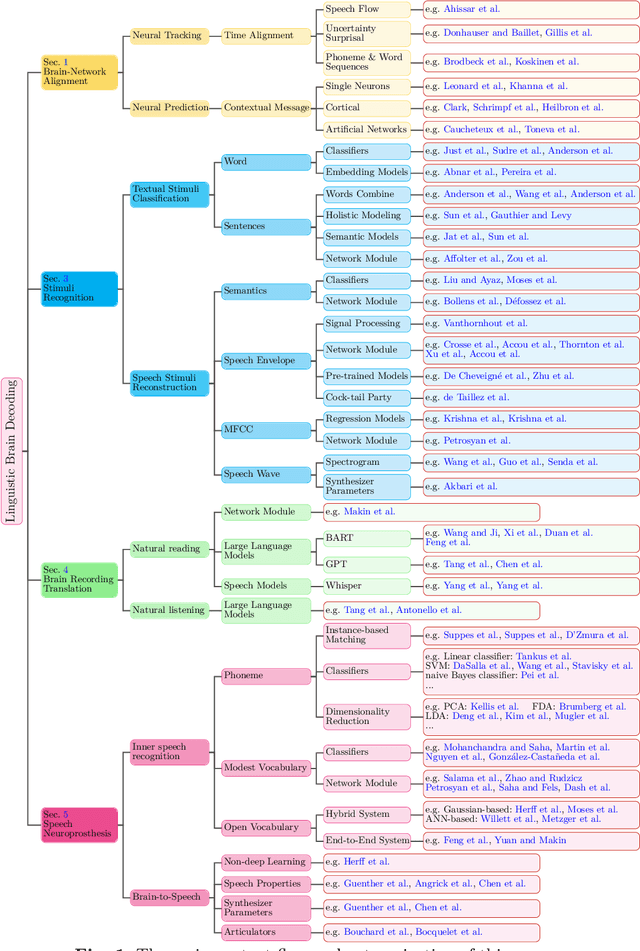
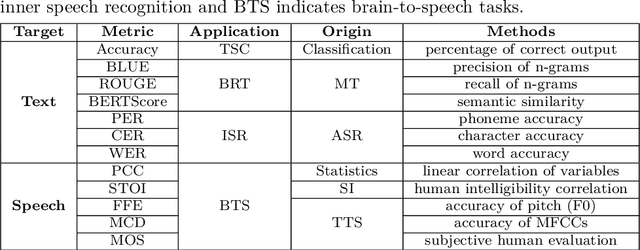
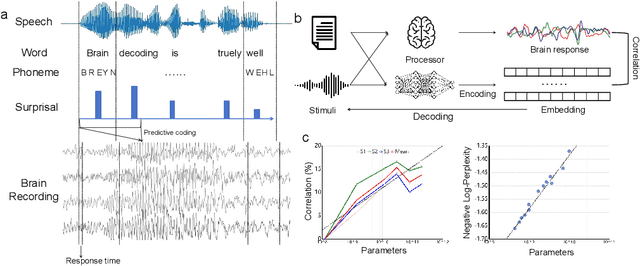
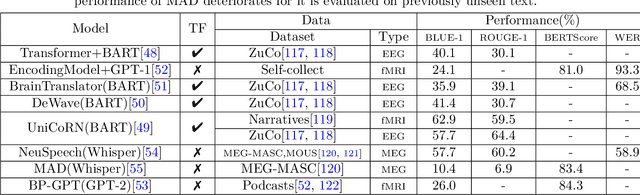
Language, as an information medium created by advanced organisms, has always been a concern of neuroscience regarding how it is represented in the brain. Decoding linguistic representations in the evoked brain has shown groundbreaking achievements, thanks to the rapid improvement of neuroimaging, medical technology, life sciences and artificial intelligence. In this work, we present a taxonomy of brain-to-language decoding of both textual and speech formats. This work integrates two types of research: neuroscience focusing on language understanding and deep learning-based brain decoding. Generating discernible language information from brain activity could not only help those with limited articulation, especially amyotrophic lateral sclerosis (ALS) patients but also open up a new way for the next generation's brain-computer interface (BCI). This article will help brain scientists and deep-learning researchers to gain a bird's eye view of fine-grained language perception, and thus facilitate their further investigation and research of neural process and language decoding.