 Add to Chrome
 Add to Firefox
 Add to Edge
FrontierOR: Benchmarking LLMs' Capacity for Efficient Algorithm Design in Large-Scale Optimization
May 26, 2026
Large language models (LLMs) are increasingly used for optimization modeling and solver-code generation, yet practical operations research and optimization problems often require a harder capability: designing scalable algorithms that exploit problem structure and outperform direct formulation-and-solve baselines. Existing benchmarks are limited to small or simplified examples far below real-world scale and complexity. We introduce FrontierOR, among the first benchmarks to systematically evaluate LLM-based efficient algorithm design for realistic large-scale optimization problems. FrontierOR includes 180 tasks derived from methodologically diverse papers published in top-tier operations research venues, each with standardized instances and a hidden, expert-verified evaluation suite. We evaluate seven LLMs spanning frontier, cost-effective, and open-source models both in one-shot and test-time evolution settings. The results reveal that frontier models still struggle to move from executable formulations to efficient optimization algorithms: the strongest one-shot model outperforms Gurobi in only 31% of cases in both solution quality and computational efficiency, and even strong coding agents with test-time evolution achieve only 50% on selected hard tasks. FrontierOR establishes a practical evaluation platform for LLM-based optimization algorithm design, which enables future LLMs and agents to be systematically tested on whether they can move beyond correct formulation toward a feasible, high-quality, and efficient algorithm.

ShapE-GRPO: Shapley-Enhanced Reward Allocation for Multi-Candidate LLM Training
Mar 31, 2026In user-agent interaction scenarios such as recommendation, brainstorming, and code suggestion, Large Language Models (LLMs) often generate sets of candidate recommendations where the objective is to maximize the collective utility of the entire set rather than individual candidates independently. However, existing reinforcement learning post-training paradigms, such as Group Relative Policy Optimization (GRPO), typically assign the same set-level scalar reward to every candidate in the set. This leads to noisy training signals where poor candidates free-ride on the high reward produced by a single strong peer, resulting in suboptimal exploration. To address this, we propose Shapley-Enhanced GRPO (ShapE-GRPO). By leveraging the permutation-invariant nature of set-level utility, we derive a Shapley-enhanced formulation from cooperative game theory to decompose set-level rewards into granular, candidate-specific signals. We show that our formulation preserves the fundamental axioms of the Shapley value while remaining computationally efficient with polynomial-time complexity. Empirically, ShapE-GRPO consistently outperforms standard GRPO across diverse datasets with accelerated convergence during training.
Choosing the Better Bandit Algorithm under Data Sharing: When Do A/B Experiments Work?
Jul 16, 2025We study A/B experiments that are designed to compare the performance of two recommendation algorithms. Prior work has shown that the standard difference-in-means estimator is biased in estimating the global treatment effect (GTE) due to a particular form of interference between experimental units. Specifically, units under the treatment and control algorithms contribute to a shared pool of data that subsequently train both algorithms, resulting in interference between the two groups. The bias arising from this type of data sharing is known as "symbiosis bias". In this paper, we highlight that, for decision-making purposes, the sign of the GTE often matters more than its precise magnitude when selecting the better algorithm. We formalize this insight under a multi-armed bandit framework and theoretically characterize when the sign of the expected GTE estimate under data sharing aligns with or contradicts the sign of the true GTE. Our analysis identifies the level of exploration versus exploitation as a key determinant of how symbiosis bias impacts algorithm selection.
Experimenting on Markov Decision Processes with Local Treatments
Jul 29, 2024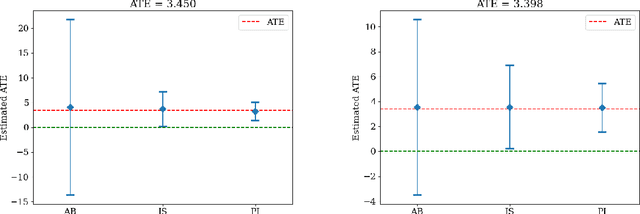
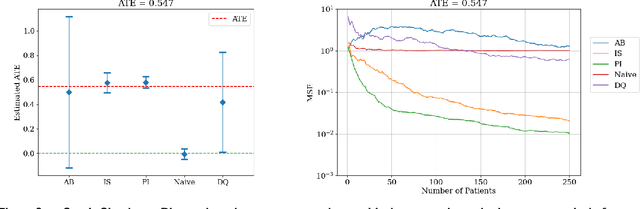
As service systems grow increasingly complex and dynamic, many interventions become localized, available and taking effect only in specific states. This paper investigates experiments with local treatments on a widely-used class of dynamic models, Markov Decision Processes (MDPs). Particularly, we focus on utilizing the local structure to improve the inference efficiency of the average treatment effect. We begin by demonstrating the efficiency of classical inference methods, including model-based estimation and temporal difference learning under a fixed policy, as well as classical A/B testing with general treatments. We then introduce a variance reduction technique that exploits the local treatment structure by sharing information for states unaffected by the treatment policy. Our new estimator effectively overcomes the variance lower bound for general treatments while matching the more stringent lower bound incorporating the local treatment structure. Furthermore, our estimator can optimally achieve a linear reduction with the number of test arms for a major part of the variance. Finally, we explore scenarios with perfect knowledge of the control arm and design estimators that further improve inference efficiency.