 Add to Chrome
 Add to Firefox
 Add to Edge
MiMo-V2-Flash Technical Report
Jan 08, 2026
We present MiMo-V2-Flash, a Mixture-of-Experts (MoE) model with 309B total parameters and 15B active parameters, designed for fast, strong reasoning and agentic capabilities. MiMo-V2-Flash adopts a hybrid attention architecture that interleaves Sliding Window Attention (SWA) with global attention, with a 128-token sliding window under a 5:1 hybrid ratio. The model is pre-trained on 27 trillion tokens with Multi-Token Prediction (MTP), employing a native 32k context length and subsequently extended to 256k. To efficiently scale post-training compute, MiMo-V2-Flash introduces a novel Multi-Teacher On-Policy Distillation (MOPD) paradigm. In this framework, domain-specialized teachers (e.g., trained via large-scale reinforcement learning) provide dense and token-level reward, enabling the student model to perfectly master teacher expertise. MiMo-V2-Flash rivals top-tier open-weight models such as DeepSeek-V3.2 and Kimi-K2, despite using only 1/2 and 1/3 of their total parameters, respectively. During inference, by repurposing MTP as a draft model for speculative decoding, MiMo-V2-Flash achieves up to 3.6 acceptance length and 2.6x decoding speedup with three MTP layers. We open-source both the model weights and the three-layer MTP weights to foster open research and community collaboration.

Single upper limb pose estimation method based on improved stacked hourglass network
Apr 16, 2020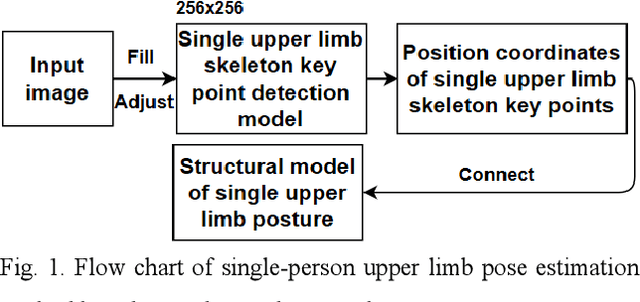
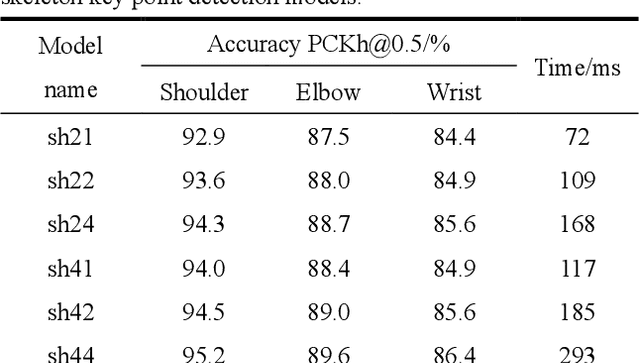
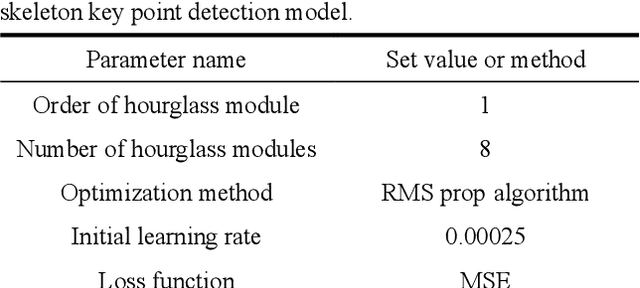
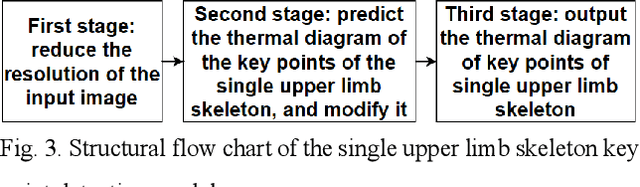
At present, most high-accuracy single-person pose estimation methods have high computational complexity and insufficient real-time performance due to the complex structure of the network model. However, a single-person pose estimation method with high real-time performance also needs to improve its accuracy due to the simple structure of the network model. It is currently difficult to achieve both high accuracy and real-time performance in single-person pose estimation. For use in human-machine cooperative operations, this paper proposes a single-person upper limb pose estimation method based on an end-to-end approach for accurate and real-time limb pose estimation. Using the stacked hourglass network model, a single-person upper limb skeleton key point detection model was designed.Deconvolution was employed to replace the up-sampling operation of the hourglass module in the original model, solving the problem of rough feature maps. Integral regression was used to calculate the position coordinates of key points of the skeleton, reducing quantization errors and calculations. Experiments showed that the developed single-person upper limb skeleton key point detection model achieves high accuracy and that the pose estimation method based on the end-to-end approach provides high accuracy and real-time performance.