 Add to Chrome
 Add to Firefox
 Add to Edge
KOCO-BENCH: Can Large Language Models Leverage Domain Knowledge in Software Development?
Jan 19, 2026
Large language models (LLMs) excel at general programming but struggle with domain-specific software development, necessitating domain specialization methods for LLMs to learn and utilize domain knowledge and data. However, existing domain-specific code benchmarks cannot evaluate the effectiveness of domain specialization methods, which focus on assessing what knowledge LLMs possess rather than how they acquire and apply new knowledge, lacking explicit knowledge corpora for developing domain specialization methods. To this end, we present KOCO-BENCH, a novel benchmark designed for evaluating domain specialization methods in real-world software development. KOCO-BENCH contains 6 emerging domains with 11 software frameworks and 25 projects, featuring curated knowledge corpora alongside multi-granularity evaluation tasks including domain code generation (from function-level to project-level with rigorous test suites) and domain knowledge understanding (via multiple-choice Q&A). Unlike previous benchmarks that only provide test sets for direct evaluation, KOCO-BENCH requires acquiring and applying diverse domain knowledge (APIs, rules, constraints, etc.) from knowledge corpora to solve evaluation tasks. Our evaluations reveal that KOCO-BENCH poses significant challenges to state-of-the-art LLMs. Even with domain specialization methods (e.g., SFT, RAG, kNN-LM) applied, improvements remain marginal. Best-performing coding agent, Claude Code, achieves only 34.2%, highlighting the urgent need for more effective domain specialization methods. We release KOCO-BENCH, evaluation code, and baselines to advance further research at https://github.com/jiangxxxue/KOCO-bench.

Exploring Model Editing for LLM-based Aspect-Based Sentiment Classification
Mar 19, 2025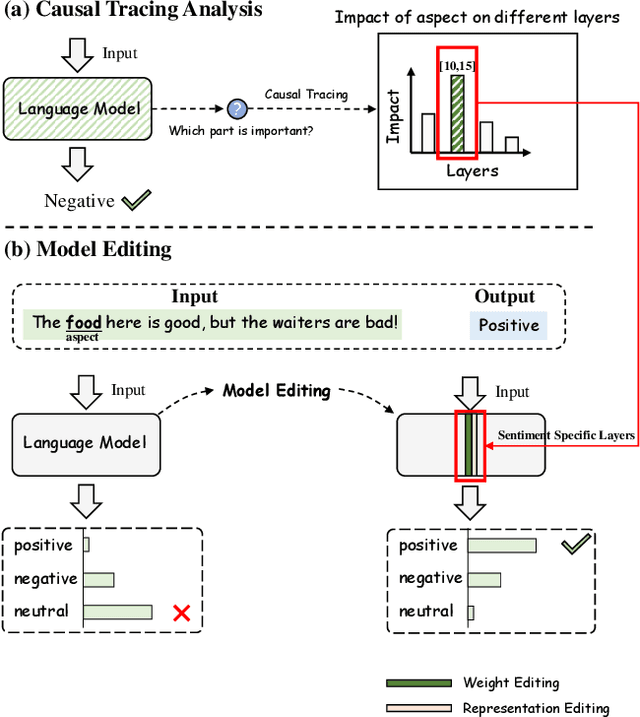
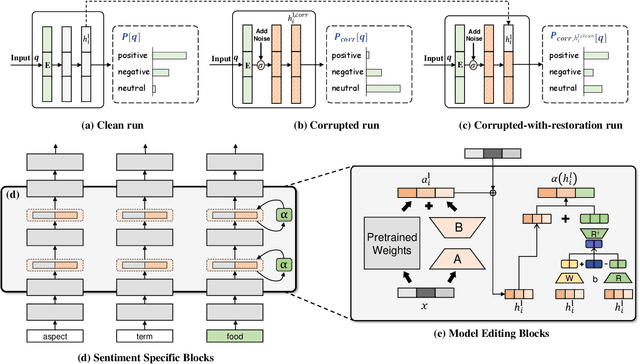
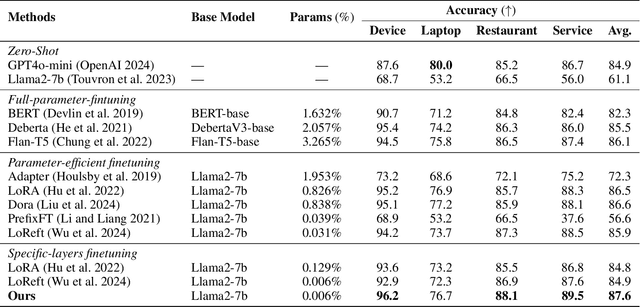
Model editing aims at selectively updating a small subset of a neural model's parameters with an interpretable strategy to achieve desired modifications. It can significantly reduce computational costs to adapt to large language models (LLMs). Given its ability to precisely target critical components within LLMs, model editing shows great potential for efficient fine-tuning applications. In this work, we investigate model editing to serve an efficient method for adapting LLMs to solve aspect-based sentiment classification. Through causal interventions, we trace and determine which neuron hidden states are essential for the prediction of the model. By performing interventions and restorations on each component of an LLM, we identify the importance of these components for aspect-based sentiment classification. Our findings reveal that a distinct set of mid-layer representations is essential for detecting the sentiment polarity of given aspect words. Leveraging these insights, we develop a model editing approach that focuses exclusively on these critical parts of the LLM, leading to a more efficient method for adapting LLMs. Our in-domain and out-of-domain experiments demonstrate that this approach achieves competitive results compared to the currently strongest methods with significantly fewer trainable parameters, highlighting a more efficient and interpretable fine-tuning strategy.