 Add to Chrome
 Add to Firefox
 Add to Edge
CogFlow: Bridging Perception and Reasoning through Knowledge Internalization for Visual Mathematical Problem Solving
Jan 05, 2026
Despite significant progress, multimodal large language models continue to struggle with visual mathematical problem solving. Some recent works recognize that visual perception is a bottleneck in visual mathematical reasoning, but their solutions are limited to improving the extraction and interpretation of visual inputs. Notably, they all ignore the key issue of whether the extracted visual cues are faithfully integrated and properly utilized in subsequent reasoning. Motivated by this, we present CogFlow, a novel cognitive-inspired three-stage framework that incorporates a knowledge internalization stage, explicitly simulating the hierarchical flow of human reasoning: perception$\Rightarrow$internalization$\Rightarrow$reasoning. Inline with this hierarchical flow, we holistically enhance all its stages. We devise Synergistic Visual Rewards to boost perception capabilities in parametric and semantic spaces, jointly improving visual information extraction from symbols and diagrams. To guarantee faithful integration of extracted visual cues into subsequent reasoning, we introduce a Knowledge Internalization Reward model in the internalization stage, bridging perception and reasoning. Moreover, we design a Visual-Gated Policy Optimization algorithm to further enforce the reasoning is grounded with the visual knowledge, preventing models seeking shortcuts that appear coherent but are visually ungrounded reasoning chains. Moreover, we contribute a new dataset MathCog for model training, which contains samples with over 120K high-quality perception-reasoning aligned annotations. Comprehensive experiments and analysis on commonly used visual mathematical reasoning benchmarks validate the superiority of the proposed CogFlow.

MathFlow: Enhancing the Perceptual Flow of MLLMs for Visual Mathematical Problems
Mar 19, 2025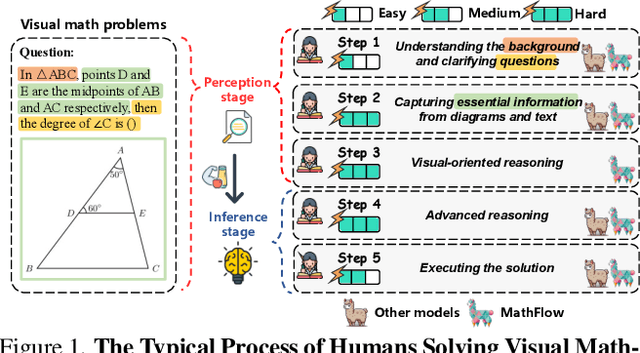
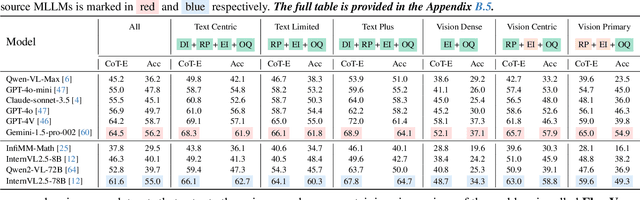
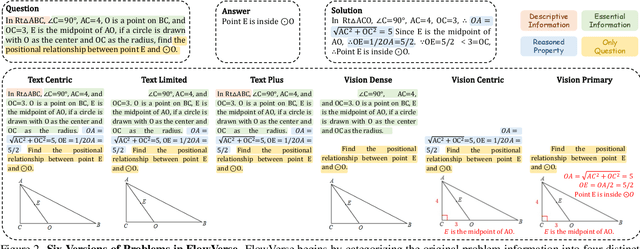
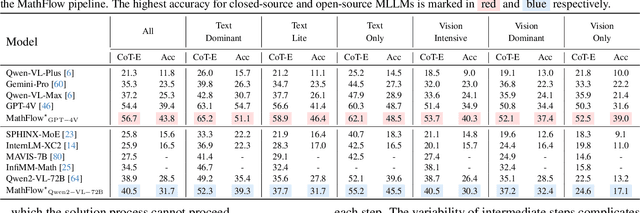
Despite impressive performance across diverse tasks, Multimodal Large Language Models (MLLMs) have yet to fully demonstrate their potential in visual mathematical problem-solving, particularly in accurately perceiving and interpreting diagrams. Inspired by typical processes of humans, we hypothesize that the perception capabilities to extract meaningful information from diagrams is crucial, as it directly impacts subsequent inference processes. To validate this hypothesis, we developed FlowVerse, a comprehensive benchmark that categorizes all information used during problem-solving into four components, which are then combined into six problem versions for evaluation. Our preliminary results on FlowVerse reveal that existing MLLMs exhibit substantial limitations when extracting essential information and reasoned property from diagrams and performing complex reasoning based on these visual inputs. In response, we introduce MathFlow, a modular problem-solving pipeline that decouples perception and inference into distinct stages, thereby optimizing each independently. Given the perceptual limitations observed in current MLLMs, we trained MathFlow-P-7B as a dedicated perception model. Experimental results indicate that MathFlow-P-7B yields substantial performance gains when integrated with various closed-source and open-source inference models. This demonstrates the effectiveness of the MathFlow pipeline and its compatibility to diverse inference frameworks. The FlowVerse benchmark and code are available at https://github.com/MathFlow-zju/MathFlow.