 Add to Chrome
 Add to Firefox
 Add to Edge
Sidelink Positioning: Standardization Advancements, Challenges and Opportunities
Dec 31, 2025
With the integration of cellular networks in vertical industries that demand precise location information, such as vehicle-to-everything (V2X), public safety, and Industrial Internet of Things (IIoT), positioning has become an imperative component for future wireless networks. By exploiting a wider spectrum, multiple antennas and flexible architectures, cellular positioning achieves ever-increasing positioning accuracy. Still, it faces fundamental performance degradation when the distance between user equipment (UE) and the base station (BS) is large or in non-line-of-sight (NLoS) scenarios. To this end, the 3rd generation partnership project (3GPP) Rel-18 proposes to standardize sidelink (SL) positioning, which provides unique opportunities to extend the positioning coverage via direct positioning signaling between UEs. Despite the standardization advancements, the capability of SL positioning is controversial, especially how much spectrum is required to achieve the positioning accuracy defined in 3GPP. To this end, this article summarizes the latest standardization advancements of 3GPP on SL positioning comprehensively, covering a) network architecture; b) positioning types; and c) performance requirements. The capability of SL positioning using various positioning methods under different imperfect factors is evaluated and discussed in-depth. Finally, according to the evolution of SL in 3GPP Rel-19, we discuss the possible research directions and challenges of SL positioning.

Accelerating 3D MULTIPLEX MRI Reconstruction with Deep Learning
May 17, 2021
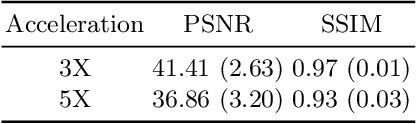


Multi-contrast MRI images provide complementary contrast information about the characteristics of anatomical structures and are commonly used in clinical practice. Recently, a multi-flip-angle (FA) and multi-echo GRE method (MULTIPLEX MRI) has been developed to simultaneously acquire multiple parametric images with just one single scan. However, it poses two challenges for MULTIPLEX to be used in the 3D high-resolution setting: a relatively long scan time and the huge amount of 3D multi-contrast data for reconstruction. Currently, no DL based method has been proposed for 3D MULTIPLEX data reconstruction. We propose a deep learning framework for undersampled 3D MRI data reconstruction and apply it to MULTIPLEX MRI. The proposed deep learning method shows good performance in image quality and reconstruction time.